
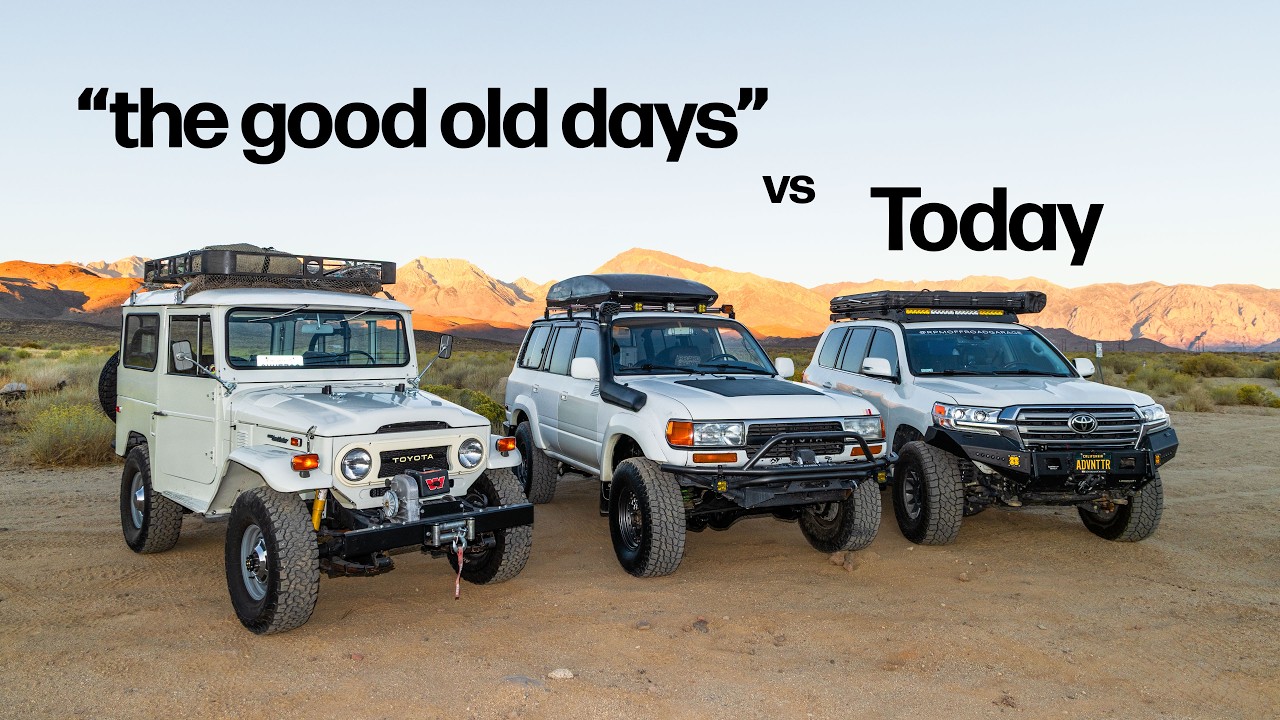
Somewhere in the Sierra Nevada mountains, a 1974 Toyota FJ40 Land Cruiser is crawling over loose rock at five miles an hour, its driver wrestling a manual clutch while a passenger maps the trail with a compass. The truck makes just over 100 horsepower and the front hubs have to be locked by hand, outside, at the source. What started as a friendly argument about whether overlanding has gotten better or just more expensive turned into a three-day, three-truck experiment that answered the question in a way nobody fully expected.
The crew from Speeed took one truck from each era deep into the backcountry: the 1974 FJ40, a 1991 FJ80, and a heavily modified modern Toyota Land Cruiser 200 Series with a rooftop tent, a propane fire pit, satellite internet, a portable hot shower, and a refrigerator holding three-day-old New York strips in perfect condition.
The FJ40 and why the clutch is basically a third passenger
The FJ40 set the tone immediately. With a 3.9L inline six, a four-speed manual, and a low-range transfer case, it demanded full attention at every moment. ‘Off roading is the most excitement you can have at five miles an hour,’ one of the crew observed, and that line held up all day. Navigation ran on a physical compass. Lunch was Oscar Mayer bologna on white bread, chosen because, as the crew put it, people in the 1970s were genuinely thrilled about preservatives. Dinner was Hamburger Helper cooked on a Coleman white-gas burner, served under a cotton canvas Ted Williams Sears tent so large it housed folding army cots with room to store gear underneath. The tent’s cotton construction was functional: when the canvas fibers get wet they swell, closing the weave and making it waterproof. Setup took a long time. Teardown took longer. The front seats did not recline.
The FJ80 that replaced it in day two felt like a different century. A four-liter straight six, coil springs replacing leaf springs, and an automatic transmission dropped the cortisol level noticeably. Camp was set up inside the truck bed, sleeping pads unrolled directly in the cargo area in a fraction of the tent time. Dinner stepped up to jambalaya cooked on propane, and the French press replaced the moka pot. ‘The 90s saw the US adopt cafe culture from Europe,’ the crew noted while grinding beans at altitude. ‘Coffee was no longer just fuel. It was an indulgence.’
Rooftop tents and refrigerators and a hot shower in the woods
The 200 Series arrived on day three carrying roughly 700 pounds of tent and awning on its roof and a drawer system designed specifically for the Land Cruiser’s cargo floor. Camp setup was timed. Five minutes, start to finish. The rooftop tent opened, the awning deployed, fairy lights went up, the propane fire pit lit without ceremony, and the portable hot shower unit, which heats water with propane, filters it, and uses an electric pump to push it to a shower head, was rigged behind a curtain made from a winch cable because someone forgot to pack rope. ‘Next time you see someone with a rooftop tent and want to make fun of them,’ the crew decided, ‘just be jealous instead.’
What the trip settled, more than which truck was best, was what the choice actually means now. The FJ40 was unanimously called the most fun day of the trip. It was also the one day nobody would bring a dog or a child. The 200 Series was the one day that felt like no compromise at all. ‘If this was the 70s, that would be it,’ the crew noted at the end. ‘We wouldn’t have the option to scale things up. And today we do.’
The moka pot that crossed an ocean
Sitting on a Coleman stove at a Sierra Nevada creek, the moka pot that brewed day-one coffee had its own backstory. American soldiers tasted espresso for the first time during World War Two. It was so strong they wanted it cut down. That diluted version became the Caffe Americano, and the moka pot followed that trail back to the States. On day three, a portable single-shot espresso maker about the size of a microscope replaced it entirely, pulling two ounces of water into a two-ounce shot at the press of a button, then getting frothed cold milk added on top in forty-five seconds of additional effort.
The cold milk made it taste like a shadow of espresso. Nobody seemed to mind.
Back at the trailhead, the FJ40 sat quiet, its manual hubs still locked from the trail.
 Wake up to Only Happy News!