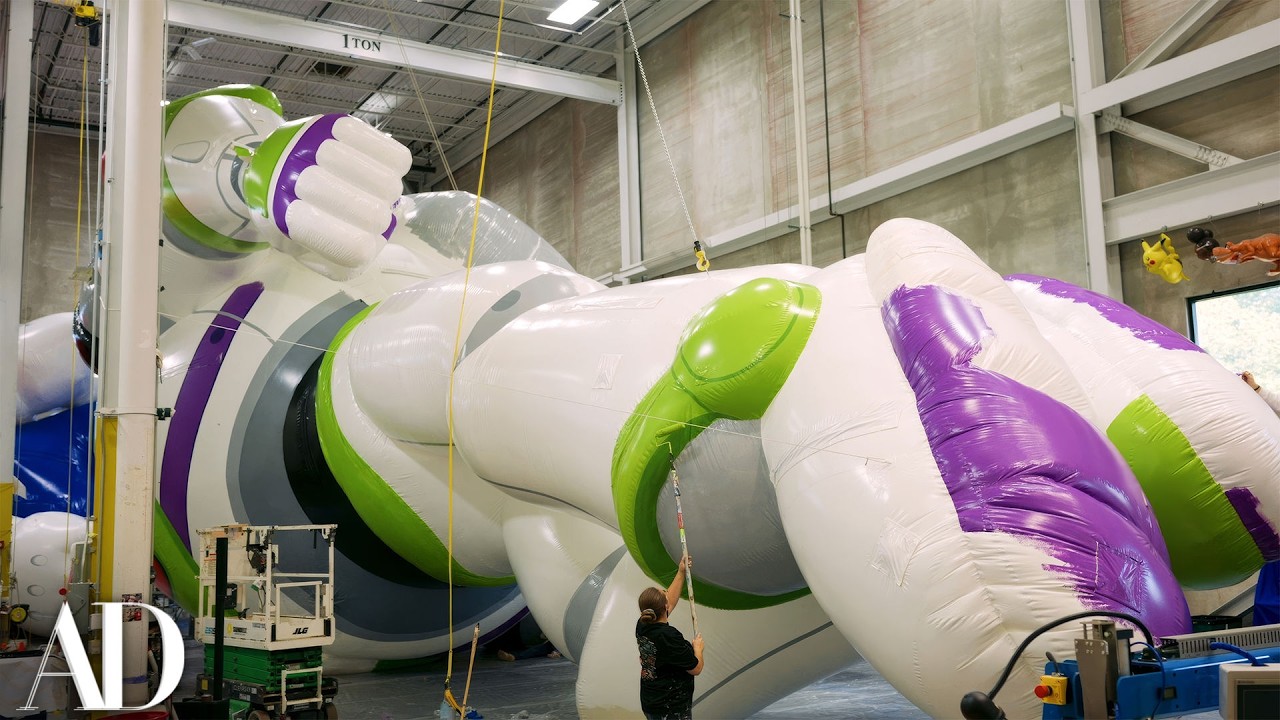
Deep inside a 72,000-square-foot studio built specifically for the Macy’s Thanksgiving Day Parade, carpenter John was putting the finishing touches on mirrors and bumpers for a miniature step van. He has been doing this since 1976, which makes this his 51st parade, and he was turning 80 the same week. The centennial parade was not just a milestone for the institution. For the people who build it by hand, year after year, it was deeply personal. The studio holds over 75 people across departments spanning costume design, sculpting, metal work, carpentry, balloon fabrication, and automation engineering, and every float, balloon, and costume that rolls down three and a half miles of New York City on Thanksgiving morning begins right here.
A thousand new costumes and one devoted head zhuzher
Kimberly, the costume director, has worked 27 parades. She came to the job after performing as Cosette on the first national tour of ‘Les Miz’ and appearing in ‘Hello, Dolly!’ alongside Carol Channing, but once she had a child she wanted to be home at night. The parade found her instead. This year her team produced around a thousand new costumes, bringing the total to roughly 8,000 pieces in circulation. On parade morning, her job is to move performers through a giant venue so that someone who walks in as, say, a Macy’s accountant walks out the other side as a giant birthday cake slice. Her full-time partner Marissa Diaz works the logistics with her; her husband, her children, and her mother have all turned up to help at various points. She described her long-running relationship with the Tom Turkey costume with cheerful candor: ‘I’ve had a little affair with Tom for about 27 years now.’
The previous studio had been in Hoboken and was so under-powered that plugging in a coffee pot and a microwave at the same time was not an option. The current building, purpose-built in 2012, has cranes, a full metal shop, a wood shop, an electronics shop, steamers, irons, and hundreds of rolling racks.
From a 3D print to a steel armature to the parade route
In the sculpting department, every figure starts as a sketch, moves to a 3D-printed model, then gets scaled up in foam or styrofoam over four to five weeks depending on complexity. Once a sculpture is finished it gets cut open, fitted with a steel armature, coated in a hard outer shell, and sent to paint. The automation and special effects team handles anything powered or moving: last year that meant engineering the Demogorgon’s face to open and close on camera. This year, one project involved designing a small car on a circular track so children could ride it around the DoorDash float.
Executive producer Will Coss, who has been building toward the centennial since his first day on the job five years ago, put the whole operation in plain terms: ‘Our end goal is to bring people together, to inspire joy, to create that new tradition, whether it’s a family experiencing it for the first time or experiencing it for the 25th time.’ Last year the parade drew 35 million television viewers and an estimated 3.5 million people lining the streets of New York City.
The parade’s history stretches back to 1924, originally called the Macy’s Christmas Parade, when it featured live animals from the Central Park Zoo. Felix the Cat joined as the first character balloon in 1927. From 1928 to 1932, Macy’s released balloons into the sky after the parade and offered a finder’s fee to anyone who returned one. That experiment ended when private aircraft began chasing the balloons down. One balloon, a Blue Hippo released in 1931, was never recovered. This year, Blue Hippo returns.
The balloon that disappeared for 42 years
Underdog, a fan favorite who last flew in the parade 42 years ago, was waiting in the balloon studio, fully inflated, when the tour reached its final room.
John, the carpenter turning 80 that week, plans to ride his own Doodlebug creation down the parade route when it finally moves.
After a half-century of building the thing by hand, they finally had to give him something.
 Wake up to Only Happy News!