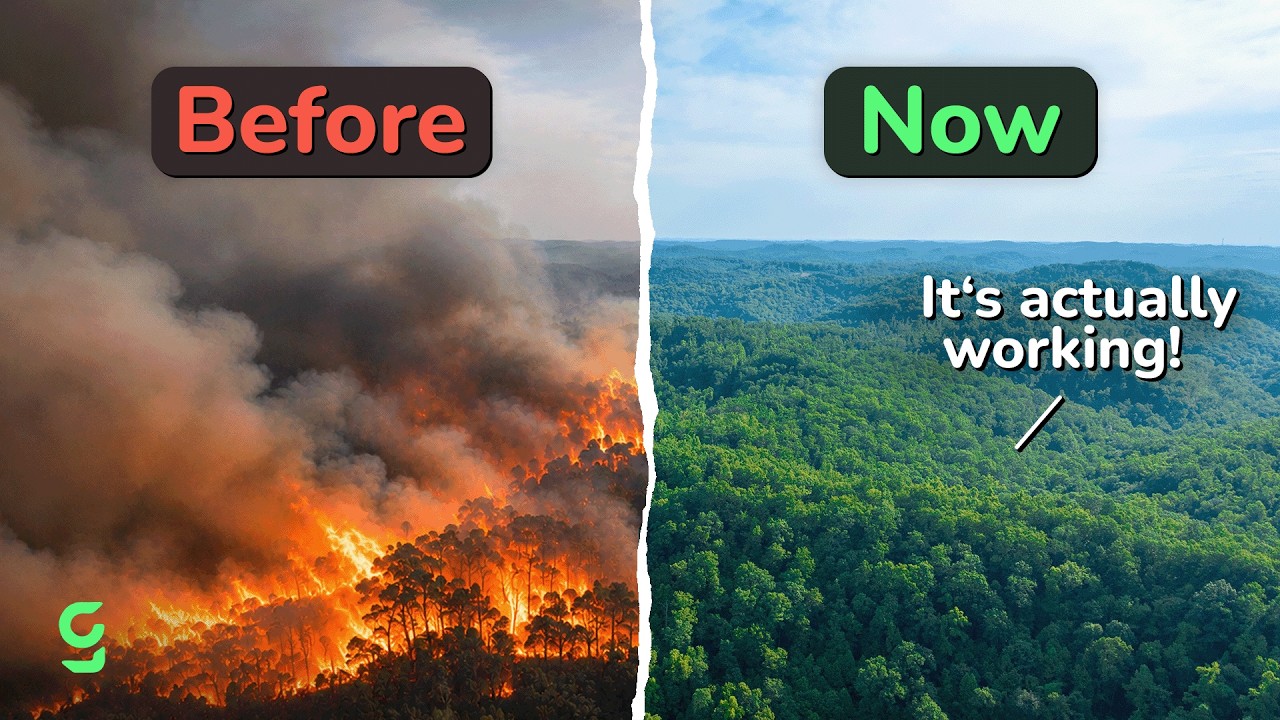
In the first half of 2026, carbon emissions from fires dropped to the lowest levels since satellite records began in 2003, and even after a brutal summer of wildfires in Canada, Siberia, and Europe, the global total was still at a record low by late August. For anyone who assumed the world was burning faster than ever, that number lands like a cold splash of water. It turns out the real story of fire on Earth is one of quiet, hard-won progress, driven by ancient knowledge, changing land use, and the kind of patient community effort that rarely makes the front page. Freddy, who assembles these monthly dispatches for Good News, put it plainly about Africa’s savannah communities and their traditional fire management: ‘they have now started to make a comeback.’
How Africa’s oldest fire techniques became a climate solution
Africa accounts for roughly 70% of the world’s emissions from plant burning, almost all of it from savannah fires. That share has been falling, partly because more savannah is being converted to farmland and roads that break up the continuous grass, limiting how far a fire can travel. But the deeper shift is human. Indigenous communities across the savannah have revived a traditional approach: small, controlled burns in the early dry season, laid out in a mosaic pattern. The scorched patches create natural gaps that stop larger, more dangerous late-season fires from crossing. As a bonus, the patchwork of regrowth stages supports a wider range of mammals, birds, and insects, strengthening the local ecosystem rather than stripping it. Researchers have linked the broader drop in burning since the early 2000s to roughly 147,000 fewer infant deaths in Africa, a figure that reframes what a land management practice can actually mean for human life.
From 2.6% to 97%: South Korea’s food waste transformation
Fire is not the only source of greenhouse gases hiding in plain sight. Food rotting in landfills releases methane, a greenhouse gas far more potent than CO2, and food waste currently contributes around 9% of all greenhouse gas emissions globally, five times the impact of the entire aviation industry. South Korea decided to treat that as a solvable engineering problem. In 1996, the country recycled just 2.6% of its food waste by weight. By 2023, that figure had climbed to 97%. The turnaround came in stages: mandatory separation of food waste from other trash in 1997, a full landfill ban in 2005, and a shift from flat fees to weight-based charges that hold households directly accountable for what they throw away. In many apartment buildings, smart bins weigh each deposit and add the cost to the resident’s bill automatically. Families typically pay between $2 and $6 a month. The collected waste is processed into biogas, animal feed, or fertilizer, so the material stays in use rather than escaping into the atmosphere.
Bison back on Mexican grasslands after more than a century
In 2009, 23 bison made the journey from Wind Cave National Park in South Dakota to a reserve just south of the US border, chosen specifically because Wind Cave’s herd is one of only two in the United States carrying no cattle DNA. Fifteen years later, the population had grown to roughly 500, allowing conservationists to move animals to other sanctuaries across the region. Bison are not passive occupants of the land. Their wallowing behavior, rolling in dirt to shed parasites, carves out craters that become distinct micro-habitats. Researchers in Mexico found certain plant species growing only inside those wallows, nowhere else. The return of the bison is also prompting the restoration of the broader North American grassland ecosystem, which once spanned an area three times the size of Germany and sheltered the pronghorn, the second-fastest land mammal on Earth.
A disease that once threatened 1.5 billion people is nearly gone
Trachoma, the world’s leading infectious cause of blindness, once put 1.5 billion people at risk and left nearly 8 million requiring surgery. As of this year, fewer than 100 million remain in danger. Since 1996, WHO-led programs combining hygiene education, clean water access, and antibiotics have driven the disease out of 34 countries, including eight in the past year alone. In July 2026, El Salvador became the first Central American country to eliminate trachoma, achieving it in just three years. In September, Timor-Leste followed, making all of Southeast Asia trachoma-free. The WHO’s target is full global eradication by 2030.
The sensor that fits under your skin
The FDA has approved a wearable device that tracks both blood sugar and ketone levels continuously, using a sensor placed just under the skin. It sends readings to a phone every minute and issues automatic alerts when either level climbs too high. It is approved for children as young as two years old. For the roughly 9 to 12 million people worldwide living with type 1 diabetes, uncontrolled ketone buildup can cause a potentially life-threatening condition called diabetic ketoacidosis. Until now, ketone monitoring required a separate test that captured only a single moment in time, not a trend. The new device closes that gap.
Germany’s 2026 road map to a fossil-fuel-free economy
Germany, the largest economy in the European Union, has published a formal plan to phase out fossil fuels by 2045, making it the third country in the world to release an official road map of this kind. The plan commits to sourcing 80% of the country’s electricity from renewables by 2030, backed by the construction of roughly 2,000 additional wind turbines capable of powering nearly 8 million homes each year. Germany is also investing in grid-scale battery storage and clean heating systems, and between now and 2029, 2.8 billion euros in funding will be made available to lower and middle-income households to help them purchase electric vehicles. All coal plants are targeted for closure by 2038, with government pressure to reach that milestone by 2035.
Kosovo’s last landmine
Kosovo has been declared landmine-free after 27 years, the final clearance of a legacy left by a war that forced 850,000 people to flee their homes between 1998 and 1999. In the decades that followed, 585 people were injured or killed by mines that remained in fields and roadsides. For the past nine years, there have been zero mine-related casualties in the country.
Somewhere in a field near the southern border of the United States, a bison wallow sits filled with water after the last rain, its edges thick with plant species that grow nowhere else on the surrounding plain.
 Wake up to Only Happy News!