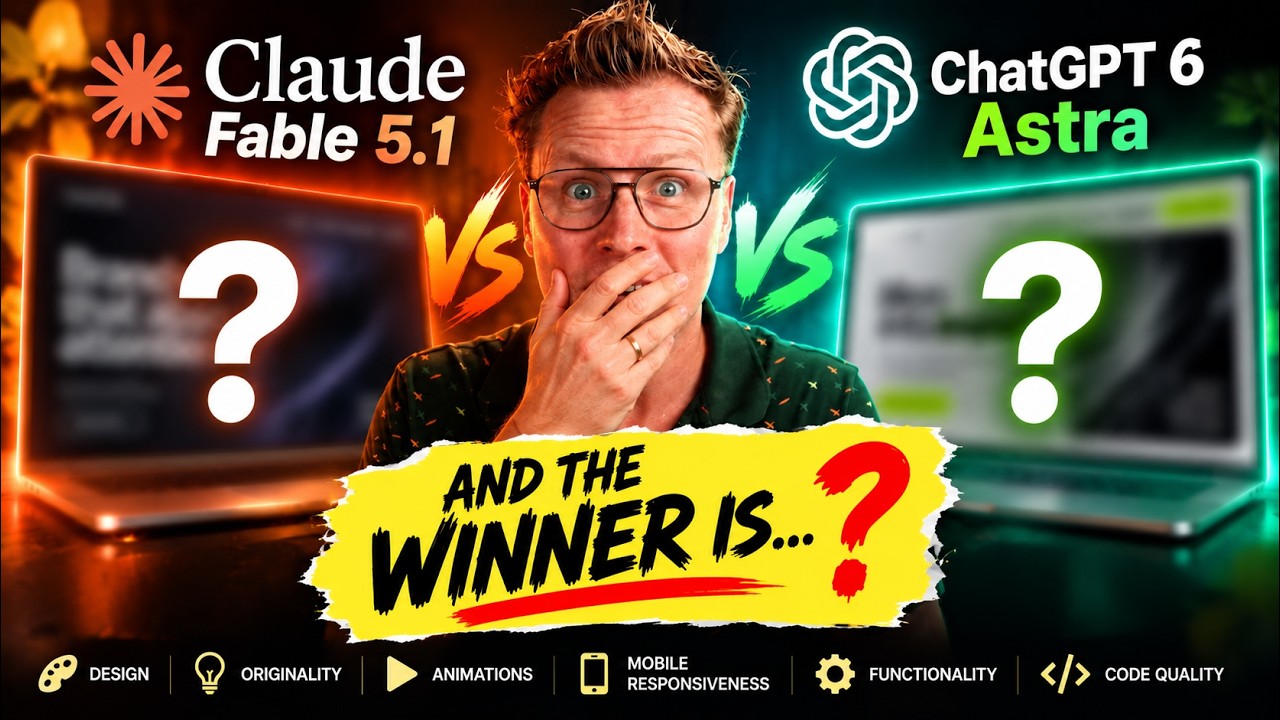
Ferdy Korpershoek typed the same prompt exactly twice, gave each platform exactly one chance, and watched two AI systems race to build a professional website for a fictional web design agency called VANTA Studio. No second prompts. No tweaks. No adjustments. What followed was one of the closest AI head-to-heads in recent memory, a 60-point rubric, six categories, and a margin of victory that came down to a single broken popup.
Two websites, one brutal rulebook
The rules were simple enough to be ruthless. Claude Fable 5.1 ran on its Max setting inside Claude Design. ChatGPT 6 Astra ran on Extra High inside Codex. Both received the identical VANTA Studio brief, which deliberately left out any mention of colors, fonts, or layout. The instructions asked for something that looked like it cost more than $50,000 to build, and then stepped back to let each AI decide the rest.
Fable delivered a bold editorial look: dark backgrounds, large serif-and-sans-serif type combinations, text that shifted from light to dark depending on the background it sat against, and a hero line that read ‘Brands that absorb attention.’ Korpershoek appreciated the gutsy decisions, including a layout that refused the standard hero-image-then-three-cards formula. Astra went a different direction: a lime green and white visual identity, generous negative space, asymmetric layouts, and interactive elements scattered through the page. Korpershoek scored design as an eight for Fable and a nine for Astra. Originality landed as a nine for both. Animations tied at eight apiece, with Fable’s continuously cycling Amsterdam-to-VANTA-Studio text drawing a particular mention.
Then came mobile responsiveness, and Astra’s lead collapsed. Fable handled the smaller screen cleanly: menus worked, animations carried over, and every tap routed correctly. Astra’s portfolio popups broke entirely on mobile. Korpershoek, who noted that more than two thirds of web visitors arrive on a phone, gave Fable an eight and Astra a five. ‘That’s actually because of the popups,’ he said plainly. ‘They got one chance.’ Functionality came in at nine points each, with both sites navigating cleanly from section to section and offering visible call-to-action anchors throughout. Code quality gave Astra a slight edge: nine to Fable’s eight, because Astra’s styling was more centralized and easier to maintain at scale.
Final score and what it actually means
Fable 5.1 finished with 50 out of 60 points. Astra finished with 49. One point separated them, and Korpershoek was direct about what that meant: ‘Overall I like the website of Astra more, but since the mobile version wasn’t working, they lost it over there. If that was working right in the portfolio items, they would have won.’
He then took the winning Fable site and put it live. Using a web hosting service, he registered the domain VANTA Studio Amsterdam, cleared the default public directory, exported the Claude project as a zipped archive, uploaded the files, renamed the main file to index, and the site appeared live on the open internet. The whole deployment process followed the single-prompt build with no code editing required.
The VANTA Studio homepage, still loading
Somewhere on a freshly registered domain sits the VANTA Studio website: dark backgrounds, shifting text, ‘Brands that absorb attention’ cycling on a loop, built in one prompt and never touched again.
Korpershoek closed with a thought that reframed the entire competition. Both tools are now so capable that the useful question is not which AI won, but what that capability means for anyone still deciding how to build websites at all.
 Wake up to Only Happy News!