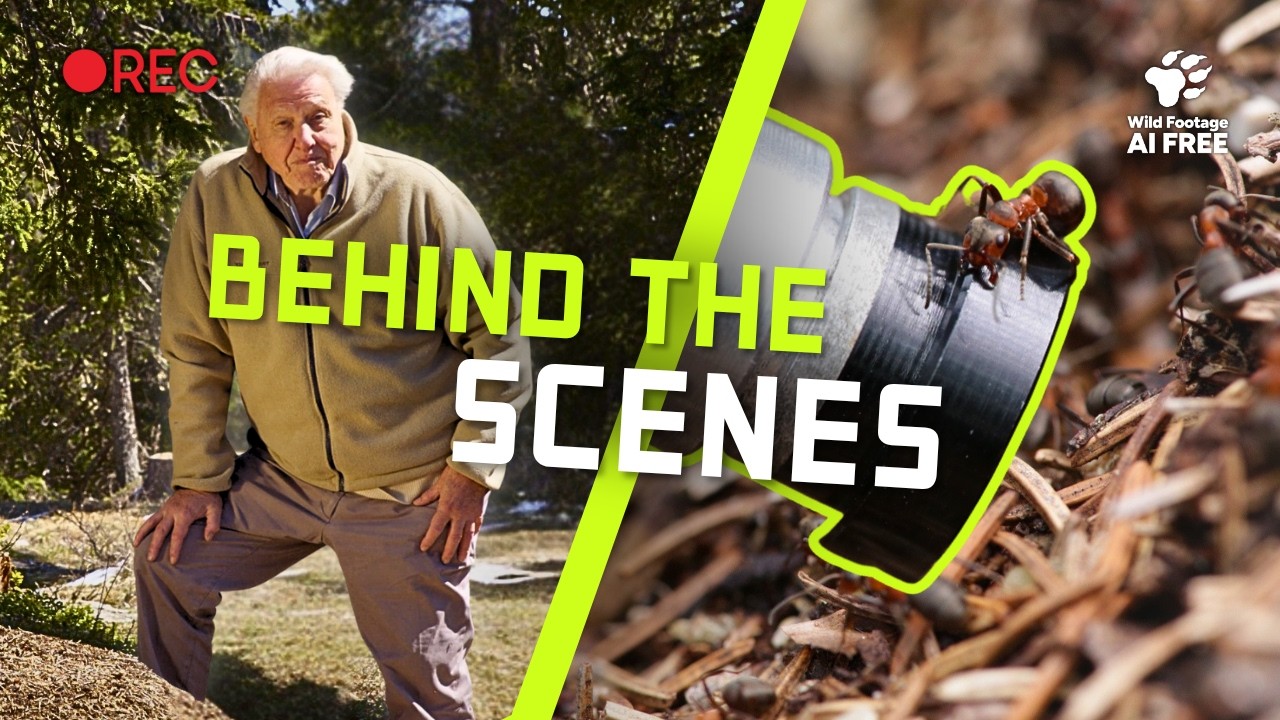
The lens responsible for some of the most striking ant footage ever captured cost 8 pounds on the internet. It is not a compromise or a budget shortfall. It is a mobile phone camera component, mass-produced in the millions, repurposed into a one-of-a-kind rig called Franken Cam, and it fundamentally changes how distance looks on screen. What Terra Mater’s filmmaking teams reveal about their craft is less a polished behind-the-scenes tour and more an honest account of broken equipment, freezing water, six-day waits in treetop hides, and the specific stubbornness required to keep filming anyway.
When the only camera in the world decides to stop working
Franken Cam works by magnifying distances the way an ant actually experiences them. To a foraging ant, five feet might as well be half a mile. The rig makes that scale visible on screen, allowing an operator to steer through individual blades of grass as though piloting through a landscape. But the camera’s most remarkable trait is also its most aggravating one. As the team puts it: ‘Unfortunately, Frank is temperamental, and sometimes he’s brilliant. And then as soon as you admit that he’s brilliant, he decides to stop working.’ The focus box took a knock one morning and went dark. With no backup in existence, the crew improvised and kept rolling. Over more than 100 days spread across a year, they captured antenna interactions between ants and tracked a parasitic queen building her chemical disguise through the undergrowth, behavior that scientists had not previously been able to observe in such detail.
The weather at the ant meadow site compounded every problem. The shoot ran six weeks late. Snow buried the meadows in what was supposed to be spring. On one arrival, the nests were already covered in winged ants, catching even the attending scientists off guard.
A kayak, a rope, and three minutes before the water kills you
The ant sequence is meticulous and controlled compared to what cameraman Kieran faced in Arctic waters. The team needed close underwater footage of narwhals in their nursery grounds. The approach: a kayak, a single rope, and no dry suit, in water cold enough to kill a person in roughly three minutes. Kieran had never attempted anything like it. After an hour submerged, he could not climb back into the kayak. Pulled out by the crew, he described what he had just experienced: ‘There was babies. There were tusks. I really didn’t want to go, but I couldn’t work anything anymore. I’m trying to make my fingers move, and they wouldn’t.’ The crew marked the occasion with an underwater narwhal cake.
Elsewhere, cameraman James Aldred spent 66 consecutive hours in a hide built 50 metres above the forest floor, waiting for a orangutan named Bogie and her infant Patrick to move into frame. He used a catapult to thread thin ropes through the canopy before hauling up a filming platform. The wait was, by his own account, a long, hot, and rather frustrating six days, broken finally when Bogie moved steadily up through the fig canopy, selecting only the ripest fruit.
For hornet footage, cameraman Graham wore an air-conditioned protective suit on what he acknowledged would almost certainly be fatal without it. The suit’s fans failed twice during the single day available at the nest site. Each failure turned the suit into a sauna. Each time, the crew repaired it and resumed. A single hornet sting can hospitalise a person. Multiple stings are almost certainly lethal.
An arowana fish trained over weeks to leap at a cricket at a specific time of day, filmed at more than 1,000 frames per second, sometimes still missed. An ostrich egg hollowed out and fitted with a remote camera worked perfectly until the ostrich spotted the lens and attacked it. A puma named in the crew’s notes nearly noticed cameraman Ben mid-chase before killing a guanaco and looking away.
The moment Kieran still cannot fully describe
Pulled into the kayak with hands that would not close, Kieran offered what may be the most honest summary of the whole enterprise: ‘That was one of the most magical things I ever experienced. I can’t feel anything anymore.’
Franken Cam is back in a pelican case somewhere, temperamental as ever, built around the same lens sitting in the phone in your pocket.
 Wake up to Only Happy News!