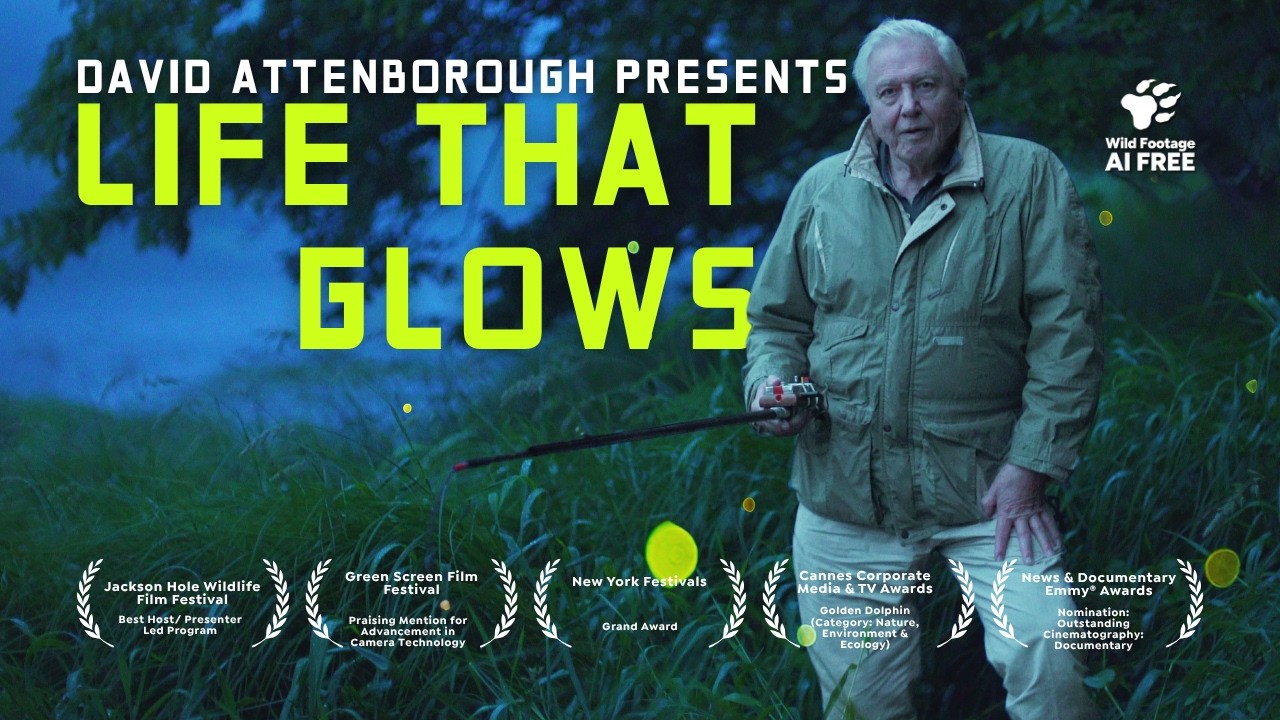
As dusk settles over a Pennsylvania woodland, David Attenborough raises a slender rod into the darkening air and waits. The rod was the same one carried by biologist Jim Lloyd, the scientist who first decoded the flash languages of fireflies, and Attenborough is using it now to join a conversation that has been running for millions of years. That conversation, conducted entirely in light, turns out to be one of the most sophisticated and widespread forms of communication on Earth. Bioluminescence, long treated as a biological curiosity, is being revealed by new camera technology as a force that shapes how countless creatures mate, hunt, hide, and survive.
A language of light with local dialects
Fireflies are perhaps the best understood practitioners of living light, and even they keep yielding surprises. Each of the at least 15 species in the woodlands Attenborough visits carries its own flash code, part determined by flight path and part by timing, ‘rather like morse code,’ as he puts it. A female evaluates a male not just by his signal but by the precision of his timing and the brightness of his glow, qualities that advertise genetic quality. Some species have gone further still, synchronising their displays so that waves of light pulse through entire forests in unison. Why they flash together remains, to this day, unresolved.
The cheating runs deep, too. One femme fatale firefly mimics the flash patterns of other species to lure males in, then eats them rather than mates with them. She cannot produce the defensive toxins fireflies carry and so acquires them by predation. When males prove elusive, she searches for them on spider webs, using her own light to see clearly enough to steal a trapped male directly from a living spider, dazzling the spider in the process.
On the forest floor, the glowing threads of certain fungi form underground networks that only appear above ground at night, and only in their most intense green. The working theory is that the light attracts insects that then disperse fungal spores, but it remains, as Attenborough notes plainly, just a theory. Glowing earthworms found across much of France went entirely unnoticed by science until 2010, when biologist Marcel Koken first documented their eerie blue light. His experiments showed the worms can control their brightness, flaring their entire bodies when a beetle bites them, though whether the light deters enough predators to count as a true defense is still being tested.
From the California mountains to the deep ocean floor
In the high mountains of California, millipedes that are completely blind still bioluminesce. Their living light evolved from a chemical process that originally helped conserve water in dry conditions, but since the millipedes already carried cyanide, the glow took on a second function. When scientists placed clay models of these millipedes in the field, half of which glowed, nocturnal predators consistently attacked the non-glowing ones far more often.
The ocean scales everything up. In 1995, the captain of a British vessel recorded sailing through a sea that glowed a milky white for 15 minutes, surrounded by luminescence stretching 150 miles off the coast of Somalia. Marine biologist Stephen Haddock later matched that ship’s log against satellite data and found a 300-kilometer glowing feature rotating with the currents across three successive nights. The cause: bacteria feeding on a dying algal bloom in such concentration that their collective glow registered from orbit.
Aboard the research vessel Western Flyer, Haddock and his team use a submersible to collect living deep-sea creatures, working against the clock because pressure changes cause bioluminescent abilities to vanish quickly after surfacing. They have brought up vampire squid, viper fish, and dragon fish, each with its own light strategy. Firefly squid use panels of light-producing cells called photophores to match the faint background glow filtering down from the surface, breaking up their silhouette against the sky above so that predators looking upward cannot distinguish them from open water.
Researchers Gretchen Gerrish and Trevor Rivers study ostracod mating displays in the Caribbean, diving without torches on moonless nights. Male ostracods release precise trails of glowing liquid as they swim, timing each dot so a female can calculate exactly where he will be half a second later. As one male displays, others join, fanning out into what Gerrish described as ‘streaming stars floating past you,’ produced by crustaceans barely understood by science.
The bioluminescent earthworm nobody believed
A woman in the Loire valley first encountered the glowing earthworms when her dog began digging a hole in the garden one evening and the soil at the bottom began to glow. She told people what she had seen, and few believed her.
Bioluminescence has evolved independently more than fifty times across life on Earth. In the oceans, as Attenborough observes near the end of his journey, the creatures that produce light are not the exception but the norm. The cameras built specifically for this project make visible a world that was functionally invisible to science even a decade ago, and every research season, Gerrish and Rivers surface with new ostracod species, each carrying its own untranslated light language.
 Wake up to Only Happy News!