Justin True Axe grew up in a bedroom where floodwater ripped through the walls every November, the Satsop River surging more than 20 feet and threatening to carry the house downstream. That kind of childhood does something to a person. It roots them. The timber country of Grays Harbor County, Washington, is one of those places that rewards the people stubborn enough to stay and quietly filters out everyone else, a calculation made in rain-soaked months that stretch from October through April without a break. This is where trees become 2x4s headed to Home Depot by next week, where a 19-year-old named Bo runs a $750,000 machine at 2 in the morning and calls it a dream job, and where a hermit outlaw from 1913 still draws visitors from Oregon who leave pre-rolled joints and handwritten opinions in a forest registry.
Three generations on machines the size of houses
The True Axe family operation, Shal Valley Timber, runs three logging crews simultaneously on private timberland southwest of Montesano. Justin, who studied geology in college before coming home 13 years ago, started as a choker setter doing the most dangerous ground work on steep slopes before working up to foreman. His wife came in from Maryland as a self-described ‘greener’ who had never thought logging was a current profession, then met Justin online and went on a 24-hour first date that ended at the family gravel bar. She now runs HR, safety coordination, and trucking for the company. The conversion, Justin admitted, was easier than he expected.
Out on the active logging side, a ground-based crew of three men moves timber from stump to truck in a choreography of processor, loading shovel, and shovel logger. Each machine costs close to three-quarters of a million dollars. The loader operator, Bo, arrives at 2 in the morning to start filling five trucks, pulling three loads each before knocking off at 12:30. He is 19 years old, third generation, and described the experience with the kind of precision that comes from being raised in the back seat of a log truck cab: ‘This is like Tonka toys, but as an adult.’ His father went to Alaska, started his own company, then went blind from diabetes. Bo made a resume, listed his experience, and Justin gave him a shot. He goes to bed around 4:30 in the afternoon and does it again the next day.
The single largest operating cost for the company is fuel. Off-road diesel at the time of the visit was running around seven dollars a gallon in Washington State. With three machines each consuming roughly 100 gallons or more per day, the monthly fuel bill runs close to $100,000. When diesel climbs two dollars a gallon, that translates to tens of thousands in additional monthly costs that ripple directly into what contractors can charge private landowners, which then determines how many crews get hired.
The spotted owl, carbon credits, and the promise that never came
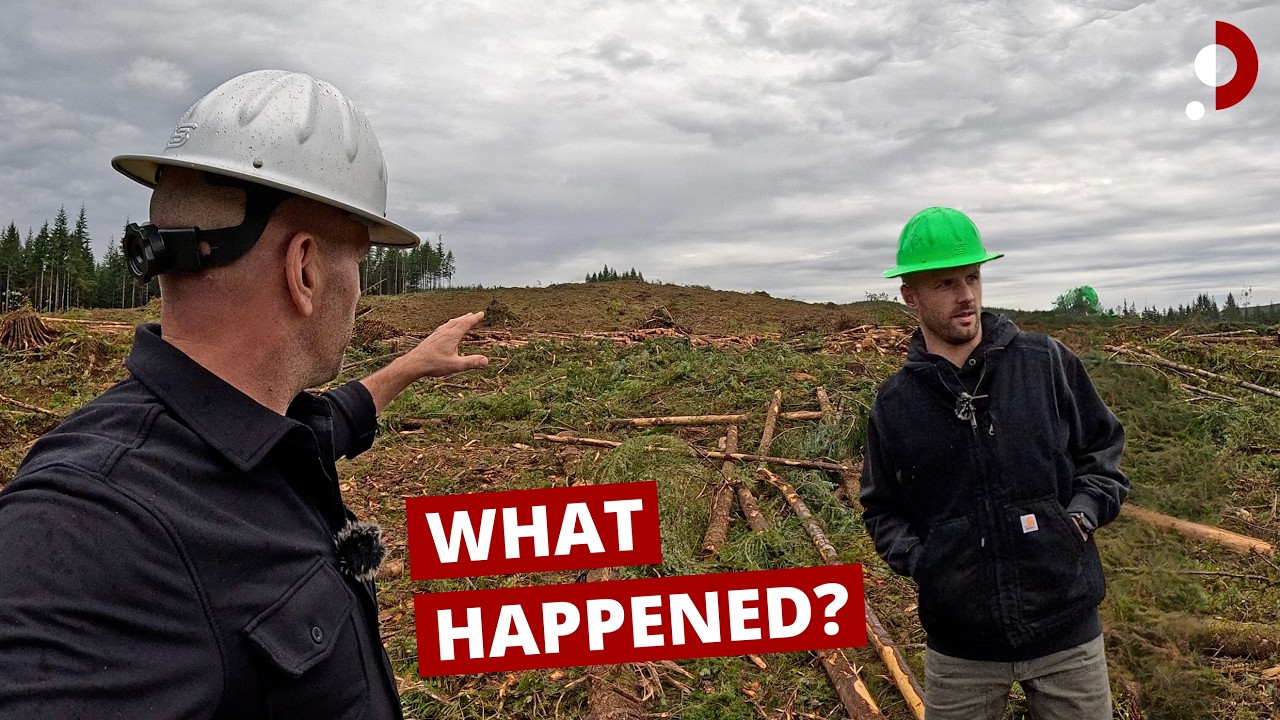
Teddy, a veteran logger with 41 years in the industry, described watching the late 1980s and early 1990s federal halt to national forest timber production land on the region like a slow-motion collapse. Private timberland kept running, but the loggers whose livelihoods depended on federal contracts had nowhere to go. Kyle, working alongside him and processing logs with a chainsaw and a tape measure when he started four decades ago, put the community argument plainly: ‘We plant more than what we take.’ The replanted stands Justin drove through on the way to the active side were 20 to 30 years old and nearly ready for another rotation. A fresh clearcut looked like a wasteland, Justin acknowledged, but within five years the browse, willows, and ground vegetation draw more wildlife than the closed canopy ever did. Ten minutes before the conversation, a herd of elk had walked past the crew on exactly that kind of recently opened ground.
The newer pressure is corporate carbon credit purchasing. Technology companies, required to offset their carbon output, have been buying timberland on the Olympic Peninsula and permanently removing it from harvest rotation. As Justin described it: those forest owners take the money, the land is tied up indefinitely, and the resource simply disappears from the community without ever being processed. The tourism economy that regional planners promised as a replacement after the federal logging slowdowns never materialized at scale. ‘That was the lie they told us,’ one longtime resident in Aberdeen said flatly. ‘They said tourism was going to be our saving grace after the logging. It never happened. Rains too much.’
Aberdeen, 10 miles from Montesano, carries that weight visibly. The downtown that was once described as the lumber capital of the world now has empty storefronts, a homeless population that arrived largely from out of state, and rents that one man on the street described as $3,600 a month for a one-bedroom. Montesano’s courthouse, built with timber money in the late 1800s, still has marble floors, ornate woodwork, and murals of trees mid-fall. Aberdeen’s equivalent buildings are being photographed for their murals now.
There is one record shop downtown called Boomtown Records with a grand reopening underway. Its owner, Pedro, bought the naming rights to a Nirvana-branded coffee concept at auction, outbidding the local Unplugged museum in a bidding war he still cannot fully explain. The building itself is the original location where Kurt Cobain bought his first guitar. Pedro was the most optimistic voice on the block.
The registry at the end of the unmarked road
Deep in the second-growth timber east of Montesano, marked only by a faint blue spray-painted T on a stump, sits a DIY memorial to John Turno, a logger and hermit killed in a sheriff’s deputy shootout in 1913. Turno had been wanted for the alleged murder of two twin boys, nephews by marriage, whose bodies were found buried in a T-formation near one of his remote camps. The local version of the story, passed through generations, is that the brother-in-law who hated Turno may have sent the twins to antagonize him, and that Turno, living alone at the edge of a pond with more than 100 live bullfrogs strung on thread as an alarm system, may not have known who was shooting at him when he shot back. After his death, his body was dragged behind horses through Main Street of Montesano while townspeople watched.
The registry box at the site, checked by Justin and Peter Santenello on the visit, contained entries going back to 2022. Visitors had come from Mitchell, Oregon. Grandparents had brought their grandchildren. The most recent entry read: ‘Just learned about John Turno this morning and here I am. Rest in peace, Wild Man.’ The page was split almost evenly on whether he did it.
Bo’s last truck of the day
At 12:30, Bo swung the loader around and picked up the trailer of the fifth truck to hook it clean. Justin watched and said nothing for a moment. Bo is only a few months into the job.
The cedar stump at the edge of the active side stood roughly 20 feet tall, with springboard notches cut into it at shoulder height where the fallers of the previous century stood to make their cuts. The tree it came from had been growing for hundreds of years before it was felled. The old-growth stand visible just past the clearcut edge held trees that no local mill could process even if anyone wanted to. They were simply too large for the existing equipment.
 Wake up to Only Happy News!