Dan Martell picked up the phone, cold-called a plumbing company, and booked a Zoom meeting in under two minutes without pitching a single product. That moment is the entire argument of his $100K-a-month blueprint: most people overcomplicate the path to serious revenue when the actual steps are uncomfortably straightforward. Martell built and sold three multi-million dollar companies after watching his first two fail, and he traces both the failures and the wins back to a single variable: knowing the right sequence.
The money math that decides everything before you build anything
Before choosing a product, a niche, or a sales script, Martell starts with arithmetic. There are five ways to reach $100,000 a month: one client at $100K, ten at $10K, one hundred at $1K, one thousand at $100, or ten thousand at $10. He walks through each and dismisses most of them. One client at $100K is dangerous concentration risk. Ten thousand clients at $10 is a logistics problem for someone who, as he puts it, probably only knows six people personally. A thousand clients at $100 is just exhausting volume for thin margin.
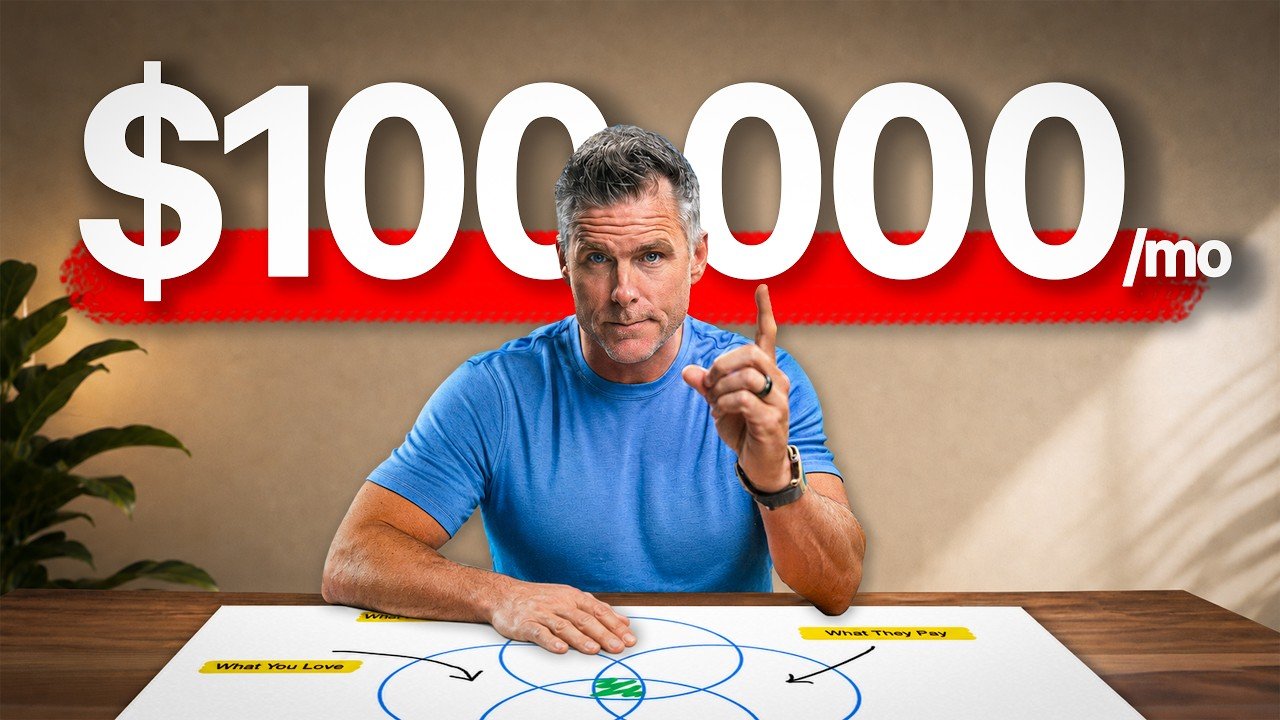
The target lands in the middle: a minimum of $1,000 per month per client, with a goal of one hundred clients. That is the $100K equation, and it shapes every decision that follows.
For the service itself, Martell uses a framework he calls the Ikigai, a Japanese philosophy built around four intersecting questions: what do you love, what are you good at (specifically, what do other people tell you you are good at), what does the world need, and what will people actually pay for. The fourth filter is the one most people skip. ‘Nice to have’ ideas fail; ‘must have’ problems attract money.
The pricing structure he recommends is a three-tier decoy system. The core offer sits at $1,000 a month. A stripped-down, do-it-yourself version sits at $500, and a fully managed, done-for-you version sits at $10,000. The expensive tier makes the middle feel like a bargain; the cheap tier exists to catch anyone who hesitates. The goal is to sell one hundred of the middle-tier every month.
Cold calls, chat closes, and why the first five calls are always throwaway
Martell is direct about what actually drives early revenue: outbound first, inbound second. He suggests opening the contacts in your phone before building any audience, because most people have two hundred names sitting there untouched. From there, the play is warm referrals: ask each contact whether they know anyone with the problem you solve, use that person’s name when reaching out, and lead with a question rather than a pitch.
For cold calls to businesses, Martell’s rule is to book a meeting, not close a deal. His live call with a plumber named David ended in a scheduled Zoom demo in roughly ninety seconds because the only ask was fifteen minutes on a video call. He recommends leaving a voicemail on a missed call and then calling back immediately, because a second call within a few seconds rings through most do-not-disturb settings.
For chat-based selling across social platforms, Martell says he has personally closed eight figures this way, opening every new follower conversation with a simple either-or question that surfaces whether someone has a business problem worth solving.
On rejection: ‘Every no gets you closer to a yes, and a yes gets you closer to 100k a month. My rule would be to get to 100 no’s a day. If you can get to that level of rejection, you’re going to be rich.’
The one sequence most people reverse: Martell insists on collecting payments before building the product. Sell the offer, tell clients delivery starts in two weeks, then use that window to prepare. For software or anything with a long build time, charge $50 to join a waitlist. That $50, he argues, is proof of real demand in a way that a free sign-up never is.
David from HBC Plumbing
Somewhere in a plumbing office, David has a Zoom link sitting in his messages confirming a fifteen-minute call about AI answering his phones while he works with clients on-site.
Martell’s Maritime Vacation website, his first company, launched to total silence after months of solo coding because he built the product before finding a single customer willing to pay for it. The cold call to HBC Plumbing took less time than building that first page.
 Wake up to Only Happy News!