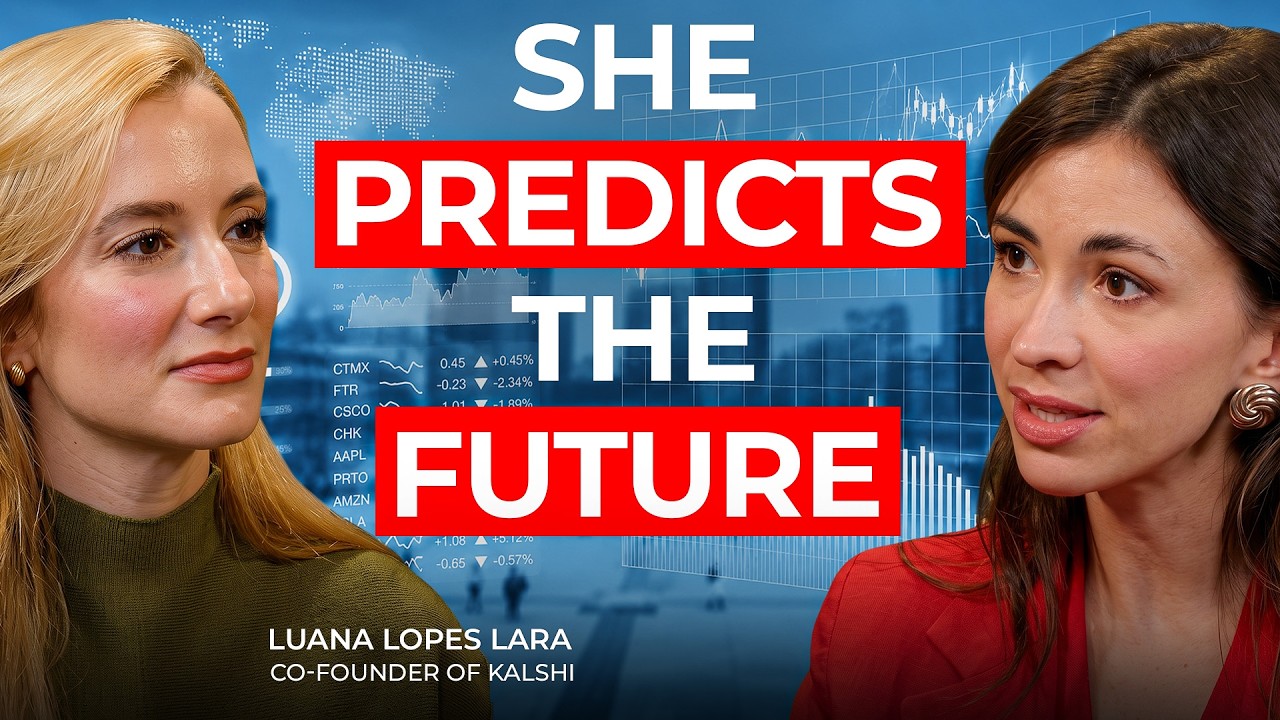
Lana Lopez Lara pulled up the number without hesitation: a 73% chance that AI would be the number one reason for job cuts in May. That figure had already held true for March and for April, and the market volume behind it was deep enough that she trusted it completely. For anyone watching their industry shift under their feet, that single probability carries more weight than most headlines. Lopez Lara is the co-founder of Kalshi, a prediction market platform now valued at 22 billion dollars, and Forbes has named her the youngest self-made woman billionaire in the world. She built a company where anyone can look up the odds on things that have not happened yet, and the numbers she sees every morning are starting to tell a specific story about work, money, and who gets left behind.
When the questions people ask started to change
A year or two ago, the markets people proposed on Kalshi were almost entirely about AI capabilities: which model would outperform another, what tasks AI could accomplish, which lab would pull ahead. That has shifted. The requests flowing in now are about impact: tech layoffs, unemployment, how the economic fallout will land. Lopez Lara sees that change in the market requests as a cultural signal. The early excitement has given way to something more sober, and the crowd trading real money is pricing that in.
The numbers are specific. There is currently a 26 to 30% chance that a five-condition scenario tied to unemployment and AI disruption, one that her co-founder follows closely, reaches the threshold where three of those five conditions are met. That probability is a lot higher than most people expect, she noted, and the market behind it has been traded in the millions of dollars. Meanwhile, the New York Knicks are sitting at around 37% to win the finals, which feels lighter by comparison.
For the 70% of Kalshi users who never place a single trade, none of this requires betting anything. They come to see the forecast the way someone else opens a news app. Lopez Lara put it plainly: ‘Even with like 5,000 in volume you already see convergence to a very calibrated number, so that number can be trusted for sure.’ A Federal Reserve paper on prediction markets has backed that calibration claim, and Kalshi’s own internal research shows that when a market says 70%, it is genuinely closer to 70% than most alternative forecasts.
The jobs she thinks are actually getting safer
When asked which roles are becoming more secure, Lopez Lara did not hesitate. Physical and craft-based work holds up better. The roles that were supposed to be safe, the engineering positions, the technical knowledge work, are the ones under the most pressure now. She is still an optimist. At Kalshi itself, no role has been eliminated outright in favor of AI. Instead, every function has been augmented: engineers run dozens of cloud agents, the 170-person team does the work of a much larger organization, and Sundays that used to be consumed entirely by reviewing company metrics have freed up enough time that she can fit in brunch.
For small businesses and individual workers who want something more than a probability to look at, hedging is a growing use case. A bar in the Upper East Side of New York recently bought a position on the Knicks to cover a potential 10,000 to 20,000 dollar tab it had promised to absorb if the team won. Along the Florida coast, people are asking for hurricane markets tied to specific geographic areas so they can offset insurance deductibles before a storm lands.
On the hiring side, Kalshi now asks engineering candidates to use AI freely during interviews and is starting to apply the same expectation to design and legal roles. The question is no longer whether someone has mastered a specific skill. It is whether they are willing to let go of how they used to work.
The pope and the 1%
The American pope held a 1% probability on Kalshi right up until the conclave concluded. When the outcome defied the market, the headlines declared the platform wrong. Lopez Lara’s read is different: one is not zero. A closed information system with no data leaking out is genuinely hard to forecast, and the market did exactly what a probability should do. It told you the odds, not the answer.
The full-circle reality of that example lands somewhere useful. The same platform that could not see inside the Sistine Chapel is showing, with months of consistent data, that the single most likely explanation for job cuts right now is AI. For a normal person wondering what changes by the end of this year, Lopez Lara’s answer is unambiguous. Work changes the most. The question is whether someone is positioned to move with it or caught holding a role the market has already priced down.