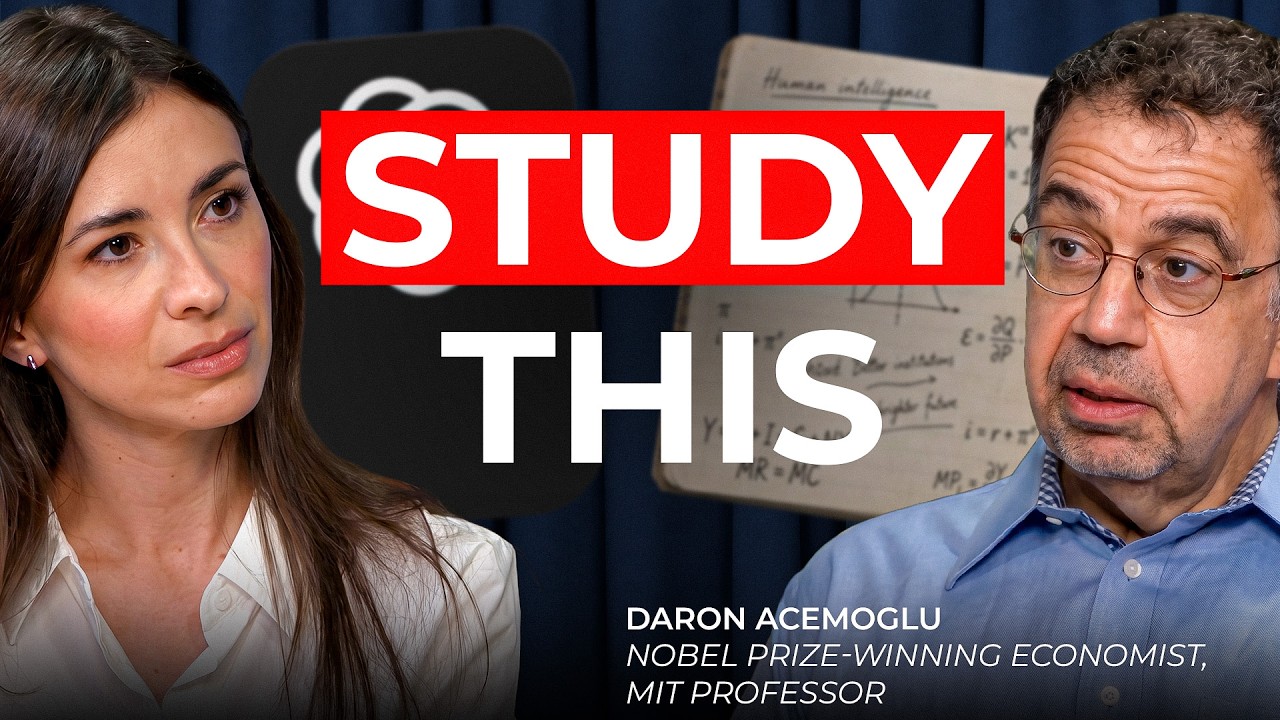
Daron Acemoglu does not reach for his phone when he needs to work through a problem. He picks up a pen. The MIT economist and 2024 Nobel Prize winner in Economics still does his math by hand, still sketches models on paper, and still worries about what happens when people stop doing the same. That habit sits at the center of his argument: the most important question about AI is not how powerful it becomes, but what we choose to do with it, and right now, he thinks the answer is too narrow.
Acemoglu was speaking with Silicon Valley Girl when he offered a frank reassessment of his own 2024 forecast. He had estimated that AI would add roughly 1% to US GDP over 10 years, with only 5% of tasks being fully automatable. Asked whether agentic AI developments in 2026 had changed his thinking, he was measured. ‘Probably now I would have put that number a little higher than 5%,’ he said, ‘but I still think that a lot of the discussion exaggerates how quickly we’re going to see automation because automation is hard.’
Why coding raced ahead while customer service stalled out
His clearest illustration of that complexity came from comparing two occupations that seemed like obvious automation targets. Coding accelerated because it operates entirely inside a controlled environment: something either runs or it does not. Reinforcement learning works precisely because there is a ground truth that delivers instant, unambiguous feedback, the same reason math and chess have seen rapid AI progress. Customer service, by contrast, looked like a simpler target but turned out to be far messier. Different people phrase the same question in entirely different ways, edge cases multiply constantly, and the social dimension of the interaction resists clean encoding. Acemoglu put it without ceremony: ‘Most of the organizations that I deal with, their AI system is so bad. It’s like a nightmare when I call customer service and I get AI.’
That gap between capability and real-world deployment is where he locates the most important business opportunity of the current moment. Existing models, he argued, are already capable enough to build tools for nurses navigating complex patient decisions, for electricians encountering equipment they have never seen before, and for teachers managing classrooms without adequate diagnostic support. The bottleneck is not the foundation model. It is the absence of the application. He pointed out that in some US markets, electricians are already booked out three weeks for routine jobs and still arrive unprepared for unfamiliar machinery. ‘This is where AI comes in,’ he said. ‘It’s just such an easy problem.’
Where he thinks the money actually is
Acemoglu is skeptical that foundation model companies will generate the returns their valuations currently imply. Open-source models are closing the gap fast, and monetization at the frontier layer will face real pressure. His view on where value will concentrate was direct: high-quality proprietary data and creative applications built on top of existing infrastructure. Companies that have spent years accumulating tacit knowledge through their workers, he argued, are sitting on an asset they have not fully recognized. ‘A lot of the tacit knowledge is with the workers,’ he said. ‘You can’t just sit in your office in front of a computer and come up with an application. You need to go there, get your hands dirty, and talk to workers.’
For individuals navigating this shift, his advice was blunt and surprisingly traditional: study math, study physics, study engineering, and resist the urge to delegate thinking to AI before you have done the thinking yourself. He acknowledged the calculator analogy but rejected it as insufficient. A calculator took over a narrow mechanical function and left critical reasoning intact. AI reaches directly into the reasoning process itself, and the boundaries of where to stop using it are genuinely unclear. His one concrete rule for students: use AI to catch grammatical errors in writing, never to generate the writing itself.
A number that has not moved much
In 2025, Acemoglu rated AI on a scale from minus 10 to plus 10 and landed at minus 6. Asked in this conversation whether that score had gotten worse, he paused before answering that it had not shifted significantly, because the potential for harm and the potential for genuine benefit had both grown together. What he remains most concerned about is not a superintelligent system acting autonomously. It is the quieter loss of ordinary people’s control over their own decisions, their work, and their learning, accelerated not by a rogue machine but by the choices of a small number of organizations deploying AI without sufficient public input or ethical framework.
The pen still on the desk
Acemoglu’s own notebook, pages filled with hand-calculated models.
He acknowledges he is behind the frontier in his personal AI use. He uses it for background research and increasingly to stress-test his own ideas. The math, he still does himself.