A taxi driver in Morocco who spoke no English was running his entire business through ChatGPT as a translator. Reid Hoffman, co-founder of LinkedIn, dropped that detail mid-conversation as a snapshot of where AI adoption actually stands right now: patchy, early, and moving faster than most people realize.
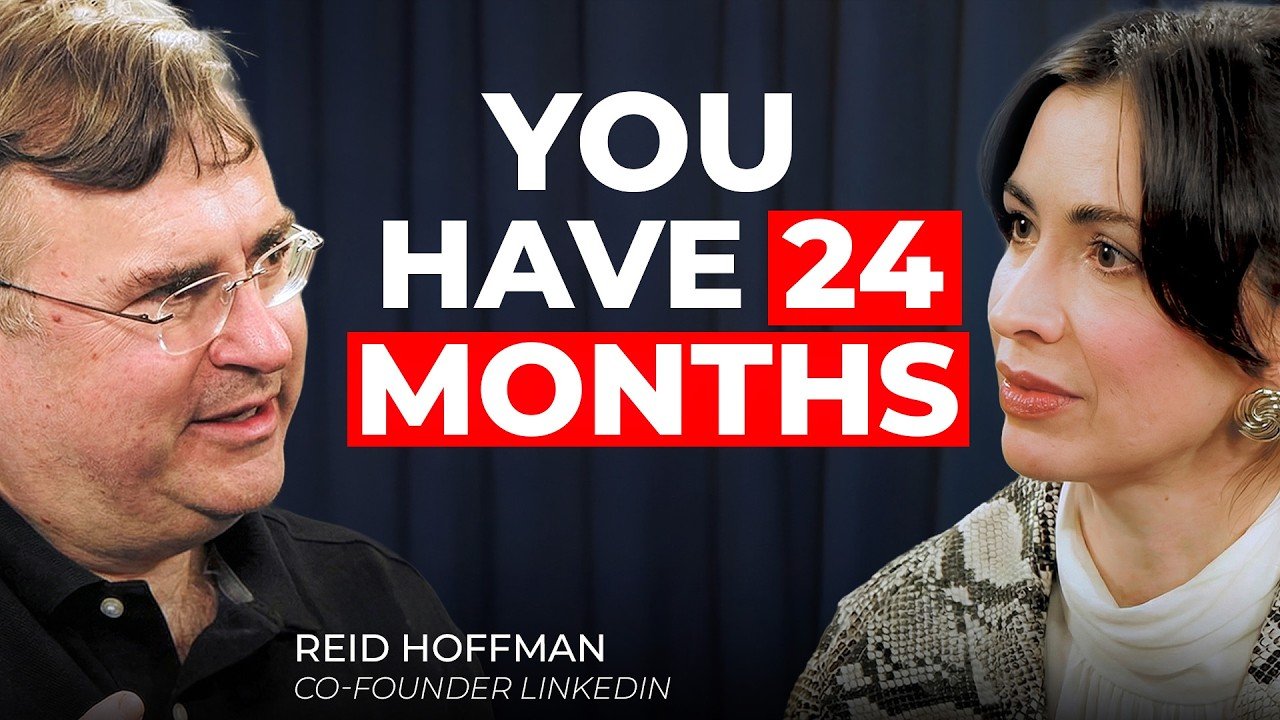
Hoffman was speaking with Marina Mogilko of Silicon Valley Girl about what he calls the real gap in how workers and entrepreneurs are approaching AI. His position is blunt: even people who say they use AI daily are almost certainly not using it seriously enough.
What ‘basic’ actually means when Reid Hoffman is the one defining it
Hoffman draws a hard line between dabbling and doing. Typing seven words into a chatbot and waiting to see what comes back is not, in his view, meaningful engagement. The baseline he describes starts with speaking to AI tools rather than typing, on the grounds that people speak far faster and tend to supply richer context when talking aloud. From there, his own habit involves asking an AI to generate the prompt he should be using, rather than constructing it himself. He described asking about fusion energy prospects, then requesting that the AI write him a two-page research prompt based on that interest, and then running that prompt to get a genuinely useful output.
He flagged one trap that catches people repeatedly: assuming the model has current information. Most major AI models finished their training roughly 18 months before a user interacts with them, which means anything time-sensitive, including the current landscape of AI tools, requires an explicit instruction to pull live web data rather than rely on stored knowledge.
The role-assignment method Hoffman uses for complex decisions
For anyone past the basics, Hoffman recommends using AI’s ability to adopt distinct roles as a structured thinking tool. Using an interest in fusion energy as his example, he described asking the same question from the perspective of a venture investor, a government policy official, a nuclear safety expert, and a climate technologist, then asking the AI whether there were roles he had not thought to include. The same technique applies to writing. He routinely asks an AI to argue against his own position, then asks separately what arguments he might be missing in his own favor.
When Mogilko described her own setup, which includes 35 team members, Claude projects for each social media channel with access to performance data, and role-assigned instructions so the AI acts as a strategist, Hoffman rated it as medium-level. To reach advanced, he suggested adding a meta-agent that interrogates all the individual project agents together, looking for patterns across what is working, what is not, and pulling in comparable data from outside the organization to surface ideas worth testing in the next month or two.
For someone earning around $80,000 in a standard salaried role and looking to increase that, Hoffman pointed to a specific and immediate opening. Businesses across every sector know they need AI transformation and are actively looking for people who can demonstrate competence with the tools, not just researchers or engineers, but people who understand how to apply AI to supply chain analysis, financial modeling, risk assessment, marketing, and sales. Visibility matters here. Being findable on LinkedIn or social platforms as someone already doing this work, in a domain the employer recognizes, is the mechanism he describes for moving up.
He also addressed entrepreneurs worried about AI displacing their specific niche. For Mogilko, who runs a language-learning and test-prep company, his advice was to assume the core product will eventually be available free through major AI platforms and to build around what those platforms will not easily replicate: group experiences, trust relationships, personal brand, and the kind of adaptive positioning that large companies locked into legacy distribution models cannot execute quickly.
On the broader economic shift in B2B software, Hoffman acknowledged the $300 billion in market value wiped out after Claude demonstrated a 200-line code output that rattled enterprise software assumptions. He framed this as a genuine structural change rather than a short-term market reaction. The old logic of SaaS, which required a competitor to spend roughly a billion dollars just to match an incumbent’s feature set before starting to sell, is weakening. A company that once needed five features from Salesforce and had to accept 50 it did not want may now find it cheaper to build and maintain its own AI-generated system. Software engineers, he argued, are not losing jobs in this scenario. They are shifting from writing code to conducting networks of coding agents, a role he expects to remain valuable for years.
When asked whether AI represents the last human-driven revolution, Hoffman estimated a 60 to 70 percent probability that inventions over the next 50 to 100 years will be the product of human-plus-AI collaboration rather than either alone. He put another 25 to 30 percent on primarily AI-driven invention, with humans checking rather than directing. Fully unassisted human discovery, the lone eureka moment with no AI involvement, he placed at around 5 percent.
His single piece of advice for anyone watching before February 2027 was to build a reflex. Before any task, any decision, any conversation, including a difficult one with a family member, he suggested stopping to ask how AI might help. Not always acting on that question, but always asking it. His estimate of where the current boom sits relative to what is coming was 5 percent, possibly 2.
The Morocco taxi driver who did not know he was making a point
Eighteen months before the interview, a friend of Hoffman’s was traveling in Morocco. The taxi driver spoke no English. He had built a functioning business by using ChatGPT as a real-time translator for every conversation with foreign passengers. He had no technical background and no onboarding. He had a problem, found a tool, and was operational.
That taxi driver in Morocco, navigating a language gap with a chatbot on his phone, was doing something that Hoffman’s framework would classify as beginner level. Which raises the question of how far the medium and advanced stages actually reach, for someone willing to find out before the window closes.
Source: Watch original
This article was reported in June 2026.
OHN Editorial Note: This article is based on publicly available sources. If you spot an error or have updated information, contact us at editorial@onlyhappynews.com. We correct mistakes promptly.