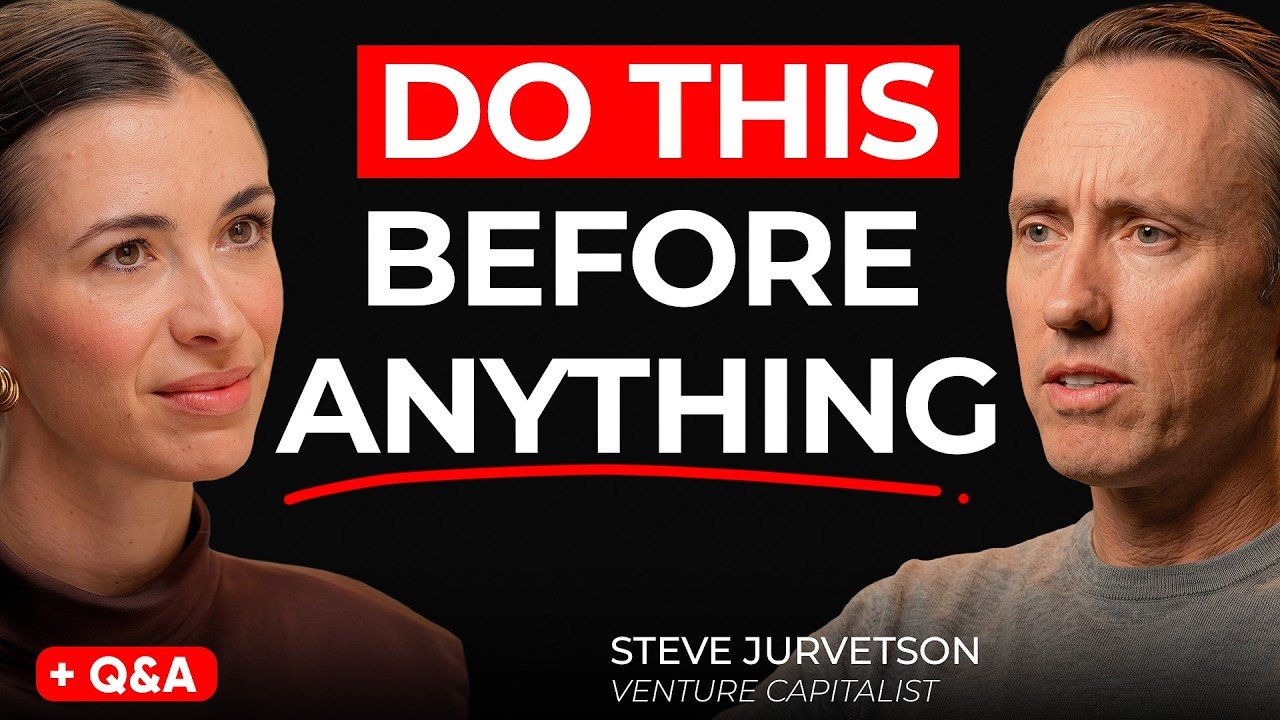
Steve Jurvetson was in the room when almost no investor would touch a private rocket company. Thirty years of backing world-altering bets, from SpaceX to Tesla to nuclear fusion, have given him a lens on the future that most people only develop in hindsight. Now, with artificial intelligence rewriting the rules of every industry it enters, the question he keeps returning to is not whether the transformation is coming but which sleepy sectors it will hit hardest and fastest.
The three industries nobody is watching closely enough
Jurvetson has spent decades watching software eat industries that thought they were immune. His current conviction centers on energy, agriculture, and construction, three sectors he describes as enormous, growing as a percentage of GDP, and the least digitized on the planet. None of them have seen meaningful productivity gains from a new entrant in years, which is precisely why he finds them compelling. The same logic that made SpaceX possible, a software-centric engineering approach dropped into a sector frozen in time, is the template he sees replicating across all three.
He is putting real capital behind the thesis. At Future Ventures, his firm is actively investing in nuclear fusion, subcritical fusion that sidesteps Nuclear Regulatory Commission oversight, epigenetic editing for crop health, and analog AI chips designed to deliver dramatic reductions in power per calculation. A company called Mythic is among his bets, using in-memory compute to perform 8-bit multiplication inside a single transistor. On food, he is blunt: slaughter-based meat production has a visible end date, and mycelium-based alternatives are currently the fastest-growing path to get there.
Healthcare sits just behind those three. His framing for it is unusually specific: free diagnostics for personal health via a cell phone, available globally, and almost certainly not launched first in the United States, where FDA and insurance structures would slow it down.
What he actually learned watching Elon Musk up close
Jurvetson has known Musk for 29 years and invested in every company of his across that span. When pressed for the transferable lessons, he named three. First, a ferocious ability to say no, not to things that are unimportant in general, but to things that are not mission-critical right now. He offered a telling example: years ago, Jurvetson tried to connect Musk with geneticist Craig Venter to brainstorm terraforming Mars with gene sequencers. Musk cut it off immediately, telling him it did not matter until Starship was flying.
Second, and more important in Jurvetson’s view, is an obsession with the cycle time of learning. Tesla cameras now gather more AI training data every four days than Waymo has collected in its entire history. The insight behind that was enabling every vehicle, regardless of whether the customer paid for full self-driving, to function as a data-collection node.
Third is talent identification. Jurvetson describes Musk drilling candidates through engineering crises, pushing further and further to find genuine mastery rather than credential proximity. ‘Focus on learning loops,’ Jurvetson said, summing up the throughline. ‘Where do you learn more quickly?’
A founder who could not stop talking about 50 years out
In meetings where a deal is getting serious, Jurvetson says he asks founders what their business looks like in 50 years. Some laugh. The ones he backs light up with relief, as if they have been waiting all day to say what they actually mean. He contrasted that with what he called the ‘arbitrary-seeking opportunist,’ chasing each new bright object, and noted that the best founders have usually learned to suppress their real vision early in a pitch because ‘colonizing Mars is an uninvestable proposition on day one.’
The compute curve he returns to most often is Ray Kurzweil’s 130-year graph, a logarithmic plot showing a 10,000 billion billion times improvement in what a dollar of computation can buy across five distinct technology substrates. He credits Kurzweil with seeing the pattern in 1999 before anyone realized they were fitting to a curve, and says the analog and custom AI silicon now carrying that trend forward is what makes every other transformation on this list possible.
The question left sitting in the room
An audience member asked Jurvetson whether AI could ever develop genuine consciousness, invoking Roger Penrose’s argument that quantum processes in the brain make it irreproducible synthetically. Jurvetson did not dismiss the question.
The conversation moved on. Nobody had a clean answer.
Jurvetson’s bet across three decades has never really required one. He backed rockets when space was not a venture category, electric cars when the auto sector seemed untouchable, and fusion when most investors had stopped reading the proposals. Energy, agriculture, and construction are next on his list, not because he is certain, but because the pattern says they are overdue.