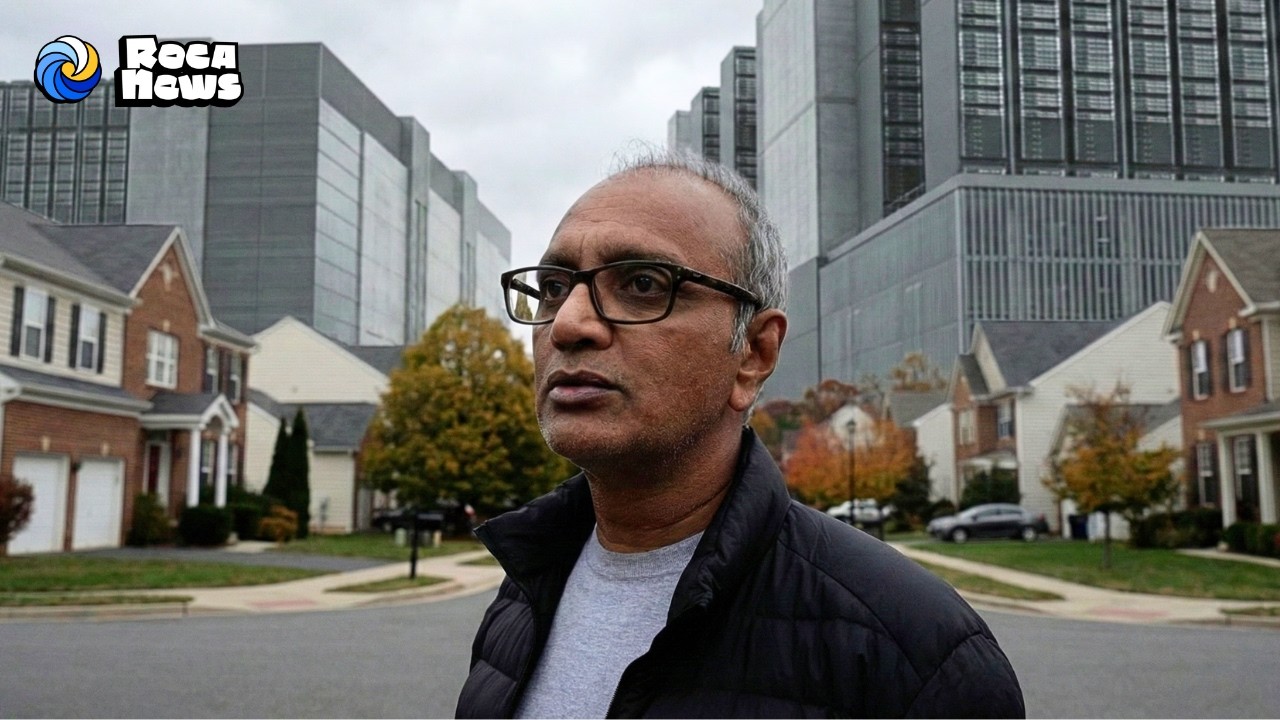
The security guard stepped out of the Align Data Centers facility in Ashburn, Virginia, before the RocaNews crew had even finished parking. ‘The reason why I stopped you is we’re not allowed to take photos,’ he said, calm but firm, one hand raised. It was a strange scene: a public road, a sunny afternoon, and a building so enormous it blocked the horizon, yet somehow off-limits to a camera. That tension between the internet’s physical infrastructure and the people who live next to it is the defining argument of Data Center Alley, a stretch of Northern Virginia that is, by any measure, the most consequential piece of real estate in the digital world. Roughly 40% of the internet passes through this area, and most Americans have never heard its name.
The alley nobody sees but everyone uses
Ashburn, Virginia sits about 35 miles from Washington, D.C., in Loudoun County. When longtime residents describe moving there 15 years ago, they describe an unremarkable suburb with empty lots and low property taxes. What filled those lots was unlike anything a residential community had seen before. Loudoun County now hosts around 200 data centers, with roughly 100 more under construction. Northern Virginia holds more hyperscale data centers, the kind powering AI applications, than any other city in the world.
The reasons cluster around a concept a local named Patrick explained on the street: data gravity. ‘It’s cheaper and faster if you’re closer to all the data that’s already there,’ he said, drawing on what his brother, who works in Amazon’s data operations, had told him. Beyond that economic logic, the area carries genuine strategic weight: its proximity to D.C. and federal government networks, an internet history stretching back to government projects in the 1970s and to companies like Netscape and AOL in the 1990s, and a geography that is relatively insulated from natural disasters have all made it the default nucleus of the industry.
The scale on the ground is difficult to absorb. These are not office parks. They are fortress-sized structures, windowless and humming, sitting behind fences on land that, according to local sources, was selling for around $1 million per acre and has since climbed to roughly $4 million per acre, a price no residential developer or conservation group can match.
What the county gains and what residents pay
The financial return to Loudoun County is real. The 200 data centers in the county generate approximately $1 billion a year in tax revenue, working out to roughly $5 million per facility annually, and that revenue has historically helped keep local property taxes low. A typical data center facility runs to 250,000 square feet. The full-time workforce inside it averages around 50 people. Construction of each site employs up to 1,500 workers temporarily, but once the building is operational, it is largely self-running.
For many residents, that arithmetic does not add up. Electric bills have climbed. HOA fees, insurance, and basic costs have risen on what some describe as a near-quarterly schedule. A proposed 500-kilovolt power line running along Loudoun County Parkway has become a flashpoint, with a campaign called nopowerlines.org collecting signatures. One resident put the fear plainly: her children play near the route, and high-voltage infrastructure running through a neighborhood is, in her words, dangerous in a way that is hard to argue around. Another resident, speaking from a more measured position, acknowledged the tax benefit while noting that power lines running through a community tend to pull home values down, regardless of whatever health debate surrounds them.
Water is the concern that gets the least attention. According to Ashley Studholm, director of a local conservation alliance in nearby Prince William County, data centers currently consume 2% of all the water drawn from the Potomac River Basin to cool their servers. In summer months, that rises to 8%. If current growth trends hold, it could exceed 30% of the basin’s total water draw. Studholm described a situation where proposals were filed to site new data centers adjacent to Prince William Forest Park and near Manassas Battlefield, two national parks. ‘We are in a situation,’ she said, ‘where we are literally trading in our real world for a virtual one.’
Back at the Align Data Centers facility, the security guard, a former military member, made his own argument with genuine conviction. ‘Everything that you see on the phone, your games, your videos, your YouTube, all that, where do you think it goes? There. Into there.’ He compared the public’s discomfort with data centers to the discomfort people express about oil while wearing clothes made from petroleum products. It was not a dismissal. It was a version of the same honest contradiction every resident in Ashburn is living inside.
The bill nobody agreed to pay
One number sat in the conversation with Studholm that did not come with a rebuttal. If no legislation increases accountability or transparency around data center energy consumption, utility rates in Virginia could double by 2030. Data centers already account for 25% of the state’s energy draw. Projections put that figure at 50% by the end of the decade, paid for not by the companies drawing the power but spread across every ratepayer in Virginia.
Equinix, a company most Virginians would not recognize by name, is now among America’s 150 most valuable companies, worth more than PayPal, Ford, and Airbnb. The industry’s biggest players, Amazon, Microsoft, Meta, and OpenAI, recently joined a multi-billion-dollar acquisition of Align Data Centers alongside BlackRock and Nvidia. The wealth is concentrated. The costs are distributed.
The parking lot on Loudoun County Parkway
A stretch of Loudoun County Parkway currently runs clean and wide, the kind of suburban road that becomes a point of quiet local pride. If the proposed 500-kilovolt transmission line is routed along it, the road will be flanked by towers that residents say will be visible for miles.
RocaNews kept driving after the confrontation at the Align facility, past building after building with no identifying signage, companies whose multi-billion-dollar balance sheets lived entirely behind fences and camera warnings. The parkway, still unmarked and still pleasant, sits at the center of a decision that no resident interviewed felt they had any real power to influence.
Ashburn built the internet’s backbone quietly, out of sight, in a suburb that used to be empty fields. The empty fields are gone. The debate about what replaced them is only beginning.