Phat Gus, a 800-gram eastern gray squirrel with an instinct for the camera and an appetite that knows no restraint, became the breakout star of a two-month backyard engineering project that turned a simple bird-feeder theft problem into one of the most elaborate obstacle courses ever built for wildlife. Mark Rober designed, built, and filmed the entire operation from his suburban home, and the result was a fully functional 8-station Ninja Warrior course purpose-built for four squirrels who had been raiding his bird seed for weeks.
The Course: Eight Stations, Zero Mercy
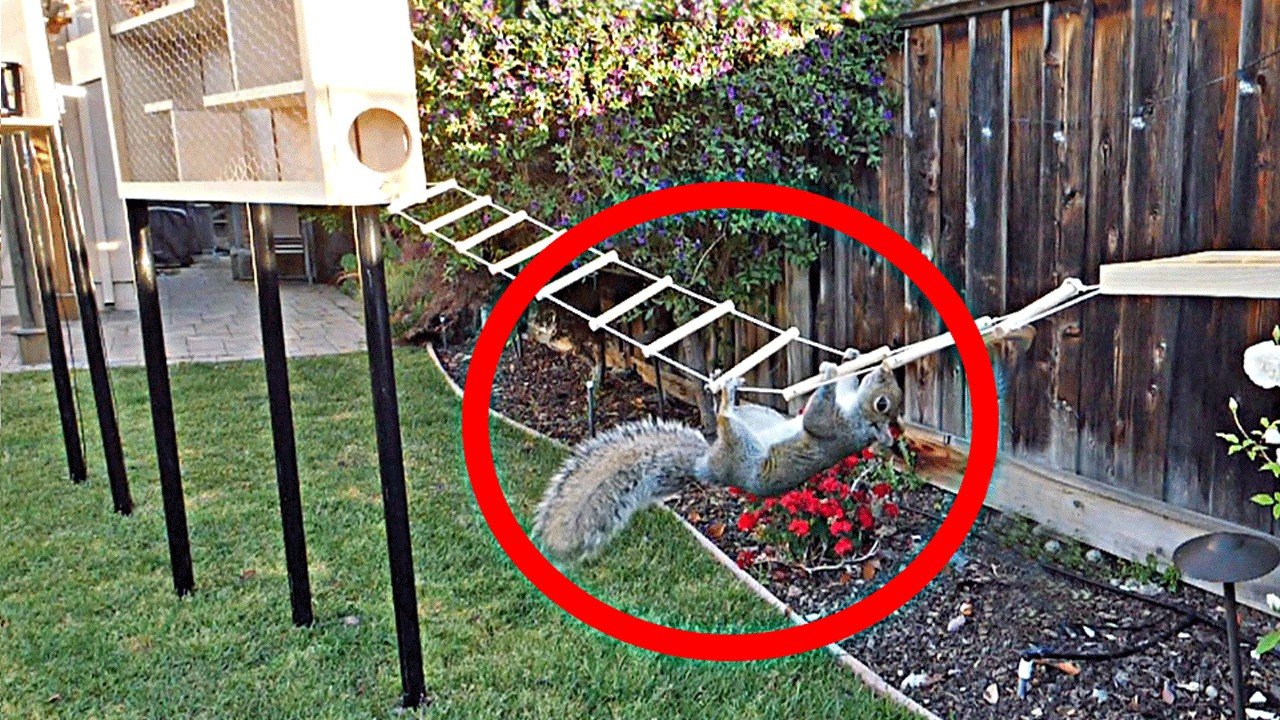
The course began at the sole entry column not coated in a slippery material, forcing competitors to climb it as the mandatory starting point. From there, Station One presented the Wobbly Bridge, a span anchored at only a single point on each end, creating a physics challenge identical to a tightrope. Station Two was the Thousand-Path Maze, a cognitive puzzle requiring spatial navigation. Station Three introduced the Spinning Wipers, a rotating obstacle inspired by the television program ‘Wipe Out’ but engineered to cause no injury. Station Four, the Matrimony Destroyer, featured a pressure sensor on its lower surface connected to a control unit, a signal transmitter, a solenoid coil, and a pneumatic piston – if any competitor stood on it for three seconds, they were launched back to the beginning of the course. Station Five was the Springy Wobbly Bridge, with a fresh walnut fixed to its center that the bridge could not support under a squirrel’s full weight. Station Six offered the Tourist Trap, a painted board created by Rober’s wife where a squirrel could pose for a commemorative photograph, incentivized with a walnut. Station Seven featured the Quad Steps, angled at 45 degrees with smooth bases. Station Eight, the Final Countdown – also called the Squirrel Catapult – was the last barrier before the bird feeder prize, launching any competitor who lingered longer than three seconds back to the start.
Rick, Marty, Frank, and Phat Gus Take the Course
Rick, weighing approximately 500 grams, was the first registered competitor. Intelligent but quick to panic, Rick required roughly one week of dedicated attempts before becoming the first squirrel to reach the prize. His caution served him well at the Matrimony Destroyer, where he avoided placing his full weight on the pressure platform for more than a fraction of a second. Marty, nearly indistinguishable from Rick in appearance and inseparable from him in daily life, followed closely behind, completing the course shortly after Rick’s breakthrough. Frank, also approximately 500 grams, was described as extraordinarily brave and somewhat reckless – he reached the Matrimony Destroyer no fewer than 12 times before progressing. Phat Gus, at 800 grams the heaviest of all four competitors, demonstrated a particular genius for the Thousand-Path Maze, navigating it with a speed that surprised Rober. Phat Gus also executed a celebrated leap of approximately three meters after Rober removed the middle base from the Quad Steps station, making it the standout athletic performance of the entire competition. A mid-course discovery revealed that Phat Gus, originally assumed to be male, was in fact pregnant, prompting Rober to immediately soften his commentary about her weight.
The Squirrel Catapult operated at 40 percent of its maximum pneumatic pressure, producing acceleration equivalent to half of Earth’s gravitational constant. High-speed footage captured each launched squirrel locking its gaze onto its intended landing point within 300 milliseconds, then using its forelimbs to control rotational momentum – extending them to slow rotation and pulling them in to accelerate it, the same angular momentum conservation technique used by competitive figure skaters.
The Engineering Behind the Build
Mark Rober, a former NASA engineer who worked on the Curiosity Mars rover, built the course over approximately one month alongside collaborator John. The squirrel-proof bird feeder at the course’s end dispensed a large volume of walnuts when a squirrel stood on its hidden pressure platform, simultaneously triggering a series of celebratory flags. Rober had conducted four separate seven-nut taste trials over one week to confirm that walnuts were the food squirrels selected first, making them the scientifically validated prize of choice. The complete course was filmed continuously using multiple fixed cameras, with Rober personally rising each morning between 6 a.m. and 10 a.m. – the window of peak squirrel activity – to conduct live observation from inside his home.
Squirrels are documented to live up to 20 years in favorable conditions, which means Phat Gus and her offspring could plausibly return to the same suburban yard for decades to come. Rober retired the course after one month of open competition and replaced it with a miniature picnic table, scaled for squirrels, where a small daily walnut ration is served each morning – a quiet acknowledgment that four small animals had more than earned their place at the table.