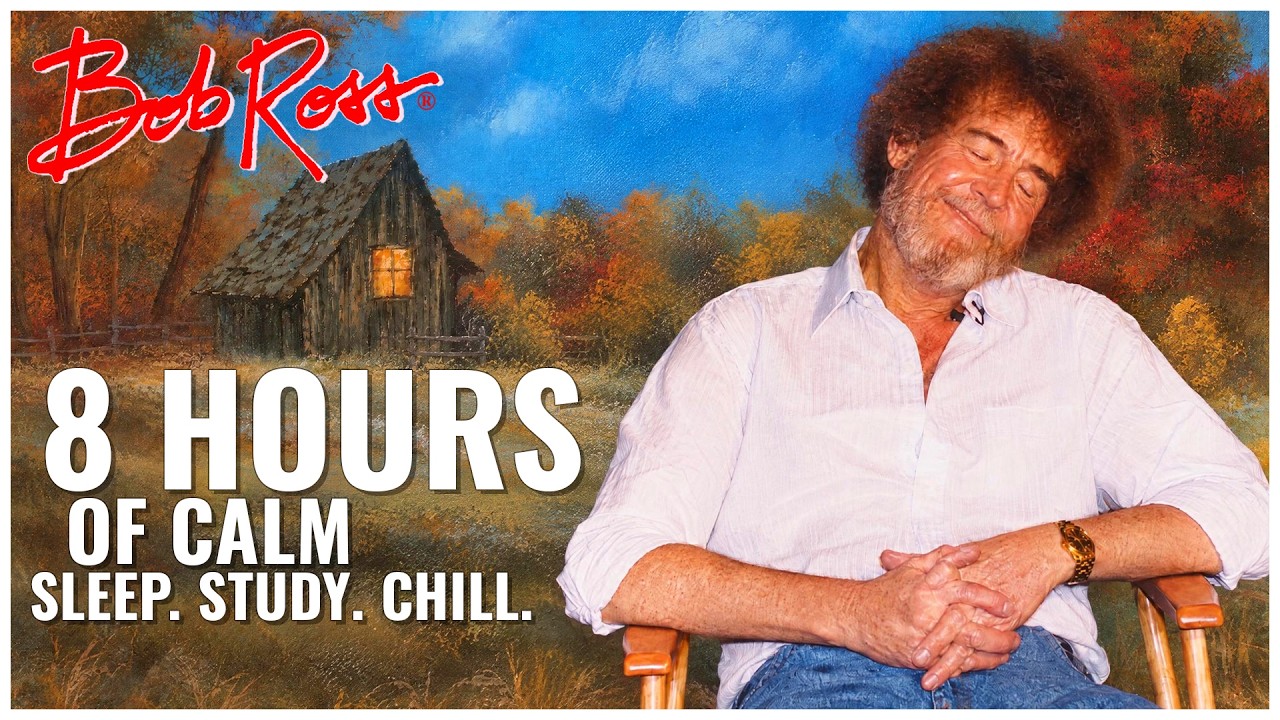
Bob Ross picked up his 2-inch brush, tapped a small amount of Indian yellow into the bristles, and said what he always said: ‘Let’s just have some fun.’ That single phrase, repeated across a full day of continuous painting, carries more weight than it lets on. For anyone who has ever stood in front of a blank canvas and felt the cold certainty that they could not do this, eight hours of Bob Ross is not background noise. It is a quiet, persistent argument that they are wrong.
The sessions move through autumn meadows, winter cabins, northern lights, seascapes, a covered bridge, a forest on a black gesso canvas, and a window-frame painting built around masking tape and contact paper. Each one begins in the same way: a wet coat of liquid white, a 2-inch brush, and a color decision that commits to nothing. The commitment comes later, and by then the painting is already half alive.
Where a stranger’s first brushstroke actually lands
The recurring practical fact across every session is the wet-canvas technique. Liquid white keeps the surface slick enough that a 2-inch brush can pull dark blue into yellow ochre without mudding either color, and that Prussian blue sky will naturally pale toward the horizon without the painter doing anything deliberate. Ross’s own description of it was more useful than any technical explanation: ‘a thin paint will stick to a thick paint,’ he said, returning to the phrase so many times it became a kind of refrain. It is the single rule that makes everything else possible, including the snow, the mist, the reflected trees, and the foam crashing across a seascape built almost entirely with a palette knife.
The knife work across the seascape session is where the method gets strangest and most convincing. Ross scraped the rough outline of a wave directly into thick paint, rubbed the ‘eye’ of the wave smooth with cadmium yellow until it looked like sunlight bending through water, then splashed white across the crest with what he described as sound effects included: ‘boom, make little sound effects when you do this, it really helps get you in the mood.’
The squirrel in the basement and the 12-year-old selling paintings
The painting sessions are interrupted, warmly and often, by the lives that run alongside them. One squirrel, named Squirrely Girly Brown, had been living in Ross’s basement for four or five years after a veterinarian told him she would die within six months from epilepsy. Ross’s response to that prognosis was simple: ‘I didn’t tell her.’ Peepod, a pocket squirrel released more than a year earlier, still scratched on the back door of his kitchen each day, walked in, picked a nut from the storage spot it had memorized, and left. A moose weighing around 1,000 pounds grazed in the yard of his home near Fairbanks two or three times a week. A nighthawk with one wing sat on the easel shelf during one session. Two baby flying squirrels named Slim and Trim spent another session in his shirt pocket.
The human stakes are just as specific. He described 12- and 13-year-olds selling their paintings and what that money actually does: ‘It’s not the money. The money means nothing. But what it does to a young person, it’s ego is unreal. That somebody would spend their hard-earned cash on something that you saw in your mind and you put on a piece of canvas with your hand.’ His son Steve sold his first painting at 12 and, in Ross’s telling, had not really worked since. A woman in Boston painted using this method and was blind. At an instructor reunion in Daytona Beach, Florida, more than 150 people showed up and spent a week painting together in what Ross described as working them to death, with pride.
What remains of the old fence
In one of the final winter scenes, a broken fence appears near a cabin at the edge of a snowy path. Ross scraped its posts in with a palette knife, left most of the rails gone, and said it was ‘like me, it’s had a hard, tough old life.’ He put a highlight on one post so it would stand out, added liquid white to suggest snow collecting on the crossbeam, and moved on.
The fence posts are still standing in that painting, rough and slightly crooked, holding a few remaining rails and nothing else, out in the cold at the edge of someone’s world.