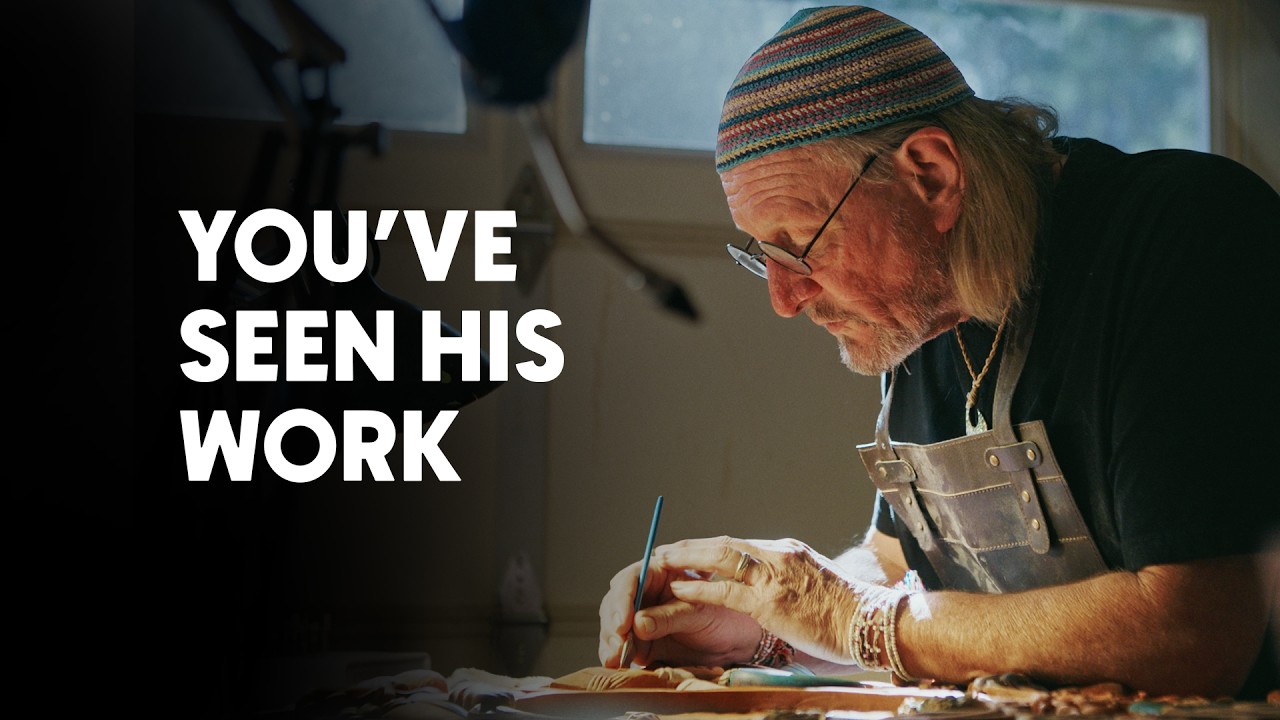
The two carving tools are worn down to about half their original length after nearly 50 years of daily use, but the Disney Imagineering artist who holds them still reaches for them first. For anyone who has ever been told they have a gift, or told themselves they do not, this self-taught woodcarver’s story cuts straight through both assumptions. His name is never pinned to a plaque at Disneyland, but his hands shaped the entry signage for Indiana Jones Adventure, the woodwork inside Many Adventures of Winnie the Pooh, and a free-standing Mickey Mouse statue that only a handful of artists have ever been asked to create.
How a bike ride to Canada turned into a career at Imagineering
He was 20 years old, had no formal education, and had left Los Angeles on a bicycle with Canada as a loose destination. He made it as far as Lake Tahoe, fell in love, and never left. When his girlfriend announced she was pregnant, the bass guitar he could play a little was not going to support a family. A friend named Marty mentioned he was opening a restaurant and needed a carved sign. Asked whether he knew how to carve, the answer came back yes, a clean lie. He borrowed 30 dollars from his father, bought his first two tools, and taught himself by ruining things until he did not.
He sent packets of photographs and cover letters to Walt Disney Imagineering for what felt like a very long time. Nothing came back. He stopped. Then a senior graphic designer at Imagineering went to lunch at a restaurant he had never visited before, spotted the carved work on the walls, got the phone number from the manager, and called. Not one of the photographs had ever been seen. That lunch, that detour, that phone call: that was the break. Indiana Jones Adventure came first, the blueprints unrolled on a boardroom table in front of a man who was quietly hoping no one would notice he had no idea what he was doing.
The burnout nobody talks about when the work starts selling itself
Decades in, the commissions kept arriving and something quietly collapsed. He describes it as world-class burnout, traced back to a period when the work became about cranking output and making money. He knew he could get away with less than his best and clients could not tell. Shortcuts accumulated. Depression followed. The diagnosis he eventually landed on was precise: he had stopped learning. He had stopped pushing.
He put it plainly: ‘Everything I do, I’m trying to push it a little bit harder, because it makes it interesting. It’s fun. You don’t want to lose that fun anymore.’ He now refuses to commit to deadlines for clients, a policy he acknowledges is genuinely difficult for some people to accept. Working against a clock, he says, means working toward done rather than working toward best.
The teaching arrived late, suggested to his wife Marisa as something he wanted to try. He had no expectation anyone would show up. The first date sold out. Then the next. Then two at once. Students arrive with a baseline confidence because they know his resume. What they find inside the workshop is someone who meets each person exactly where they are, guiding every student differently, because he remembers precisely what it felt like to be certain he had no talent at all.
His central argument, refined over nearly five decades: talent is mostly a myth. What people are actually observing when they see someone excel is persistence, repetition, and time. Those are not gifts. They are choices, and he points out they are the one asset fully within a person’s control.
He bought his land for 6,000 dollars, received a building permit in 1971 for 200 dollars (a permit that would cost roughly 70,000 dollars today), and has never paid rent or carried a mortgage. He still plays bass guitar and sings, mostly blues, jazz, and soul. He walks daily and describes it the same way he describes carving: a rhythm, a pulse, a Zen quiet where the mind settles and sometimes it feels like the Earth is walking him.
The two tools that started with a 30-dollar loan
Somewhere in the workshop, the original two carving tools sit worn to roughly half their starting length, sharpened back so many times over so many years that the steel has visibly retreated. He has never replaced them.
He held one up and said simply: ‘This is my soul.’
The Indiana Jones Adventure sign is still the first thing a visitor sees walking into that attraction at Disneyland, shaped by hands that learned the work by getting it wrong, borrowed the first tools on credit, and never did make it to Canada.