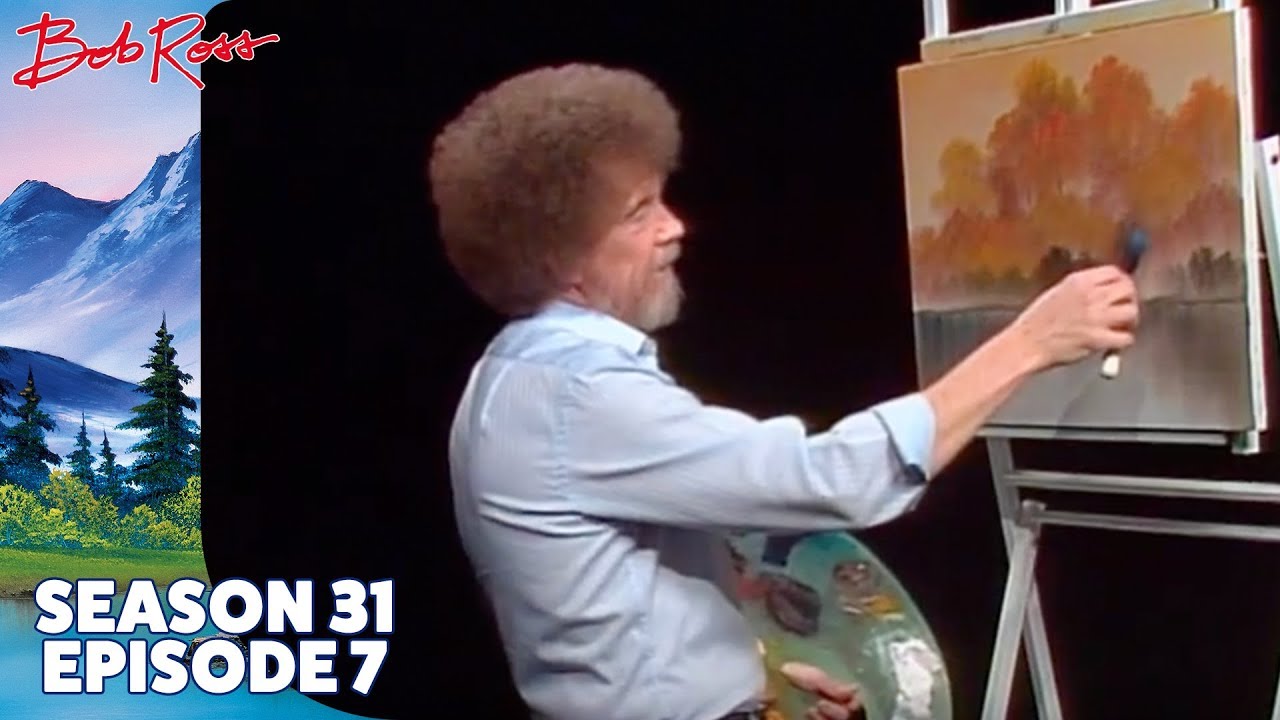
Bob Ross picks up his two-inch brush, presses a small amount of bright red and cadmium yellow into the bristles, and sets out to do something he has never done on air before: paint the very picture that greets viewers at the start of every episode. The animated opening that millions have watched without a second thought turns out to be a real, physical canvas, built from scratch using the same wet-on-wet method he teaches every week. For anyone who ever wondered exactly how that warm autumn scene came to life, Season 31, Episode 7 is the answer.
The sky, the trees, and a brown nobody expected
The canvas is an 18-by-24-inch pre-stretched double-prime surface, already coated in a thin layer of liquid white so the paint can move freely. The sky goes on first: a quick pass of orange-yellow that looks darker than the finished color should be, because the liquid white beneath it pulls the tone lighter as the brush works down. Then the background trees arrive, dozens of them, built with a single technique. Ross makes a large pile of brown by mixing sap green and alizarin crimson in roughly equal parts. He credits Audrey Golden, one of his instructors based in Florida, with naming it ‘Christmas brown because you use red and green.’ Loaded into a two-inch brush and tapped lightly against the canvas, that one color builds an entire treeline in minutes.
A liner brush, a number two script liner, carries the same brown color thinned with paint thinner until it flows like ink. Ross turns the bristles until they come to a sharp point, then draws in trunks, stems, and limbs wherever the composition calls for them. A little sap green here and there picks out the trees that Jack Frost has not yet touched. ‘He gets them all sooner or later,’ Ross observes. ‘That rascal’s sneaky.’
Building the covered bridge one honest layer at a time
The bridge itself goes in with van dyke brown and dark sienna, laid out in basic shapes the way Ross would frame a cabin, except with a large opening at the front. Highlight color comes from brown mixed with white, yellow, and a touch of red, applied with a small roll of paint on the knife to pick out individual boards and the suggestion of rafters. A gray mixed from black and white goes on the roof, barely grazing the surface. To show depth inside the tunnel, Ross simply changes the angle of his strokes, and the interior opens up. Liquid white suggests the road disappearing into the darkness.
A small detail grounds the whole painting in a real place. Ross mentions filming a show in Muncie, Indiana, where covered bridges are still standing across the region. A nearby town called Matthews holds a covered bridge festival every year, one he has painted at several times.
The water below the bridge is mostly implied: vertical strokes of the dark brown pulled straight down, then a knife cut of prussian-blue-tinted white across the surface. Ross is direct about why the direction matters: ‘If you make these lines go at an angle, your reflections just absolutely will not look right.’
The engineer nobody talks about
The animated countdown that emerges from a gap in the painted treeline, the one that sounds, as Ross puts it, ‘like an old car,’ is the invention of Jerry Morton, one of the show’s engineers. Ross credits Morton with coming up with the opening concept, adding that Morton is ‘like the rest of us, he’s about half crazy, and that’s what it takes to work here.’
At the end, Ross loads his liner brush with thinned paint, signs the corner, and declares it done. The same canvas that opened the episode now sits finished on the easel.
The painting that started it all, built from two colors of paint mixed into a Christmas brown nobody had a name for yet.