Jeff crouched under a rotisserie-mounted 1973 Alfa Romeo 2000GTV, staring at bare steel that had just come back from the sandblasting shop looking far worse than he had hoped. For anyone who has ever looked at a project and asked whether the bones are good enough to build on, this moment is the one that decides everything. Jeff, a self-taught firefighter working on this build between shifts, had paid less than $10,000 for the car two years earlier from someone who had already abandoned the restoration. Now he was about to find out if the chassis could carry a dream considerably larger than anything it was designed for.
When a Ferrari V8 meets a fifty-year-old Italian body
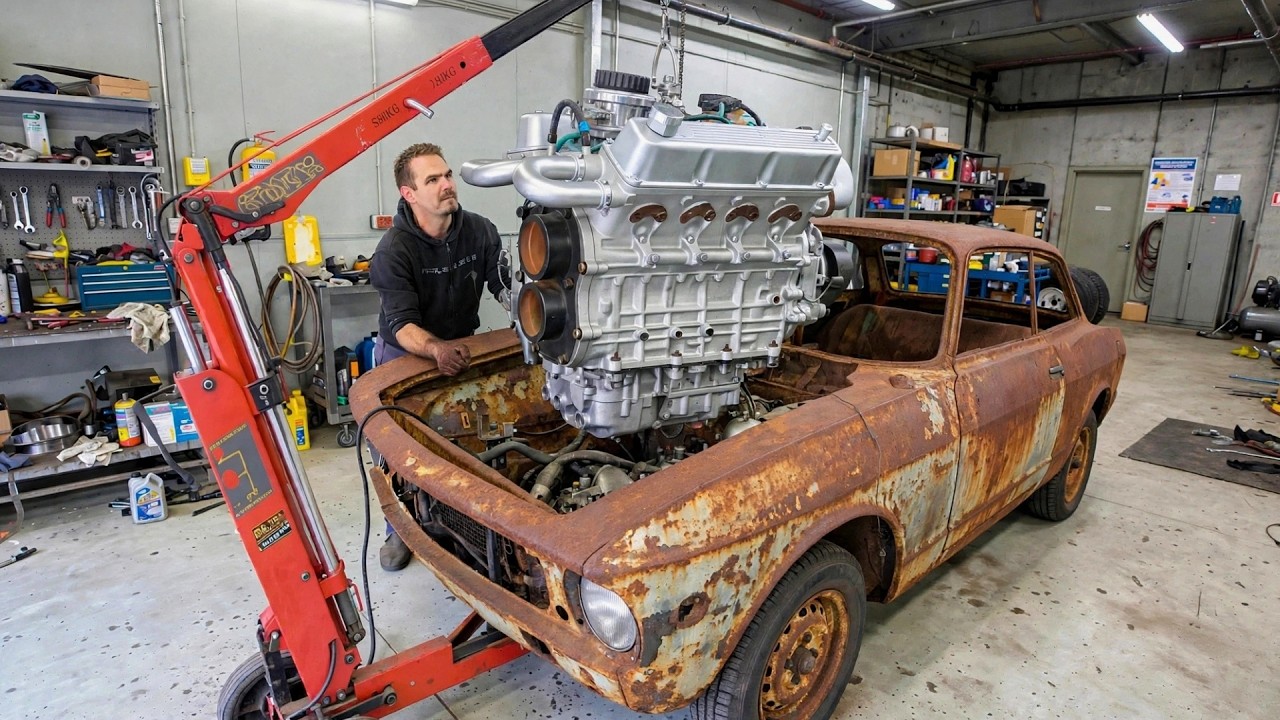
The engine sitting in the corner of Jeff’s garage was not a modest upgrade. Sourced from a Ferrari 360 Modena that had been wrecked in Japan, the 3.6-litre V8 came with double the cylinders, roughly twice the displacement, and nearly four times the horsepower of the Alfa’s original motor. At over $15,000, it cost more than the entire rest of the build combined, and a crane scale comparison revealed it weighed 60 lb more than the factory engine. The Subaru BRZ manual gearbox Jeff sourced for $500 added another 20 lb. Australian road laws then tightened the fit further, requiring 10 mm of clear space around the entire motor inside the engine bay.
The first real test of whether the V8 would physically fit was, as Jeff put it, ‘the scary part.’ He had done the measuring on paper, but lowering a Ferrari engine into a narrow 1970s Italian shell for the first time is a different thing entirely. The engine cleared the bay, but sat too high for the bonnet to close. Jeff shortened the intake by 2.8 inches, the maximum he could remove without badly hurting performance, then discovered that still was not enough. The solution was a custom bonnet bulge, kept deliberately small because at 190 mph a large protrusion acts like a wall against oncoming air. He welded extra bracing underneath the sliced hood to restore the structural strength the cut had taken away.
Connecting the Ferrari engine to the Subaru gearbox required a custom adapter plate, designed with his friend Chris in a 3D modelling program and sent to an engineering company to machine. When Jeff slid the gearbox into place and the shaft sat dead centre, he did not hide his relief: ‘That is a big win. I am stoked. We actually have a Ferrari engine adapted to a Subaru gearbox.’
Four years of problems solved with rope, logs, and one very tense timing belt
The build forced Jeff into territory far outside mechanical work. He planned the wiring loom using rope run through the chassis, then laid flat on a table to turn a three-dimensional routing problem into a two-dimensional map. He shaped a curved body panel using a log and a nylon hammer rather than expensive workshop machinery. He built a custom rotisserie rather than pay the $3,000-plus retail price. When a loose metal box slipped into the engine bay during the first start attempt and shredded a timing belt, Jeff discovered, with visible disbelief, that the belt had held just long enough to keep the engine in time. ‘I cannot believe what I am seeing,’ he said, exhaling slowly over the intact right-side belt. Ferrari’s own app, which reads belt tension through sound frequencies, confirmed the replacement was set correctly before he tried the key again.
For the interior, Jeff chose Alcantara and layered in charcoal Ferrari leather in a Daytona-style pattern, carrying the Ferrari identity beyond the engine bay. The exterior colour is Giallo Fly, Ferrari’s iconic yellow, striped with two thick silver bands. A glass panel cut into the bonnet keeps the Ferrari logo visible even when the car is closed.
After a formal engineering inspection that could have forced changes to years of completed work, the Alfa passed. It was registered, plated, and driven on public roads for the first time.
The crease in the roof
During a routine final check, Jeff lifted the car without accounting for a beam directly above it and pressed a crease into the freshly painted roof. He decided to leave it there.
There are other Alfas and there are other Ferraris. Jeff pulled away from his garage in the only car that is both, built entirely by one set of hands over four years, and the roof carries the proof.