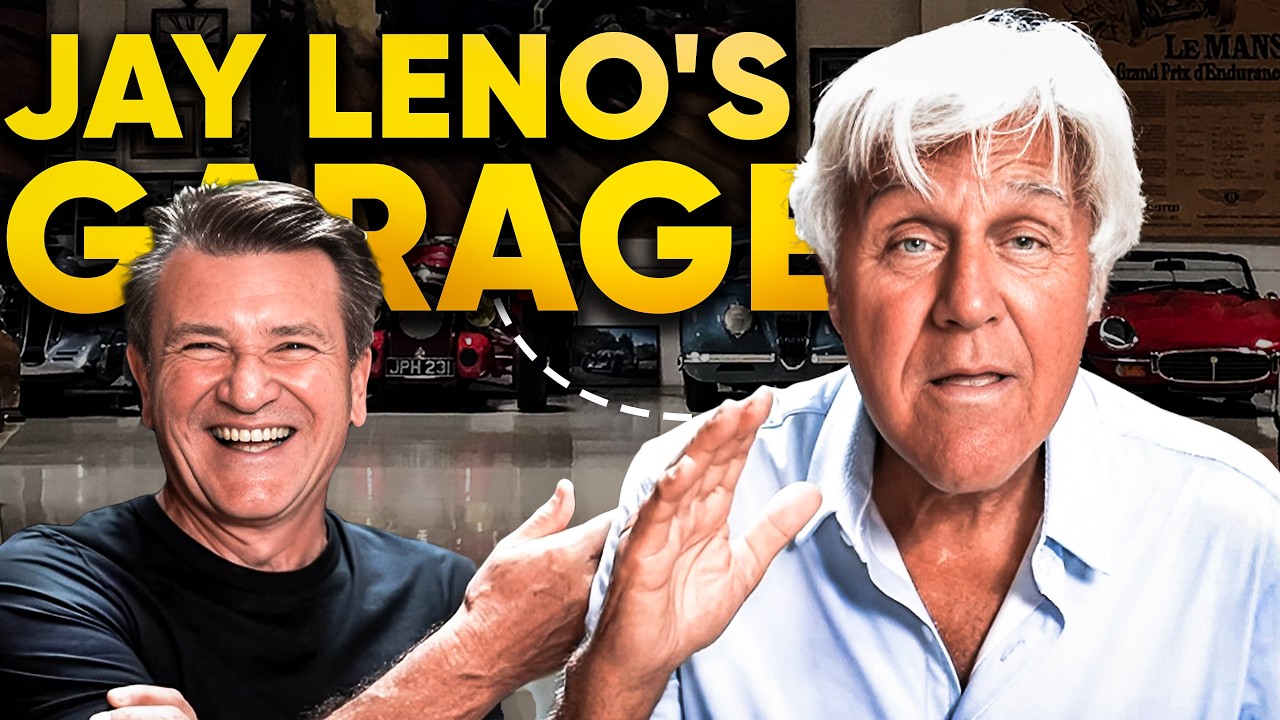
The McLaren F1 sits near the back of Jay Leno’s sprawling Burbank garage, and it looks almost unremarkable next to the louder, flashier machines surrounding it. That ordinariness is the point. When Leno first got the car, he drove it to McDonald’s and parked in the lot. Now the last offer he received for it was 20 million dollars, and a comparable example recently sold for 24 million. For anyone who has ever cared about what a car can be, this place is something close to a living archive.
Shark Tank investor Robert Herjavec spent a day walking the collection with Leno, and the two moved through decades of automotive history the way old friends wander a neighborhood, stopping wherever something tugged at them.
The Lamborghini Dean Martin’s son cracked and walked away from
Leno’s favorite corner of the garage starts with a Lamborghini Miura that Dean Martin bought new in 1967. Martin gave it to his son Dino to drive to school. Dino cracked the oil pan, and being a Lamborghini in the 1960s, there were no parts available unless you spoke Italian and had a relationship with the factory. A friend of Leno’s acquired it thinking he could fix it, couldn’t, and let it sit for about a year before his wife suggested giving it to Leno. It was, in Leno’s words, literally given to him because it wasn’t worth anything. One example of the same model recently sold for 4.9 million dollars.
A few steps away sits a 1962 Maserati in deep blue. When Road and Track originally reviewed it, the writer opened with the question of why anyone would need 220 horsepower. The car was dubbed the Italian Rolls-Royce, with a rear seat that slides back far enough to accommodate a basketball player. Leno has about 60,000 to 70,000 miles on his daily-driven Countach.
Then there is the McLaren F1. Gordon Murray, the designer, had the Kenwood stereo unit rebuilt with aluminum-based components to save 9 to 12 ounces. The titanium toolkit that comes with the car weighs almost nothing and floats in the hand. Leno held it up and noted the obvious: ‘The idea is you’re actually going to fix this car by the side of the road with this toolkit. Keep dreaming.’ The car remains the fastest normally aspirated production car ever built, reaching 241 miles per hour with no turbocharger, no supercharger, and no carburetor.
A Ford Bronco that arrived by tow truck as a retirement joke
Not everything in the collection carries a multi-million-dollar valuation. A 1968 Ford Bronco near the entrance came from Craig Ferguson, who had it towed to Leno’s Tonight Show parking space on his last day as host with a note suggesting he’d have something to work on in retirement. The Bronco had previously belonged to someone else and was, in Leno’s description, a piece of junk. It now runs a Shelby GT500 motor producing around 800 horsepower on a modified chassis.
Elsewhere in the garage: a Rolls-Royce Spectre electric sedan that Leno argues is exactly what a Rolls-Royce should be, a Ferret tank on the same wheelbase as a Porsche 911 that is fully street legal and street driven in Burbank, a 1914 Fiat with a 12-cylinder aircraft engine featuring four valves per cylinder and an overhead cam, and a custom-built car running a 27-liter Merlin aircraft engine pulled from a Spitfire, producing around 1,100 horsepower, with an intake manifold printed in-house.
Asked about the philosophy behind collecting rather than selling, Leno was straightforward: the cars he wants are the ones he drives. The McLaren P1 in the collection has 10,000 to 11,000 miles on it. The Spectre gets used regularly. The Miura came to him for free and is now worth millions, but the value was never the point.
The portable record player that named a company
On a shelf near a row of early automobiles sits a hand-wound portable record player designed to be taken on car picnics before in-car audio existed. It uses no electricity, only vibration. Leno still isn’t entirely sure how it works. The device is called a Motor Victrola. Its name, shortened and adapted over time, became Motorola.
Herjavec left Burbank having learned the origin of a brand he has probably owned a product from, and having watched the world’s fastest normally aspirated car get described the same way Leno describes everything else in the garage: as something he actually uses.