On the edge of the Makgadikgadi salt pans in Botswana, a small Opel was skipping across a crust of prehistoric fish and mineral sediment, wide as Portugal and almost completely lifeless, while a Lancia and a Mercedes sank wheel-deep into the ooze around it. No car had ever crossed these flats before. The stakes, as the crew noted repeatedly before setting off, were not metaphorical: run out of water, break down beyond rescue, run out of food, and you die. What followed was one of the most chaotic, funny, and genuinely dangerous driving challenges ever assembled, anchored by a cast of cars that became characters in their own right.
When the car becomes a crewmember
The preparation alone told the story. In camp the night before the crossing, weight shedding began in earnest. Fuel fillers were questioned. Hub caps were debated. Seats were hefted and tested. Richard Hammond circled his little Opel, named Oliver, muttering that he needed every single part of it. Jeremy Clarkson watched and diagnosed the problem immediately: ‘He’s formed an emotional attachment. It’d be like saying to him, could you cut bits off his wife?’ By morning, James May’s car had shed its doors. Clarkson’s Lancia Beta Coupe had been stripped to what he christened the ‘Superleggera’ configuration, and Hammond refused to remove so much as a bolt from Oliver.
The vice president of Botswana arrived in a motorcade and was visibly astonished to learn what was being planned. ‘I’ve just never known anybody to go across in a car,’ he said. Then he smiled, wished them luck, and left. They set off into nothing. The horizon was so flat and so vast that, as Clarkson put it, you could see the curvature of the earth. The Lancia dug in first. Then the Mercedes. The UAZ camera truck proved so useless at towing that the entire crew had to haul by hand. Oliver kept moving.
The cars that defined the rest of the countdown
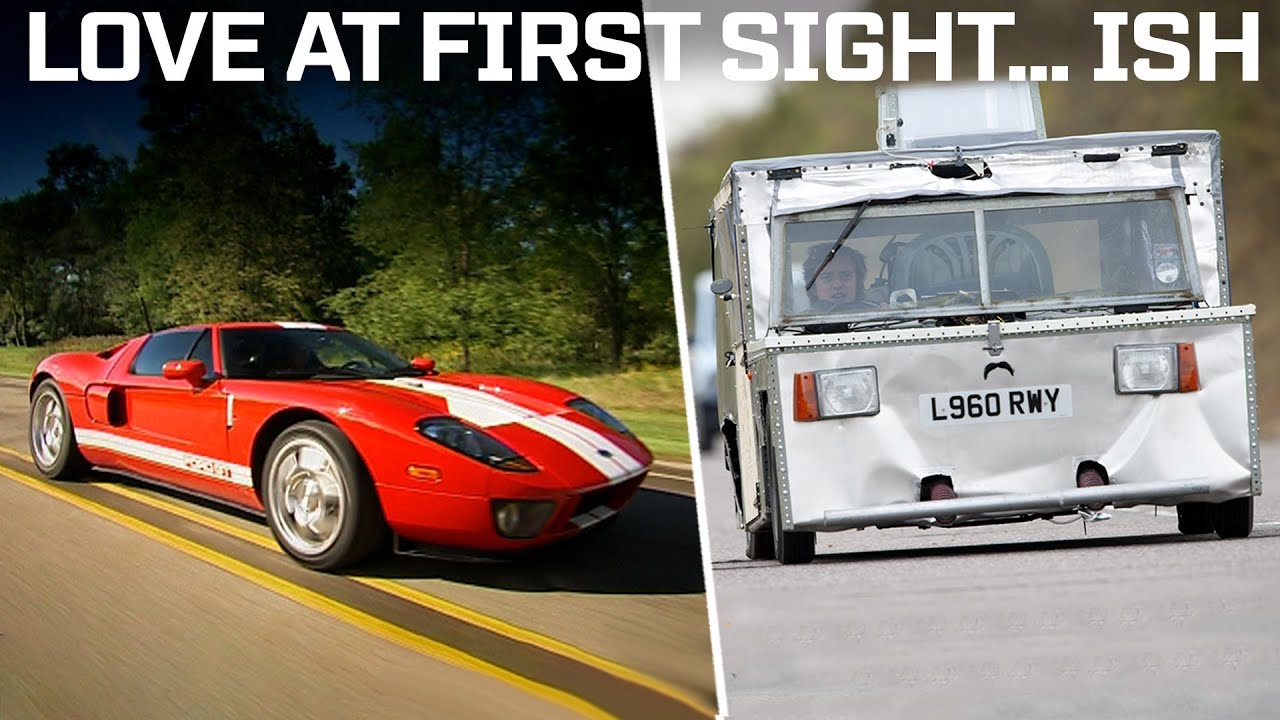
The Makgadikgadi crossing was just one thread in a longer reel of automotive tributes. In Detroit, a city Clarkson described as a place where ‘God rested on the seventh day and Beelzebub popped up and did this,’ he found the Ford GT and declared it the first proper American supercar. It offered 500 brake horsepower from a supercharged 5.4-litre V8 lifted from a pickup truck, handled like a Lotus, shocked like a Lamborghini, and cost less than 100,000 pounds, undercut the Ferrari 360 by 8,000 and the Lamborghini Gallardo by 17,000. A blue-collar car hunting aristocrats.
The Ford Focus RS and the Renault Megane R26R went at each other in a straight argument about whether power or lightness wins. The Renault had lapped the Nurburgring in 8 minutes 17 seconds, faster than any other front-wheel drive car at the time, on 227 horsepower and a stripped-out cabin with no radio, no soundproofing, and a single airbag. The Focus had 300 horsepower and voice-activated stereo. They raced Le Mans-style, sprinting to the cars from a distance. The argument was never fully resolved.
A Dodge Viper SRT-10, rebuilt with an 8.3-litre V10 producing 500 brake horsepower, came with warning stickers confirming the exhaust pipe gets hot and clarifying that the bar behind the seats is not a roll bar. Clarkson called it ‘as stupid and wonderful as owning a pet elephant.’ A Pagani Zonda had to be partially disassembled to escape a Paris car park. A Bugatti Veyron raced a light aircraft from Italy to London with Hammond and May landing in Lille and sprinting to a Eurostar while Clarkson drove to Calais needing the toilet since Italy. The Moon Buggy Mark II, which costs $4.5 million, crabs sideways on 12 wheels and contains memory foam beds, an iPod dock, and a space toilet.
And then there was Jeff. A homemade electric car built on a TVR Chimera chassis with a milk float motor, two batteries, aluminum bodywork hammered out from garage door panels, three-abreast seating with no headroom, and a tape player. Jeff reached 10 mph, broke down repeatedly in central Oxford, was escorted by police out of a pedestrian zone, and ran out of charge on the A34 dual carriageway at rush hour.
Oliver, still crossing
Kubu Island rose out of the white nothing about a third of the way across: ancient baobab trees on a rocky outcrop, the remnant of what was once an actual island in an actual lake. Hammond pulled up next to one and went quiet. ‘It is just about the most astonishing place I’ve ever been,’ he said.
Oliver made it across. The Lancia needed a nudge that Clarkson described as ‘a crash.’ The Mercedes needed the camera crew. The rotted prehistoric fish, which is what the black gunk under the salt crust turned out to be, jammed the Lancia’s rear wheels solid. Oliver kept going.
The baobab trees at Kubu Island still stand on that rocky outcrop in the middle of the flats, unchanged, surrounded by salt and ancient lake bed, exactly where they were when Hammond saw them from the window of a car that, by rights, should have been abandoned miles back.