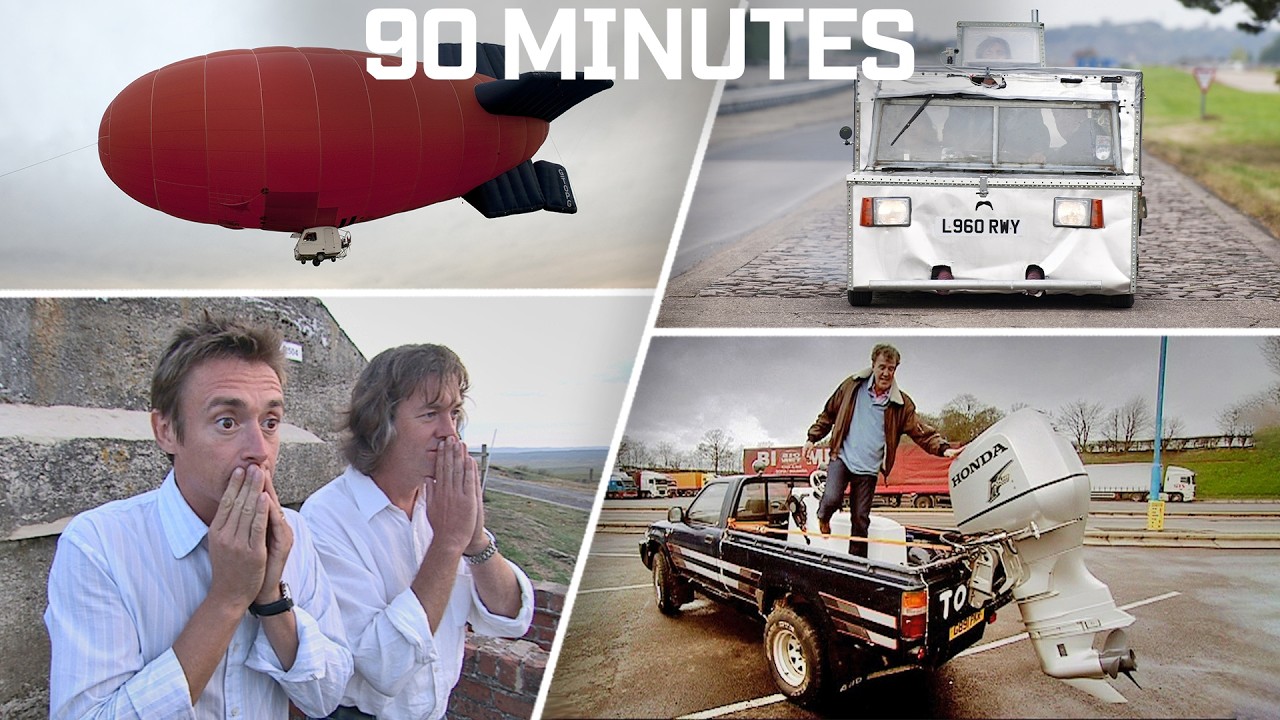
At a military base whose location was classified, a Reliant Robin sat strapped to 8.5 tonnes of rocket thrust, pointing skyward on what amounted to a scaffold held down with concrete blocks and furniture removal straps. If the premise sounds unhinged, that was the point: Richard Hammond, James May, and Jeremy Clarkson had spent weeks building the thing, and now a model aircraft pilot named Steve, who had politely declined their offer of a bunker, was about to glide it back to earth. Whether any of it would work was, as Hammond put it, ‘just words.’
This particular stretch of Top Gear Classic is less a car show than a collection of ambitious ideas failing in increasingly spectacular ways, with three men who genuinely seem to enjoy the chaos they create. The Porsche challenge, the homemade electric car, the stretch limousines, the amphibious vehicles, the caravan airship: each segment escalates the previous one, and the throughline is always the same. Someone has a plan. The plan is flawed from the start. Nobody admits it until something catches fire.
Three men, three Porsches, and one very disappointed judge
The sequence that opens the compilation sets the tone cleanly. Each presenter bought a Porsche 924 or 944 for £1,500 and modified it, knowing a judge from the Porsche Owners Club of Great Britain would assess the results. May sealed interior components with bathroom sealant and fitted a cabinet door handle as a replacement for the missing original, explaining to the judge that the correct part was ‘a very, very difficult component to get hold of these days.’ His secret weapon was a spotless engine bay, cleaned by hiring a man to do it. Clarkson painted large portions of his car with blackboard paint, aiming for the look of an old Capri with a black bonnet, then admitted he overshot and just kept going. Hammond lowered his car on new springs and lower-profile tyres, called it a track car, and had Gulf racing flames painted on the bodywork with help from an art college contact.
The Stig lapped all three. Hammond’s came in at 1:43, May’s at 1:45, and Clarkson’s at 1:45 as well, though by then May’s gleaming engine bay had been comprehensively ruined by oil smoke during the run, which Hammond noted was ‘all he had.’ The skidmark challenge, the Elevenses, saw May lay down 31 feet, Hammond reach 35 feet, and Clarkson attempt an ‘Asian number 11’ with an automatic gearbox that, as he acknowledged, ‘can’t do smoking starts.’ His effort was disqualified. When final scores arrived, Hammond stood on minus 1,471 after failing to sell his car at all. Clarkson finished on minus 73. May sold his 944 for £1,400, losing £100 on the deal. Hammond, however, had dismantled his car entirely and sold it as furniture: the engine became a coffee table, the seats were mounted with their electric motors still inside so they could slide, and he shifted the lot at a market for £600. ‘You’ve turned your car into a living room,’ Clarkson said, sounding genuinely gutted.
Geoff the electric car nearly brought Oxford to a standstill
The homemade electric car segment is where the ambition-to-competence ratio reaches its peak. May sourced a milk float motor for £20 and £100-worth of batteries. Hammond stripped a TVR Chimaera for its chassis, having paid £5,000 for it. Clarkson, who was in charge of bodywork and interior, built his design around a mood room hung with images of big cats, jet fighters, and the actor Peter Bowles. A section of garage door featured prominently in the finished body. The car, named Geoff, seated three abreast, with Hammond in the middle, his head in what he described as ‘a plastic box.’ Top speed was nearly 10mph.
They took Geoff into Oxford, a city that, as Clarkson noted, ‘loathes the motorcar.’ The indicators, when used, noticeably drained power. The motor cut out on corners, forcing them into a buses-only zone. They ran out of charge entirely in moving traffic, pulled into a residential street, knocked on a door, and asked to borrow an electrical socket. Charging fully, May explained while holding the cable, would take six or seven hours. His arm was already aching. ‘Those are the facts of battery-powered cars,’ he said. ‘We know that.’
The moment the Reliant went up
The rocket launch is the segment the whole compilation builds toward. The Reliant Robin orbiter attached to its fuel tank and solid rocket boosters was, by any measure, an extraordinary object. When the ignition sequence counted down and the Robin lifted clear of the pad, the cheering from all three was unscripted and loud. It climbed. It looked, briefly, like it might actually work. Then the orbiter failed to separate from the main body on cue, came down still attached, and hit the ground. Steve the pilot, who had built the recovery system and declined a bunker, watched it go.
Clarkson, assessing the wreckage, observed that the whole thing had ‘only one major flaw.’ He said it the way a man does when he already knew what the flaw was and built it anyway.
The caravan that nearly entered Norwich Airport’s controlled airspace
May’s airship caravan, 125 feet long and carrying 110,000 cubic feet of hot air, had a top speed of 17mph. With a headwind above 13 knots, it went backwards. It drifted into the controlled airspace of Norwich Airport while a KLM Cityhopper was on the ground nearby. A police helicopter was dispatched. May’s radio communications during this period included the word ‘cock’ on at least two separate occasions. He eventually landed at a caravan site he was not certain he had booked, came in sideways, and hit the ground hard enough to qualify as a controlled crash. Hammond, driving the Lamborghini Gallardo Balboni that was supposed to meet him there, heard nothing about it on the radio and assumed everything was fine.
The Gallardo, priced at £163,000, was 18 grand more expensive than the standard four-wheel-drive version, despite being simpler in almost every respect. Lighter, rear-wheel drive, manual gearbox, ordinary steel brakes. Hammond called it ‘Lamborghini’s punk album.’
A coffee table in a market stall
Somewhere in the background of the Porsche sale segment, a ruined engine block with a flat surface on top changed hands for an undisclosed amount, now serving as furniture in someone’s living room. The seats went with it, still capable of sliding back and forth on their original electric motors.
Hammond walked away with more money than he started with. The engine was the most valuable part, he said. Which was, given everything, probably true.