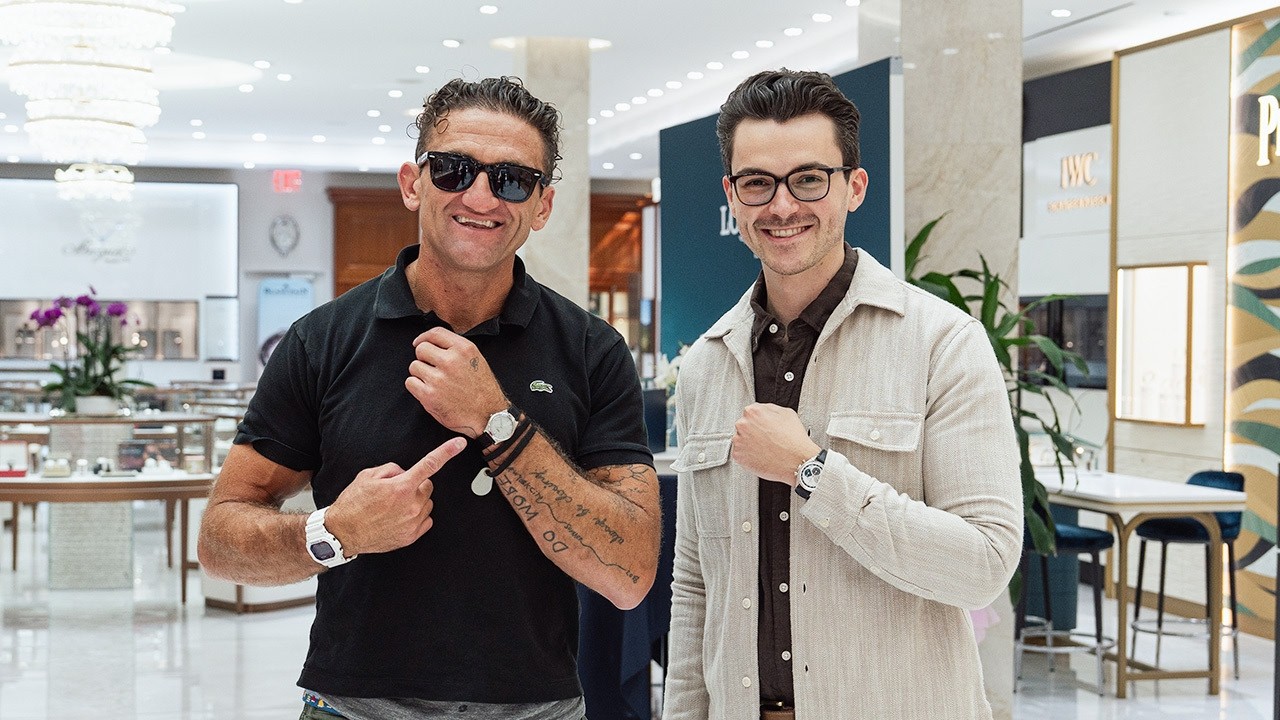
Casey Neistat walked into Carpe Diem and Co. in Flushing with a photo of his wife’s wrist on his phone and a nine-day deadline before her birthday. The photo told the whole story: a Casio F91W sitting next to a Bulgari Serpenti loaded with diamonds. That pairing, more than any spreadsheet of preferences, was the brief. What followed was two hours of enthusiastic rejection, one FaceTime call that went sideways, and an ending nobody in the room had predicted.
When the birthday gift became a self-portrait
Teddy Baldassarre had arranged the shopping trip at Carpe Diem and Co., a second-generation watch store that used to be a bank, with Derek on hand to pull cases. The mission was clear: find something for Candace. But Casey arrived carrying a well-documented personal philosophy. He wears G-Shocks because, as he put it, they are the only watches that have never failed him, no matter how hard he beats them up. He owns a Rolex he has never figured out how to fit into his life. He crashed a Phantom 4 the previous day. The word ‘precious’ is a liability in his hands.
Cartier got ruled out fast. Candace already owns a Santos, possibly two, and a Tank. Omega’s Railmaster, a discontinued 40mm tool watch from 1957, caught Casey’s eye in about thirty seconds. ‘Let’s just delete everything so she never sees this,’ he said, laughing, as it became obvious he was shopping for himself. Grand Seiko came out next. The spring drive mechanism, accurate to within 20 seconds a year and powered by the wearer’s own motion, landed well as a concept. The execution, polished indices cut by a single artisan in Nagano Prefecture, did not. Too shiny. The IWC Mark 20 with its RAF pilot heritage from 1948 looked right on paper until the metallic bracelet disqualified it. Casey runs. A metal bracelet means no running.
A FaceTime call to Candace, framed as a casual request for her opinion, produced the most efficient verdict of the afternoon. Asked what she looks for in a watch, she said her Rolex carries meaning because she bought it with her mother in Switzerland. Everything else is noise. Asked about shopping for something new, she said: ‘I don’t think you should shop for new.’ Casey spread his hands at the camera. ‘I told you guys.’
The $275 watch that ended the argument
Teddy and Derek had something in reserve. Before Casey arrived, they had quietly pulled two watches they thought might work, and the first one they showed him was a Seiko nicknamed the Captain Willard after the Martin Sheen character in Apocalypse Now. It has an olive dial, a distinctive turtle case, and a crown positioned at 4 o’clock instead of the standard 3 o’clock so it does not dig into the wrist during physical activity. Seiko has since discontinued it.
Casey was unmoved until Teddy mentioned the film connection. ‘I felt nothing until you mentioned Apocalypse Now,’ he said, and then immediately wanted to fact-check the detail on his phone. He found the reference. The watch is $275.
Then Derek brought out the second reserve piece: a Seiko from the Essentials collection, built for visually impaired wearers, with a hinged crystal that opens so the user can feel the raised indices and hands to read the time. Casey popped it open, scrambled the hands behind his back, and called out 3 o’clock correctly. On a scale of one to the Captain Willard, he rated the tactile Seiko ‘a solid six and a half or a seven.’ The Willard, he said, is a ten. ‘I’m a grown man and I didn’t know this existed before today.’
He left wearing both Seikos. The Railmaster stayed in the case.
The wrist the whole trip forgot about
The Captain Willard, olive dial up, its crown sitting quietly at 4 o’clock.
That evening Casey showed Candace the tactile Seiko at home. She held it, looked it over, and said she liked it. ‘I do. Because I don’t like your gold.’ The birthday watch problem remained officially unsolved. Casey’s wrist did not.