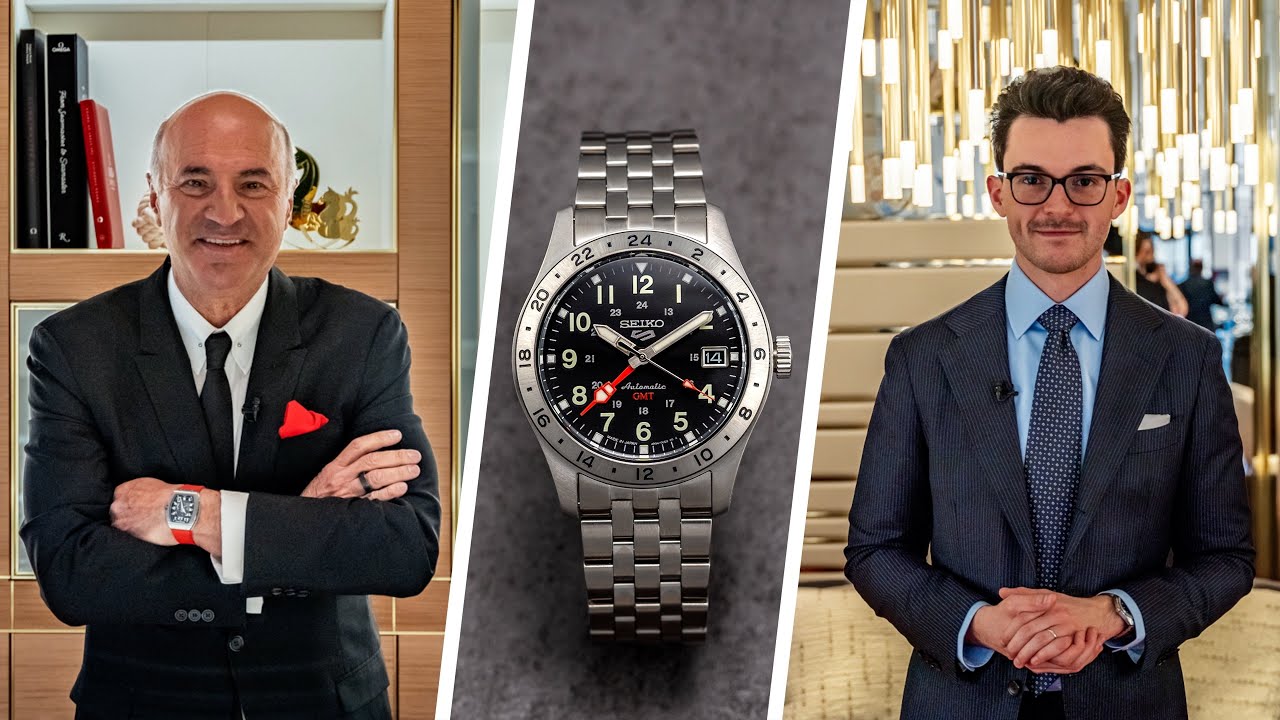
Kevin O’Leary stepped into Teddy Baldassarre‘s new retail store in Cleveland, Ohio, and the first thing he did was lay down a challenge: show me everything worth wearing under $1,000. For a man who owns watches costing half a million dollars, that kind of brief sounds almost insulting. But O’Leary has been preaching the entry-level gospel for years, and his conviction has not softened. ‘Never borrow money to buy a watch,’ he reminded anyone within earshot, and the room was full of reasons why you should not need to.
Baldassarre has built his reputation on knowing exactly where the value lives in a crowded market, and the lineup he assembled for this visit drew from Japanese and Swiss manufacturing, vintage military dial traditions, and deep-sea engineering. Ten-plus watches, all sitting below the $1,000 mark.
Where the lineup starts and what it actually covers
The first watch out was a Seiko, specifically the SSK023, a stainless steel fixed-bezel GMT powered by the 4R34 movement and priced just over $400. Baldassarre has made this argument before and made it again without apology: Seiko changed the game on affordable mechanical GMTs when that caliber launched, and finding one under $500 consistently is still remarkable. At 39mm, it draws on the brand’s field-watch DNA stretching back to 1913. Then came the Seiko Speed Timer, a 41mm quartz chronograph that sweeps its seconds hand like a mechanical and carries the name of a lineage that goes back to 1969, when Seiko was among the first brands to produce an automatic chronograph. Price: around $700. O’Leary slid his Richard Mille off his wrist and put the Speed Timer on just to feel it. ‘It wears smaller,’ he noted, and left it at that.
Bulova entered next with its Jet Star, a mid-century-inspired piece now produced under the Citizen Watch Corporation, priced around $500. The movement inside is a high-precision quartz caliber accurate to within a few seconds a month. The maroon dial with red highlights caught O’Leary immediately. ‘I’m telling you right now this is going to be one of my top three,’ he said, before he had seen half the table.
Tissot brought two perspectives. The PRX in a 35mm case, offered in glacier blue or gold PVD, runs a Powermatic 80 movement with an 80-hour power reserve and a silicon balance spring, landing just over $700. The brand has been producing Swiss watches since 1853. The Tissot Gentleman, a 40mm piece with a black dial, thinner bezel, and the same enhanced Powermatic 80 caliber, comes in at $800 to $900 and works, as O’Leary put it, with a suit of any color.
Lum-Tec brought something genuinely unfamiliar. Their Type B dial inverts the standard layout: hours on the inside track, minutes on the outside, an arrangement originally designed so pilots and navigators could read the minute hand first. Automatic, Miyota movement, under $500. O’Leary called it a big find.
Hamilton’s Murph, the 38mm steel watch inspired by a prop from Christopher Nolan’s 2014 film Interstellar, came in with a cathedral handset on a black dial, priced just under $900. O’Leary owns a Hamilton khaki field with a red band and wears it in cities where he considers a more expensive watch unwise. The Murph, he acknowledged, dresses up the same field-watch DNA into something more formal.
The watch that closed the case for number one
The final piece was the Certina DS PH1000M, a Swiss-made dive watch from a Swatch Group brand with roots in the 1800s. The DS concept, a double-security system that houses the movement inside a secondary casing with a screw-down crown, was developed mid-century as a genuine engineering solution. The PH1000M carries a 1,000-meter water resistance rating and a push-to-rotate safety bezel that requires downward pressure before it will turn, because underwater, an accidental knock on a timing bezel is not a minor inconvenience. The case runs around 43mm. The price sits in the $900 range.
When O’Leary ranked his top three, the Certina went first. ‘I have nothing like it,’ he said. ‘Story is great, dial is great, conversation piece, 1,000 meters, the whole thing, price is amazing.’ The Lum-Tec Type B came second. The Bulova Jet Star came third, partly on value, partly on the emotional pull of a brand O’Leary associates with New York City in the 1960s, when Bulova signs went up at sports events across the country.
The Certina sitting on the table
The Certina DS PH1000M rests on the display surface with its push-down safety bezel still locked, the graduated timing track sitting exactly where a diver last set it.
O’Leary walked out of the store with his rankings settled and his principle intact. Five hundred dollars, he pointed out on the way, gets you something genuinely good on your wrist, and none of it required a loan.