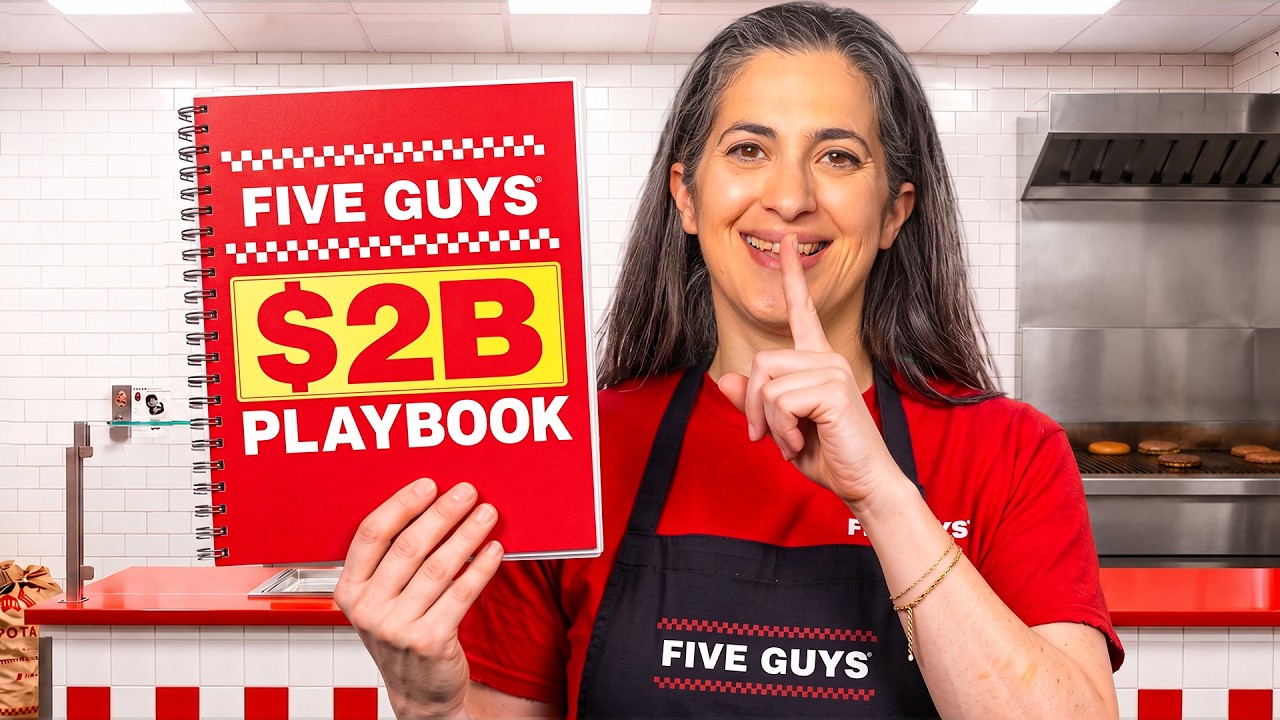
For 17 years, the Murrell family ran Five Guys out of the Washington D.C. area without opening a sixth location. No national push, no investor roadshow, no franchise pitch deck. Just five burger spots and a conviction that the food itself was doing something the industry had stopped believing in. Then in 2003, franchising opened up, and 300 buyers came chasing them. In under 18 months, Five Guys had sold rights to over 300 units. Today the company does over two billion dollars a year in sales, built on four rules that cut directly against the grain of the burger industry.
No ad budget, but the top of every search
While McDonald’s spends somewhere between two and three million dollars a day on advertising, Five Guys has spent zero on traditional campaigns. No TV commercials, no billboards. Founder Jerry Murrell used software to identify locations where foot traffic was already dense, operating on the principle that if a location is expensive, it is because people are already there. From there, Five Guys leaned hard into search engine optimization, making sure that when someone types ‘burger near me’ into Google, a Five Guys location appears at the top. Eighty-five percent of the searches they rank for do not include the words ‘Five Guys’ at all. People are simply looking for food, and Five Guys shows up first. Since 2019, the brand has climbed 33% in Google search rankings. Word of mouth handled the rest, because customers eating fresh beef and hand-cut fries told friends without being asked.
Franchising like a family, hiring like one too
When Five Guys finally opened to outside operators, their message to candidates was pointed: ‘We’re not selling you anything. We’re deciding if we want you to be part of our family.’ They were not looking for investors. They wanted people who would work the line, know the food cost numbers cold, and care the way the Murrells did. The same logic applies, according to Learn with Owner.com, to every general manager any independent restaurant puts in charge. One of the sharpest interview questions suggested for that process: ‘What kind of owner brings the worst out of you?’ There is no safe answer, which is exactly the point. It reveals self-awareness and flags whether the owner in the room might be the problem the candidate is describing.
A menu that fits on one page
For years, franchise owners pushed for chicken. Customers asked for salads. Competitors added breakfast. Five Guys said no every time, and the math backed the decision. A focused menu kept food costs between 28 and 32%, at the low end of an industry that typically runs 30 to 35%, and it did so using fresh beef and hand-cut potatoes rather than frozen shortcuts. A smaller menu also means a faster kitchen, faster onboarding for new team members, and significantly better buying power with suppliers. As the business grew, the calculus on menu additions became harder to ignore: a new chicken sandwich is not just a few ingredients. It means new equipment, new prep workflows, updated inventory systems, and new ways for tickets to slow down and mistakes to multiply.
Spending more to charge more
Fresh beef costs roughly 15 to 20% more than frozen. Hand-cutting potatoes requires more labor. Five Guys absorbed both costs deliberately and used them to build what the brand’s rise in the early 2000s created: premium fast food, a category that did not meaningfully exist at that price point before they occupied it. A Five Guys burger now runs above thirteen dollars. The margins on a thirteen-dollar burger built on quality ingredients beat the razor-thin margins on a nine-dollar burger built on cost-cutting. That premium positioning also closes the loop on the zero-ad-spend strategy: customers who believe the food is worth the price become the marketing, and that marketing costs nothing.
The question on the whiteboard
The five-question manager interview process, with its emphasis on food cost recall and crisis response over credentials, sits in the background of this entire story.
Murrell’s original location logic still holds the whole thing together. If a location is expensive, a lot of people are already there, and that is exactly where Five Guys wanted to be.