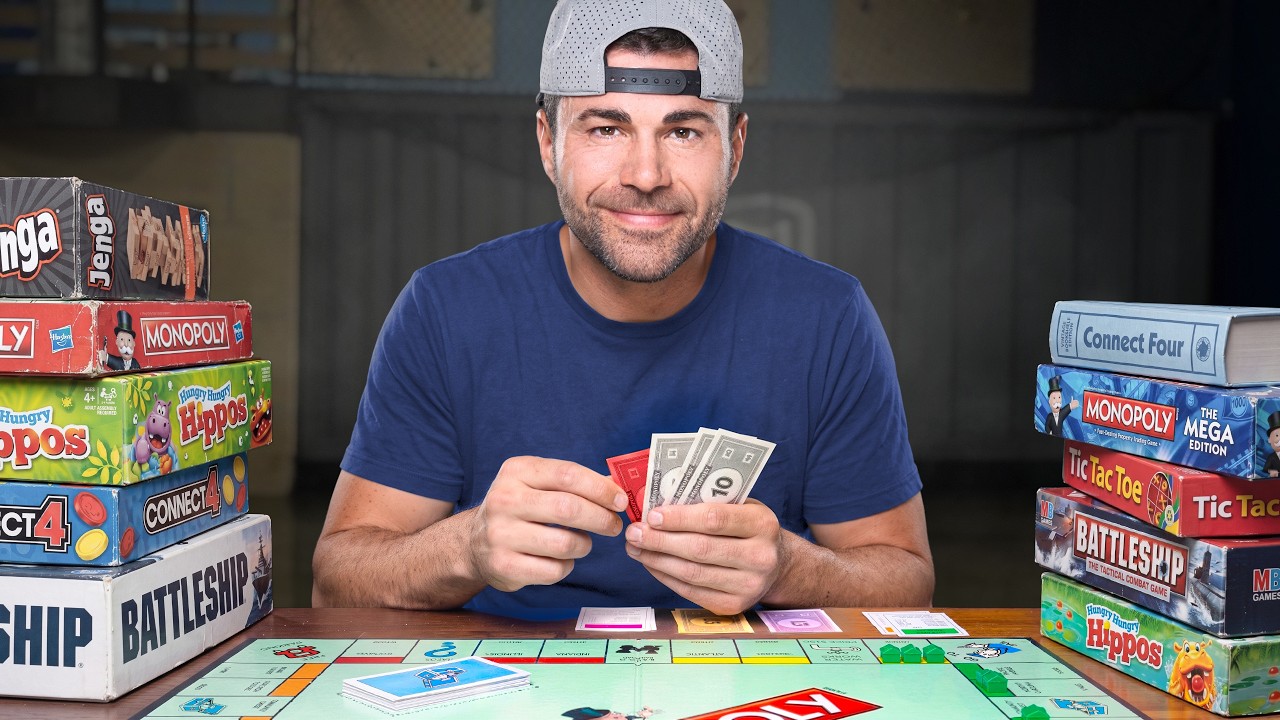
Mark Rober walked into a public park with a table full of board games and $100 cash, daring strangers to beat him at any of them. Almost none did. What looked like a stunt was actually the field test at the end of six months of obsessive data collection, simulation runs covering more than a million virtual games, and the quiet influence of a high school statistics teacher named Mr. Malloy who had already cracked Guess Who more than a decade earlier. If you have ever rage-quit a game of Monopoly or watched a smug opponent snap your Jenga tower, the strategies behind that park table are now yours.
The data haul that started it all
Before Rober took his tricks public, he needed numbers. He sent a four-person research team to an elementary school, a beach, a senior center, and a biker bar, while he gathered his own data in head-to-head matches. Everything came back to Crunch Labs, where hundreds of matchups were logged and the winning patterns were distilled into two or three precise tricks per game. The result was a claimed average win rate of over 90 percent across five games: Connect Four, Battleship, Tic-Tac-Toe, Jenga, and Monopoly.
Connect Four turns on a single structural insight: every possible four-in-a-row passes through the center column, so filling it is the highest-priority move on the board. Layer on top of that a formation Rober calls the ‘beak shape,’ a configuration where blocking your first threat automatically sets up a second. The opponent cannot stop both, and the game ends.
Battleship rewards patience over instinct. Rober’s checkerboard hunting strategy cuts the search space from 100 squares to 50, guaranteeing you will find every ship while wasting fewer shots. Simulations across more than a million games showed random guessing averages 60 turns to finish, while checkerboard hunting plus targeted neighbor-searching drops it to 50. Add the refinement Mr. Malloy contributed, aiming each shot toward the center of the largest remaining patch of open water where ship probability is highest, and the average falls further to 45 turns.
For Tic-Tac-Toe the edge is simpler and more ruthless: go first, take a corner, then occupy a second corner that threatens a win. Once the opponent blocks, the third corner sets a trap they cannot cover. The strategy fails only when the opponent takes the center on their first move, and even then a diagonal counter works roughly half the time.
Jenga rewards physics as much as feel. The loose blocks Rober spent time identifying are not accidental. He confirmed through measurements of 540 blocks that height differences between pieces can reach one millimeter. More importantly, those loose blocks regenerate as the tower shifts weight, so retesting every turn matters. When a block gets stuck, a sharp, quick tap beats a slow push every time because static friction is higher than kinetic friction. The final layer is combinatorial: count the remaining movable blocks and engineer your turns so that zero safe moves remain when it is your opponent’s turn. Zero, as Mr. Malloy pointedly reminded Rober, is an even number.
Monopoly, as Rober learned the hard way, is not about buying everything. It is about building three houses fast on the orange properties. Three houses produce the biggest rent jump per dollar spent, and every house placed is one fewer available from the bank, starving opponents of development options. The oranges earn their status because jail is the most-landed-on square in the game, and the orange group sits six, eight, and nine spaces past it, squarely inside the most common dice-roll range. Jail itself should be escaped early when properties are still available, and milked late when avoiding rent is more valuable than moving.
The teacher who came to collect
With the strategies locked, Rober staged what he described plainly as ‘a board game ambush,’ inviting Mr. Malloy to Crunch Labs under the pretense of a tour and then sitting him down across a six-game table. Mr. Malloy won Battleship by running the same checkerboard system Rober taught him, plus the heat-map layer. He won Monopoly by building three houses on the oranges while Rober scattered cash on every property he could reach. The final count, two wins for Mr. Malloy, two for Rober, and a tie at the custom Squirrel Dash game Rober designed himself around his backyard squirrels, sent the match to a tiebreaker on Hungry Hungry Hippos. No strategy applies. Rober hit the button and mashed. Mr. Malloy’s hippo was hungrier.
‘You’re just going to have to figure it out,’ Rober said of the one game he kept uncracked, grinning while his teacher collected the marbles.
One block that would not stay still
Deep in the Jenga section of the match, a block that had been completely immovable three turns earlier suddenly slid free. The tower had shifted, the weight distribution had changed, and what was impossible had become the easiest pull on the board.
The six-month project that tested every trick Rober had came down to a children’s toy and a teacher who outlasted all of it. The strategies work against almost everyone, except the person who taught you to think about probability in the first place.
 Wake up to Only Happy News!