
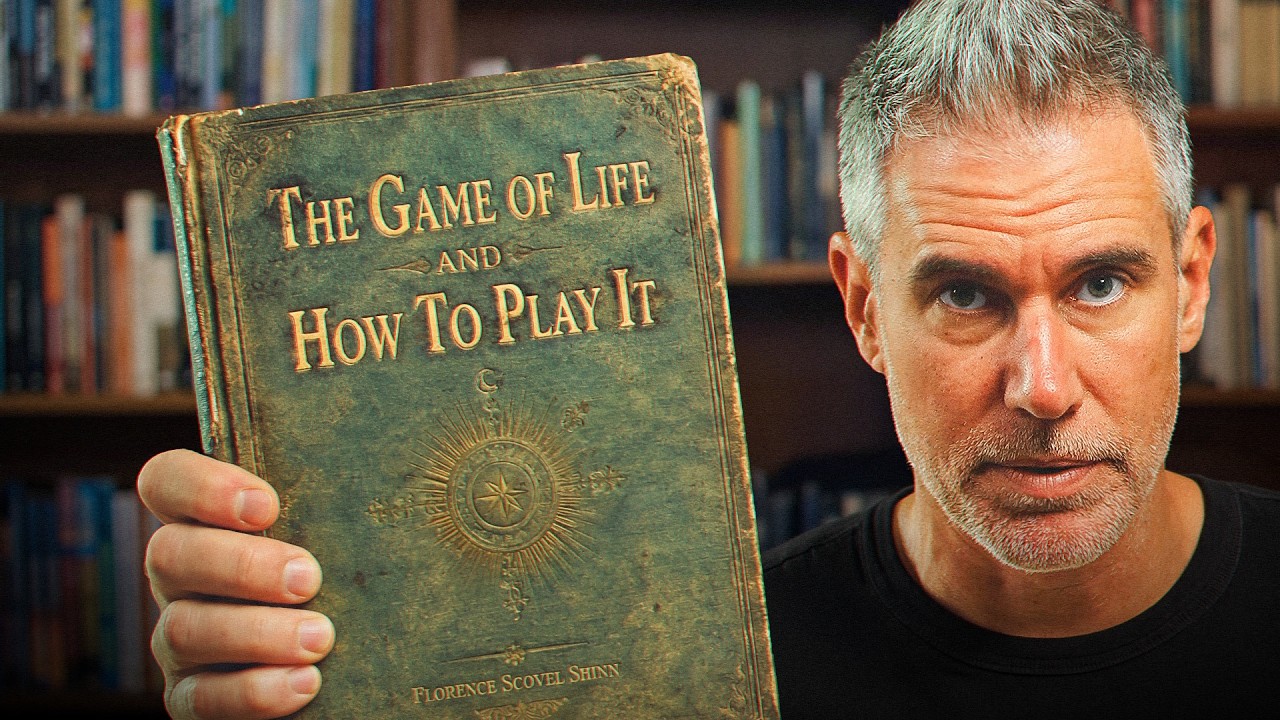
Almost 100 years ago, a woman named Florence Scoville Shinn wrote a small book that has quietly influenced millions of people, predating the law of attraction movement, predating modern neuroscience, and predating nearly every self-help framework that came after it. What makes that remarkable is not the timing. It is that the principles she laid out are now being validated through psychology, behavioral science, and research into how human identity actually forms. David Bayer, a coach who has worked with tens of thousands of people, has spent years inside her four books and returned with five distinctions he believes explain why her work has refused to disappear.
Life is a game, not a battle, and that changes everything
Shinn opens ‘The Game of Life and How to Play It’ with a claim that stops most readers cold. She writes that most people consider life a battle, but it is not a battle. It is a game. The distinction sounds simple until you follow it to its logical end: if life is a battle, then strength wins, but if life is a game, then understanding the rules wins. Shinn argued that every person is playing whether they know it or not, and that the laws governing the game are spiritual rather than material. Her stories follow a consistent pattern. A woman trapped by financial fear discovers that resentment has dominated her consciousness, releases it, and her circumstances shift. Another person stops fighting what is showing up in her life, and a resolution arrives that she could not have forced. The sequence is always the same. Internal correction first, external change second. Never the reverse. Shinn put it plainly: ‘Consciousness comes first, experience follows.’
Her second major distinction is that speech is not descriptive. It is creative. She devoted two entire books to the idea that words reveal beliefs, reinforce those beliefs into reality, and carry the ability to build or destroy. Most people, she observed, speak against themselves constantly without noticing. They say they never have enough, that nothing works out, that they always attract the wrong people, and then they are genuinely surprised when life keeps reflecting those assumptions back at them. Bayer frames this through a modern lens: words are the first representation of thought in the physical world. The stories a person repeatedly tells about themselves become the lens through which they perceive everything else. Catching a negative word, he points out, is far easier than catching a negative thought, which makes speech a practical access point for changing consciousness itself.
The ditch-digging instruction that redefines what faith actually means
Shinn’s fifth distinction may be her most counterintuitive. She defines faith not as belief in an external deity but as unconditional acceptance of a desired reality before any physical evidence appears. She illustrates this with the biblical story of the kings of Israel, Judah, and Edom, whose armies march into the desert and run out of water. The prophet Elisha delivers what sounds like an absurd instruction: dig ditches in the dry desert dust. No clouds, no wind, no rain. The soldiers, already dehydrated and exhausted, dig anyway. The next morning, a flash flood fills every trench they prepared. Shinn uses this to draw a sharp line between wishing and faith. As she writes: ‘The average person is always looking for results. He wants to see the wind and the rain before he digs his ditches. But the law is dig your ditches first and then expect the water.’
She gave her students practical ditch-digging exercises that sound almost absurd until you sit with them. A woman seeking a job she does not yet have buys a new work bag and plans her commuting wardrobe. A person with zero dollars in the bank applies for a passport before the trip is remotely possible. A man shopping for a home buys a small decorative piece for a house he does not own yet. Each physical action trains the subconscious mind away from present lack and toward expected arrival.
Modern neuroscience has confirmed something adjacent to what Shinn was teaching in the 1920s. Professional athletes who imagine performing their sport show measurable muscle fiber responses as if they were actually training. Pianists studied while mentally rehearsing a piece show brain activity nearly identical to physical practice.
The woman who set the table every night for two months
One of Shinn’s most quietly strange stories involves a woman whose estranged husband has left. Every night, for two months, she sets the table as though he is about to walk through the door. She performs the routine with loyal consistency, mentally occupying the fulfilled state rather than the absence. After two months, he reappears and they reunite. Shinn called this living in anticipation, which is another way of describing becoming your future self before the circumstances confirm it.
Full-Circle Wrap: Bayer finished all four of Shinn’s books convinced she was not teaching manifestation in the way that word is usually used. She was teaching that consciousness operates according to laws, and that a person’s words, imagination, resistance, and acceptance are not separate ideas but different expressions of the same principle. The game, as she originally described it, is still being played by the same rules she named nearly a century ago.