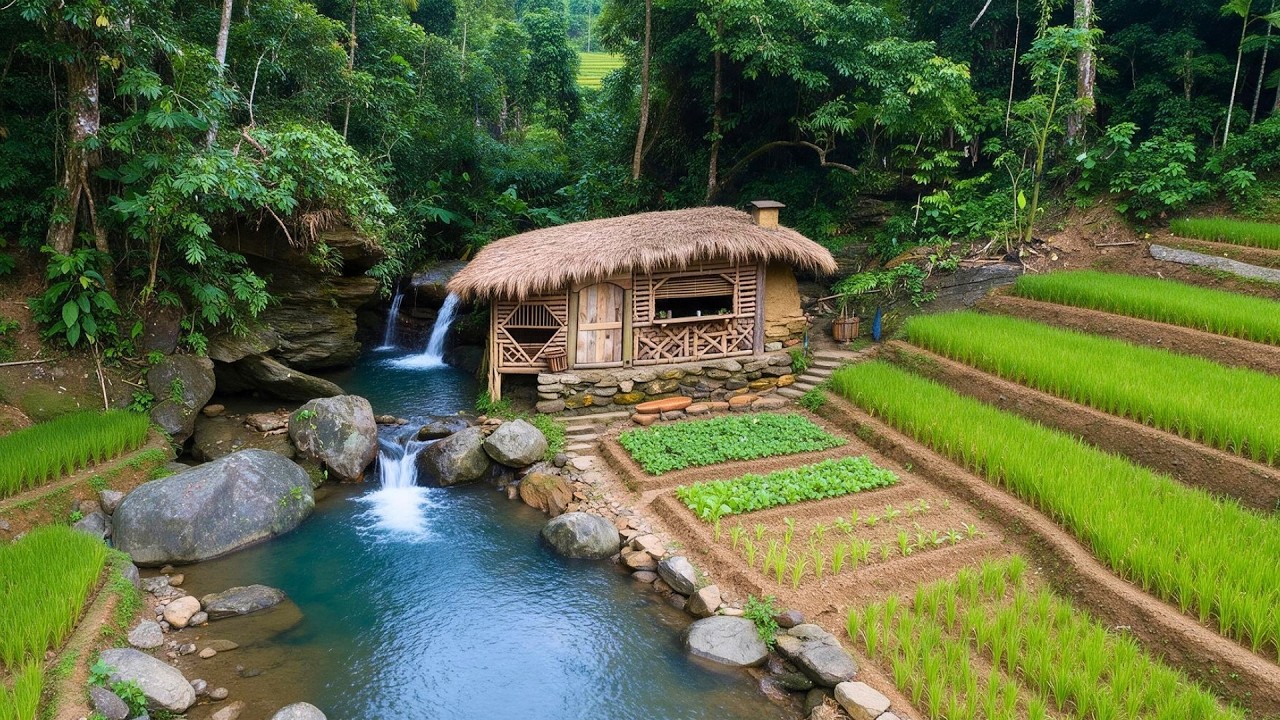
Koi arrived at a steep, jagged waterfall deep in the Vietnamese mountains carrying little more than a few hand tools and a plan that most people would have dismissed on sight. He was 24 years old. The spot he chose was deliberately harsh: rocky ground, a rushing stream, and dense jungle pressing in from every side. What unfolded over the next ten months is one of the more remarkable feats of solo off-grid construction documented in recent years, a young man turning raw wilderness into a fully functioning two-story homestead, entirely by hand.
Starting with fire, stone, and a borrowed technique
The first problem was the ground itself. To break through the solid rock, Koi used fire setting, an ancient technique in which extreme heat weakens stone enough to chip it away by hand. One wall of his first cabin was built directly against the rock face, using the cliff as a natural windbreak. He raised the foundation on river stones to guard against flooding, and when he needed to level the earth, he carved a heavy wooden tamper from scratch. Every tool he could not find, he built.
The cabin’s frame went up without a single metal nail. Using joinery skills passed down from his father, Koi carved precise geometric notches that locked heavy timber together under pressure. He extended the sleeping platform directly over the stream, installed a river clay stove beneath a deliberate gap in the roof, and covered the outside with a layer of soil and fresh grass so the structure would disappear into the hillside. Glass for the windows came from a trip to the nearest town, miles away on foot, a trek he had deliberately postponed because it was, as he framed it, a luxury for another day.
Fish, crops, bees, ducks, and a goat named Bess
With the cabin sealed, Koi set bamboo traps along the riverbank using grubs as bait, harvested the catch, and released the survivors into a new pond he had built across the stream. The fish farm was born. He terraced the steep bank with bamboo to hold soil against heavy rain, spread the ash from cleared brush as a natural fertilizer, and planted kabi alongside other leafy vegetables. Two months later the crops were ready.
Along the way, the farm kept adding lives. A young lost goat wandered into camp, drawn by the vegetation around the pond. Koi took her in, built her a small shelter, and named her Bess. A puppy called Lou arrived on the next supply run. Later, after trading mature fish to a village elder, he returned with a box of ducklings. A piglet named Moo joined the household after he sold vegetables at the local market and negotiated with a neighboring stall. ‘Without his animals,’ the account of that period goes, ‘the loneliness would be much harder to bear.’
He also found a hive of ground-nesting bees in the hillside after tracking their flight path into the brush, harvesting honey he described as a well-earned reward after months of hard physical labor.
Running water, electricity, and a nail-free bridge
The plumbing came from bamboo. Koi split and hollowed poles, overlapped them along the rocky hillside, and tapped a mountain spring, running fresh water by gravity alone down to a sink in his outdoor kitchen. The electrical system was more ambitious. He carved a wooden water wheel with interlocking joints, engineered a log foundation over the lower pool to support the axle, and built a bamboo aqueduct to channel the waterfall’s flow onto the paddles. A brought-in generator converted the rotation into current. The first test bulb lit up, and within days he had strung wiring from the generator across his handmade bridge to both structures on the property.
The bridge itself was built to lock together and support itself without any conventional fasteners, using wooden pegs at the central joint and temporary bamboo supports in the water that he removed as each section became self-bearing.
The day he turned 25 at the village market
Five months in, Koi loaded his first full harvest into bamboo baskets, enlisted Bess and Lou to help carry the weight down the mountain trail, and walked to the local village market. Every item sold. With the money, he bought seeds, supplies, and one thing he had not planned for in any structural drawing: a birthday cake. He had just turned 25.
The two-story house that followed took the same traditional joinery and charred-timber techniques from his father, scaled up to a structure with a wide terrace overlooking the waterfall, a framed balcony upstairs, large wooden shelves built into the interior walls, handcrafted clay planters, flowers, and books. In front of the house he carved a natural swimming pool from river stones, fed by the same stream that had powered everything since month one.
The bamboo valve above the waterfall
At the top of the water wheel assembly, a single bamboo valve controls the entire electrical system. Slide the pipe aside and the wheel stops. Return it and the current resumes. It sits above the falls, unattended, in a jungle that ten months ago offered nothing but rock and rushing water.
Koi woke up on the morning after his ten-month mark in a two-story home he had built from the ground up, with a fish pond, a mushroom crop, a duck flock, a garden, running water, electric light, three animals, and a growing list of future plans that includes a larger kitchen, fruit trees, improved soil, and more animals. He entered the forest with an idea. The idea is now the place where he lives.
 Wake up to Only Happy News!