
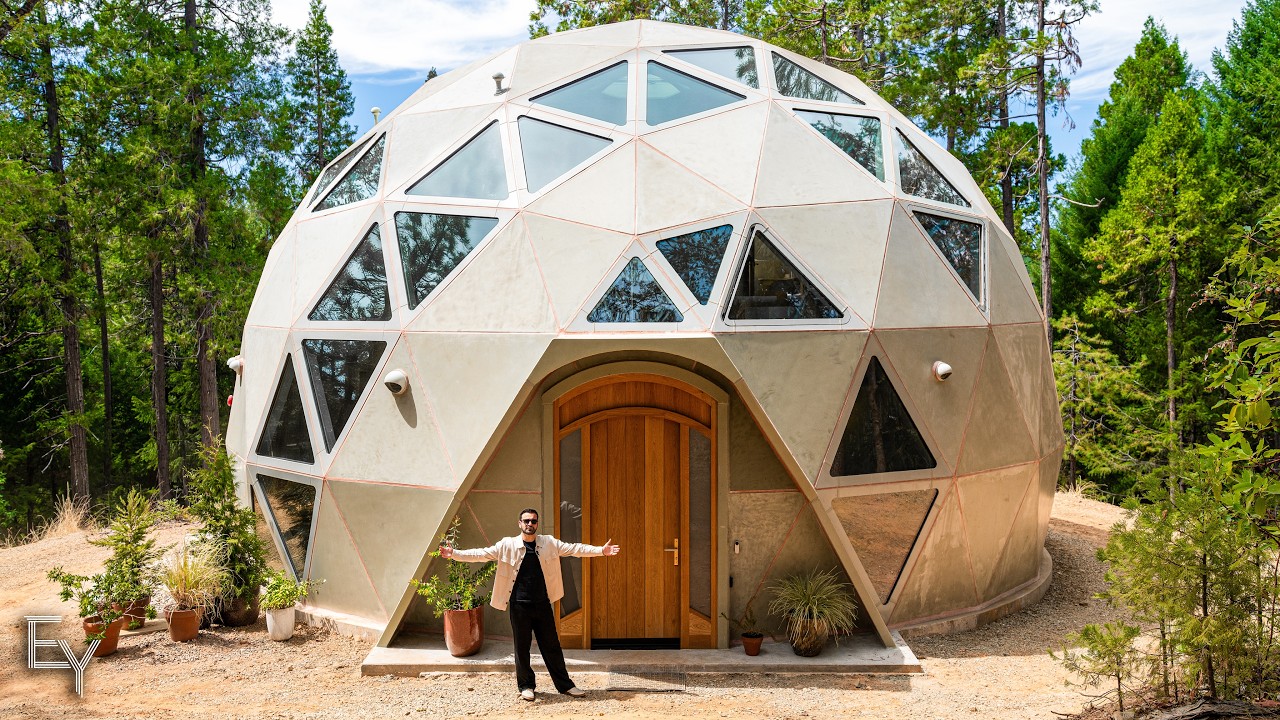
Standing outside Geoship’s headquarters in Nevada City, California, a dome-shaped structure called Amma rises from the landscape like nothing else on the block. It is Geoship’s first customer-delivered geodesic home, and it raises a question the housing industry has largely avoided for a century: what if the entire process of building a home, the geometry, the materials, the assembly sequence, was rethought from scratch? For anyone watching construction costs climb and build times stretch, the answer Geoship is attempting matters well beyond one prototype in the California foothills.
A shell made from minerals that exist inside your own body
The material driving Geoship’s approach is a proprietary bioceramic composite made from magnesium oxide, monopotassium phosphate, fiber, aggregate, water, and a retardant. It was originally invented for the nuclear industry, where the compound was used to immobilize radioactive materials inside a stable matrix. Geoship’s lead material scientist Ali spent 45 minutes walking through the chemistry: the composite hardens rapidly by reacting with oxygen and essentially becomes a rock. It resists mold because there is nothing organic for mold to consume. It resists insects for the same reason. And because the panels contain no steel, there is no corrosion pathway. Ali put the biological parallel plainly: ‘These same minerals are in your body. So when you’re in the home, you’re actually in a structure that’s made out of minerals that exist inside your body.’
The formulation can be adjusted to produce panels of radically different density. Two sample panels on-site illustrated the point: one was roughly twice the size of the other but only half the weight, because the denser formulation was dialed in for exterior weather loads while the lighter version was engineered purely to create an interior surface and conceal utilities. The same wishbone-shaped structural connectors interlock at every triangular junction, then get mortared in place. Rockwool insulation, made from natural volcanic rock and fibers, fills the wall cavity between the exterior and interior panels, delivering fire resistance, water repellency, and strong soundproofing in a single layer.
What 1,643 square feet inside a dome actually feels like
Amma runs 36 feet in diameter at its widest point, the eye-level band where the dome begins to taper both up and down, and the ceilings reach 24 feet at the peak. The floor plan fits two bedrooms, two bathrooms, and a loft office across 1,643 square feet, with a 625-square-foot second floor. Cork flooring runs throughout, oak cabinetry and paneling appear in almost every room, and the kitchen island follows the curvature of the dome rather than cutting across it. A steel spiral staircase with open risers and minimal wood-tread railings anchors the center of the main floor. Micha Mikailian, CEO of Geoship, described the perceptual effect of the rounded interior geometry: ‘In a normal room, you’ll notice your eyes want to go to where the ceiling and walls meet the corners. Here, your eyes just kind of want to relax into an infinite gaze because all the geometry is like what’s in nature.’
Morgan, co-founder and Chief Vision Officer, traced her interest in that sensory quality back to a beach experience in Portugal in her early twenties, where she noticed that light, water, and electromagnetic environment were active variables in how a space felt. That observation eventually shaped Geoship’s design philosophy: build for nervous system relaxation, not just structural performance.
Triangular casement windows can replace any panel in the system, and frosted lower sections on interior-facing windows keep the exterior surface visually clean wherever interior cabinetry or plumbing runs behind them. The mortar used to seal joints is tinted to match the local soil color at this site.
The wall sconces at the loft landing
On the second-floor loft, a row of wall sconces casts light across the raised triangular texture of the interior bioceramic panels, tracing the geometry of every joint in a warm glow that shifts with the angle of the light.
Geoship is currently selling these homes between $400,000 and $600,000, with a stated goal of reaching $111 per square foot by 2033. Build time is running several months per unit today; the team is targeting under four weeks per home by the end of next year once their full-scale manufacturing facility comes online. They have raised over $20 million through crowdfunding and carry no large institutional capital, a structure the leadership says keeps the mission intact. Amma is not the finished answer. It is iteration one, and the team is already cataloguing what to change next.
 Wake up to Only Happy News!