
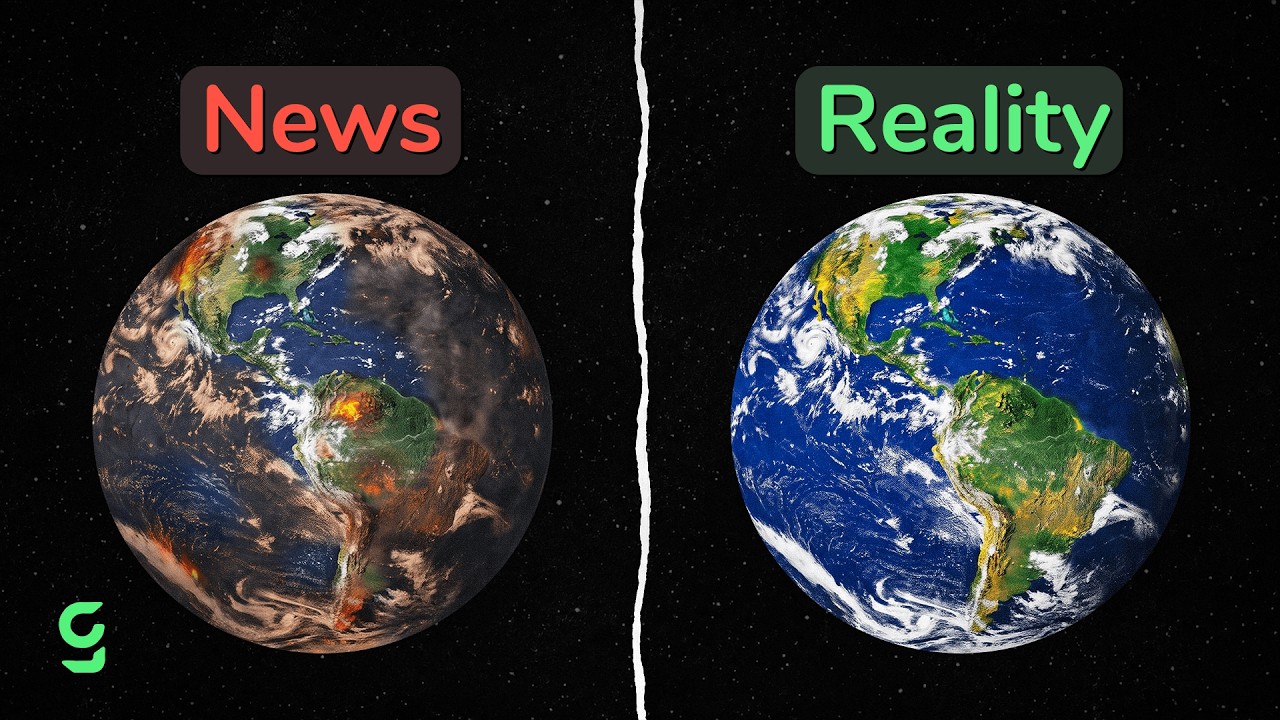
Somewhere between a 100,000-year-old threat-detection system and a media industry built on fear, most of us ended up with a picture of the world that is darker than the world itself. That gap is not weakness or ignorance. It is the predictable output of forces stacking on top of each other, and once you see the mechanism, the data on the other side of it lands differently. Freddy, the creator behind Good News, surveyed more than 500 people about their biggest fears and found something unexpected: cost of living, war, climate, corrupt politicians, and AI all scored almost exactly the same. It was not one or two things frightening people. It was everything at once, which pointed to something underneath the topics rather than any single topic itself.
The three-part machine warping your view
The first force is biological. You are, quite literally, the descendant of the ancestor who panicked at every rustle in the bushes rather than the one who stayed calm. The calm one got eaten. The nervous one survived long enough to have children. That ancient threat-detection software is still running, and it cannot tell the difference between a predator and a headline about one. The second force is structural. Studies of political TV coverage in three countries found negative stories outnumbered positive ones by roughly ten to one, and that was in 2007, before social media. Political good news made up as little as 6% of coverage. This is not a conspiracy. It is an incentive: negative coverage holds audiences, and holding audiences pays the bills. The third force is scale. For most of human history, bad news was local. A danger nearby, an illness in the family. Now every war and disaster on Earth reaches your nervous system in real time, every day. No alarm was built to carry that load.
There is also a research finding worth sitting with, something called the third-person effect, replicated across more than 100 studies in over a dozen countries. Almost everyone believes the media influences other people more than it influences them. As Freddy put it plainly: ‘Thinking you are the exception is usually the clearest sign you’re not.’
What the actual numbers show
Since 1990, the number of children dying before their fifth birthday has fallen by 60%. That progress represents roughly 132 million children alive today who would otherwise have died, a figure close to the combined population of the UK and France. Cancer survival in the United States has moved from roughly 5 in 10 patients surviving five or more years in the mid-1970s to 7 in 10 today, and the cancer death rate has fallen 34% since 1991. In 2025, renewables generated more electricity than coal globally for the first time in modern times. China alone installed more solar capacity in 2025 than the rest of the world combined, with solar and wind generation growing more than 40% in a single year. India’s renewable capacity more than tripled over the last decade, reaching 50% of electricity capacity from clean sources, five years ahead of its Paris Agreement target. In late 2024, South Korea’s president declared martial law. Within six hours, lawmakers had voted it down. He was removed from office and sentenced to life in prison. A global survey of nearly 130,000 people across 125 countries found 89% wanted their government to do more on climate change, and almost none of them knew they were in an overwhelming majority.
A detail that did not make the headlines
A joint study from two leading European universities examined more than a million solar installations in Germany and found that panels lose efficiency at roughly half the rate previous models predicted, which means the solar infrastructure already in the ground could last approximately twice as long as originally thought.
The world is not fixed. Wages have not caught up, temperatures are still rising, and politics still feels broken in many places. But nearly 100 million fewer children are living in extreme poverty today than a decade ago, and clean energy is growing faster than almost anyone who was tracking it closely predicted. The problem was never that bad news exists. It was the ratio: the alarm running at full volume all day, with almost none of the part where things are quietly getting better.
That needle stuck all the way at ‘the world is on fire’ did not get there because of reality. It got there because of what gets reported and what goes quiet. The 132 million surviving children never came from one traumatic moment, so none of it ever led.
 Wake up to Only Happy News!