In a single meeting in 2021, Google DeepMind CEO Demis Hassabis did a back-of-envelope calculation on his phone and realized that AlphaFold could fold every protein known to science — all 200 million of them — in roughly one year. Instead of building a traditional server where scientists would submit individual requests and wait days for results, his team folded the entire catalogue and released it for free. That decision, made mid-conversation, changed biology overnight.
AlphaFold: From a 50-Year Grand Challenge to a Free Global Database
Hassabis first encountered the protein folding problem as an undergraduate at Cambridge, where a biologist friend described it as ‘the equivalent of Fermat’s last theorem, but for biology.’ The challenge: predict the precise three-dimensional shape of a protein from its one-dimensional amino acid sequence. That shape determines biological function, and cracking it had required hundreds of thousands of dollars and years of effort per protein, using X-ray crystallography. AlphaFold solved this computationally, and AlphaFold 2 can now produce a structural prediction in seconds.
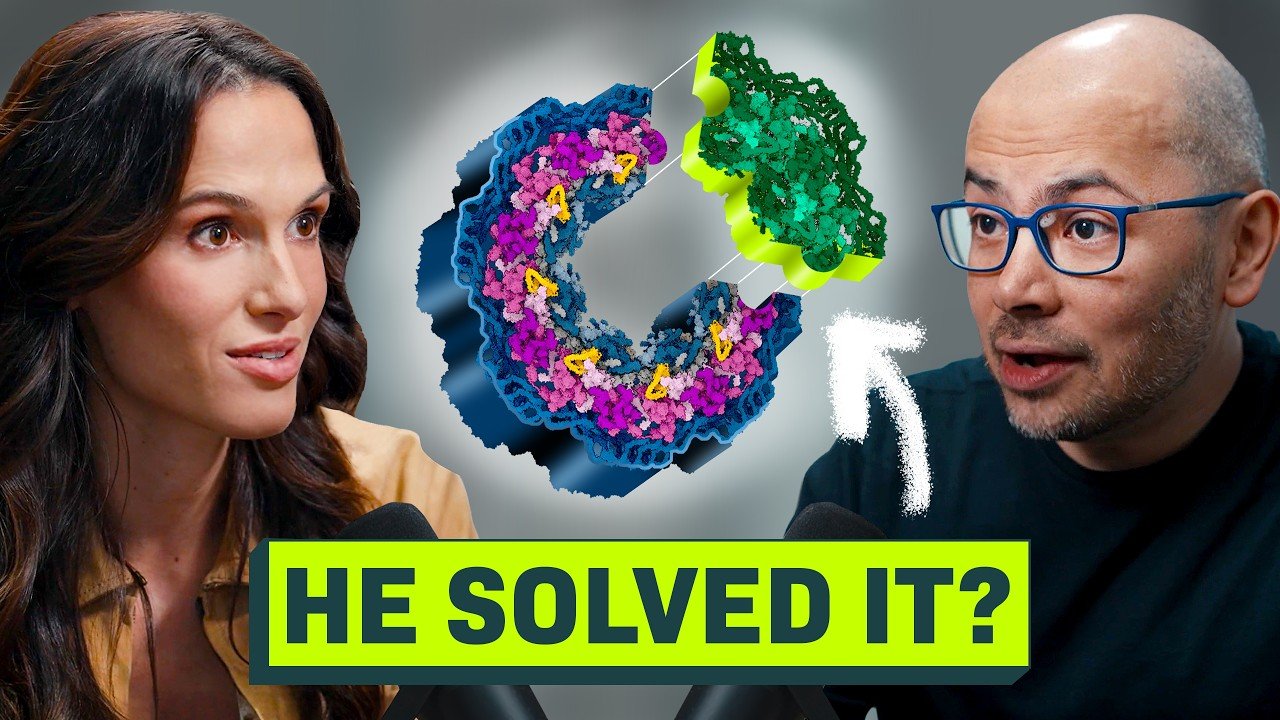
Today, more than 3 million scientists use AlphaFold, representing virtually every biologist on Earth. A scientist at a major pharmaceutical company told Hassabis that nearly every drug developed from this point forward will likely have used AlphaFold somewhere in its process. Drugs assisted by AlphaFold are now entering clinical trials, with dozens of therapies expected to emerge within the next several years. One landmark early result was the mapping of the nuclear pore complex — one of the largest proteins in the human body, a gateway structure that controls what enters and exits the cell nucleus — whose complete shape was unknown until teams used AlphaFold alongside experimental data to finally resolve it.
Hassabis also highlighted AlphaFold’s particular value for researchers working on neglected diseases such as malaria, Chagas disease, and leishmaniasis — illnesses affecting hundreds of millions of people in lower-income regions that historically receive little pharmaceutical investment. By providing protein structures at no cost, AlphaFold allows underfunded nonprofit research organizations to skip directly to the drug discovery phase.
Move 37, Alpha Zero, and the Creative Leap That Unlocked Scientific AI
In March 2016, AlphaGo played Move 37 in Game 2 of its historic match against world Go champion Lee Sedol — a move on the fifth line of the board, so counterintuitive that expert players called it a mistake. The move was not only correct; it proved to be the decisive placement that won the game more than 100 moves later. The match was watched by 200 million people worldwide, and DeepMind won 4-1.
For Hassabis, Move 37 was the proof of concept he had spent six years building toward: a system generating genuinely creative, previously undiscovered solutions. The follow-on system, Alpha Zero, removed all human-crafted knowledge and started from scratch, learning Go, chess, and other games solely through self-play. Starting from random moves in the morning, Alpha Zero surpassed all grandmasters by teatime and exceeded the world chess champion by dinner — a full arc of evolution from random to superhuman, observed live in a single day.
AlphaTensor later applied this same framework to matrix multiplication — the mathematical operation underlying all neural networks — and discovered algorithms that made the process approximately 5 percent faster. Given the tens of billions of dollars spent on AI training globally each year, a 5 percent efficiency gain represents enormous cost savings and accelerated research capacity.
Cleo Abram’s conversation with Hassabis also surfaced AlphaGenome, DeepMind’s newest tool for predicting whether mutations in the 98 percent of the genome that does not code for proteins are harmful or benign. Nobel laureate Dr. Jennifer Doudna, pioneer of CRISPR gene editing, submitted a question for the interview asking how close AI is to reliably identifying the exact genetic changes driving disease so that CRISPR can correct them. Hassabis called the combination of AlphaGenome and CRISPR ‘incredibly powerful,’ describing multigenic diseases — conditions caused by cascading interactions among multiple mutations — as a domain where AI is uniquely suited to find patterns human researchers cannot.
DeepMind’s spinout company Isomorphic Labs is building on AlphaFold’s foundation to compress the drug development timeline, which currently averages 10 years per drug with a clinical success rate of only about 10 percent. Isomorphic is currently running 18 to 19 active drug programs spanning cardiovascular disease, cancer, and immunology, using in-silico compound screening to test thousands — and eventually millions — of molecular candidates before a single wet-lab validation step.
Hassabis’s vision, articulated throughout the conversation, is to use AI as the instrument for understanding what he calls ‘root node problems’ — foundational scientific bottlenecks whose resolution unlocks entire branches of downstream research. AlphaFold was the first. He places fusion energy, room-temperature superconductors, and the nature of consciousness in the same category of targets. His hope, he told Abram at the close of the interview, is simply that his life will be remembered as ‘of benefit and service to humanity.’