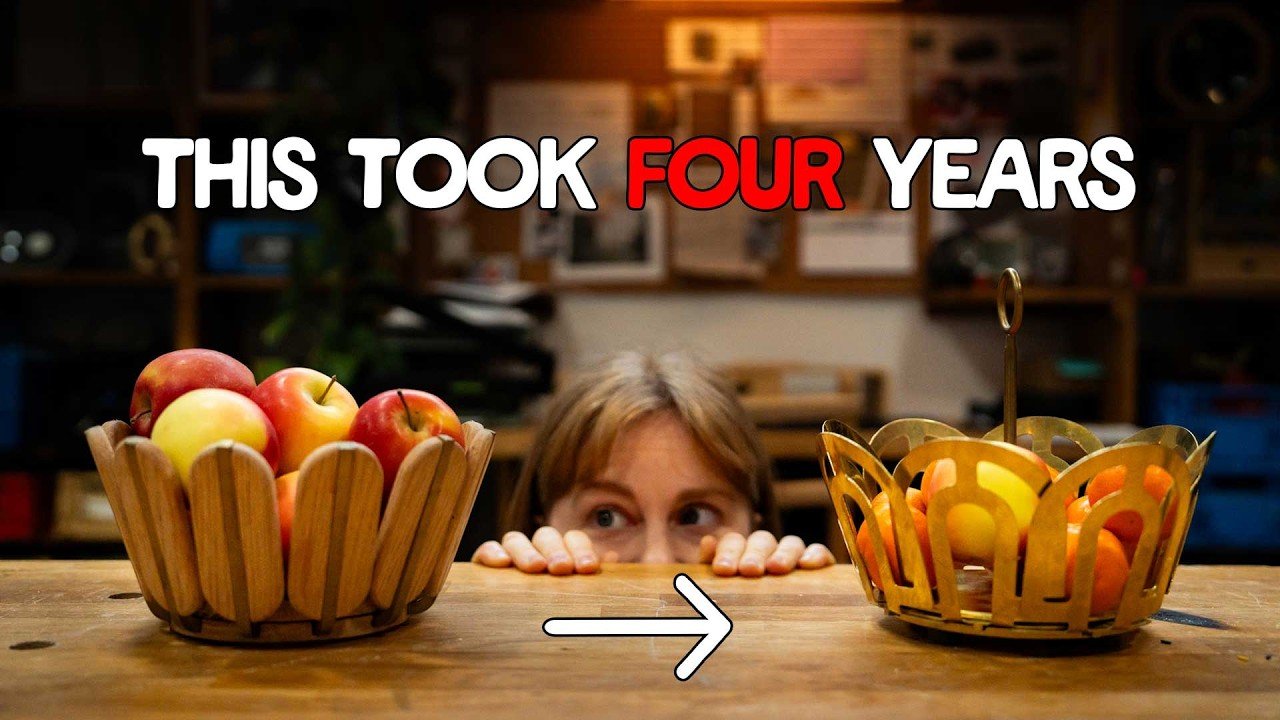
After four consecutive years of prototyping, Simone Giertz has finally produced a working brass fruit bowl that mechanically expands and contracts based on how much fruit it holds – and the breakthrough came, by her own account, only because she let an audience watch her work through the problem in real time.
The Engineering Problem That Launched Four Years of Iteration
The original concept dates to 2021, when Giertz built the first version of the bowl using an iris mechanism – the same rotating-panel principle found in camera apertures and submarine hatches. Radiating rods travel along straight tracks while pins couple into curved swooping channels, translating rotational input into a smooth expansion or contraction of the bowl’s diameter. That first prototype ranged from approximately 12 centimeters to 20 centimeters in diameter, wide enough to comfortably seat three apples in its intermediate position.
The prototype, however, carried serious structural and safety problems. The brass construction rendered it non-food-safe, and the panel gaps were wide enough for smaller fruit to slip through. A significant height difference between the mechanism plate and the bowl’s base caused small fruit to become lodged when the bowl was partially open, physically blocking the mechanism from closing. The bowl was also unstable on flat surfaces and entirely incompatible with a dishwasher.
Working with collaborator Stu, Giertz developed a slimmer second iteration featuring pizza-wedge-shaped base panels designed to prevent fruit from falling through the gaps. That version resolved several functional complaints but introduced a new challenge: Giertz could not settle on a final aesthetic direction for the side petals, the bowl’s most visible design element.
From Wire Arches to Sheet Metal: Finding the Final Form
The material debate spanned ceramic, wood, plastic, and bent wire before Giertz committed to sheet metal during a transatlantic flight from Sweden, during which she sketched and folded paper variations through the entire journey. Once back in her workshop, she cut and manually bent petal shapes from brass sheet stock, then attempted to solder the legs to the pizza-shaped base panels. The soldering process failed repeatedly – not only due to the technical difficulty of completing 16 clean joints, but because the heat stripped the spring temper from the brass, leaving the petals structurally soft and unresponsive.
Giertz pivoted to a bend-only solution, connecting the side arches directly to the inner legs of the iris mechanism rather than to the base plate. The result – which she described as carrying an art deco character – operated more smoothly than even the earlier wooden prototype. A final detail completed the object: repurposing an ice pick gifted by Jimmy Diresta, threading its cap to function as a central twist-handle, allowing the bowl to open and close without gripping the mechanical plate directly.
The iris mechanism at the heart of this bowl shares its fundamental geometry with industrial aperture systems used in precision optics and aerospace valve design, where variable-diameter openings must be actuated smoothly from a single rotational input. Applying that principle to a consumer kitchen object at a 12-to-20-centimeter scale, while maintaining food-adjacent materials and manufacturable joint counts, represents a meaningful miniaturization challenge – one that Giertz has now resolved at the prototype level after iterating across multiple material classes.
The brass bowl performed beautifully in Giertz’s initial fruit test, snugly cradling two tangerines at its smallest diameter setting. However, in a characteristically candid postscript, Giertz revealed that after showing the finished brass prototype to her team and friends, the group unanimously preferred the earlier wooden version. Factory consultation is the confirmed next step, and Giertz projects that a manufacturable version of the mechanical fruit bowl could reach the market sometime in 2027 – a timeline she is already treating as the beginning of the next spiral.
 Wake up to Only Happy News!