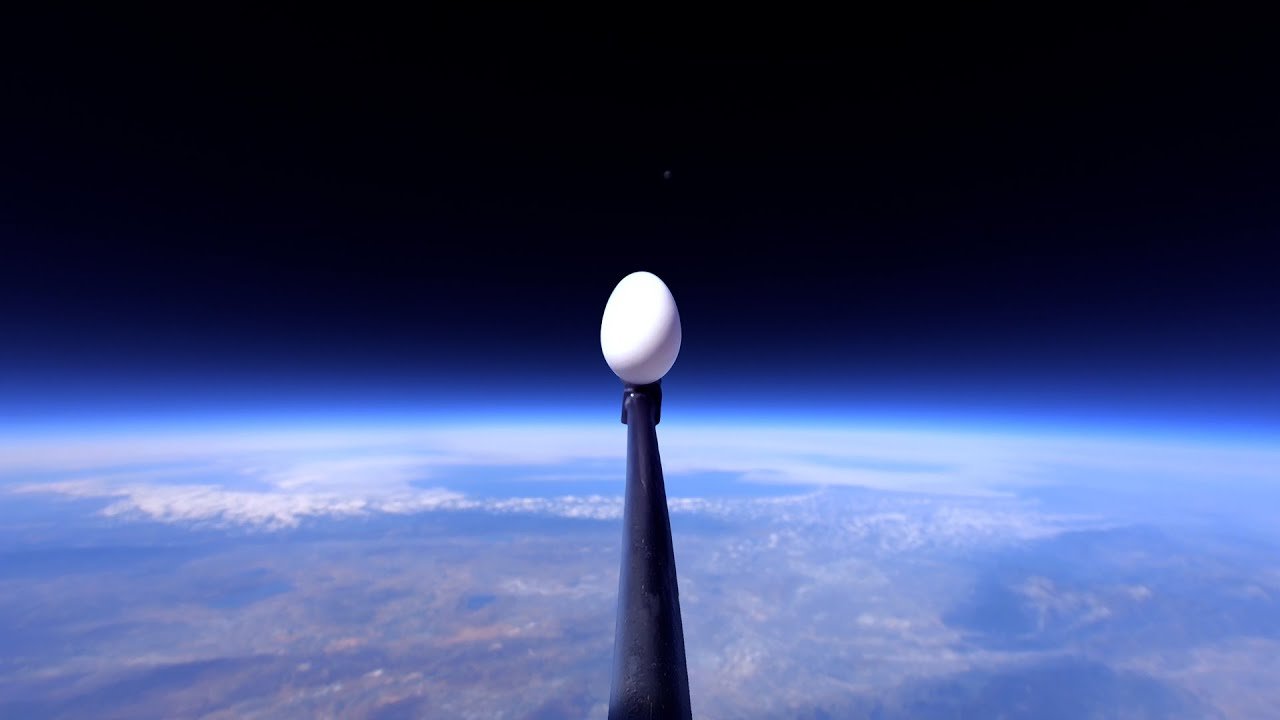
A raw egg launched to the edge of space aboard a zero-pressure balloon, traveling faster than the speed of sound, landed safely in a desert and emerged unbroken. Mark Rober documented the three-year engineering effort that made it possible – a project that survived four catastrophic failures, a last-minute redesign inspired by NASA Mars rover technology, and a near-total loss at 30 kilometers of altitude before delivering one of the most unlikely successes in backyard aerospace history.
Five Attempts, Four Failures, and a Redesign Built on Mars Science
The original concept called for a weather balloon to carry a fin-guided rocket to the edge of space, where the rocket would detach, break the sound barrier during freefall, and release the egg at 90 meters above a foam landing pad in Gridley, California. Self-taught rocket engineer Joe – creator of the PBS Space channel – handled fin-based guidance and stabilization, while Rober engineered the egg payload housing, including an oven-based heating system to prevent the egg from freezing during ascent.
The first three attempts in Gridley produced a cascade of specific failures: a GPS tracker placed near a metallic tracking ribbon caused signal interference that corrupted the rocket’s velocity calculations, forcing an aborted launch on day one. A second attempt ended when the fins induced an uncontrolled spin during freefall. A third attempt placed the rocket far closer to the target before confirming the egg had ejected – but the egg was found broken on the ground. After consulting Adam Steltzner, Chief Engineer of the Perseverance rover and a key figure in the Curiosity Mars landing, Rober and Joe abandoned the precision-guided approach entirely. Steltzner identified the guided targeting system as a fundamental flaw and noted, with pointed clarity, that thousands of people who had solved that problem were bound by federal law not to discuss it publicly.
The replacement system drew directly from NASA’s Mars Entry, Descent, and Landing architecture. The new rocket was three times longer and four times heavier than the original, designed to reliably exceed Mach 1 in freefall. A mid-descent separation event shed the aft section to reduce mass and trigger aerodynamic braking, mirroring the atmospheric drag dissipation used on Mars missions. A parachute then deployed – sewn from a physical piece of nylon cut from one of the 80 rectangular panels that formed Curiosity’s actual landing parachute, a gift Rober received from colleagues when he left NASA. The forward cone separated to expose a set of airbags modeled directly on the Spirit and Opportunity rover landing system.
The Zero-Pressure Balloon Fails at 30 Kilometers – and a Backup Egg Saves the Mission
The desert launch used a zero-pressure balloon – a variant that equalizes with external atmospheric pressure, cannot burst, and can carry heavier payloads to higher altitudes than standard weather balloons. After more than an hour of filling from four large helium tanks, the balloon lifted cleanly and ascended at the expected rate. At 30 kilometers – two and a half times the cruising altitude of a commercial aircraft – Joe spotted through his telescope that the balloon appeared to be shrinking. A call from the tracking team confirmed the payload had fallen. The rocket and the backup beach ball had rotated around the balloon for approximately 10 minutes, winding the self-destruct cord tight until it triggered involuntarily, releasing everything as a tangled mass at 240 kilometers per hour – far beyond the survivable impact speed for an egg.
What saved the mission was the redundancy system Rober had built after studying NASA’s approach to single-point failures. The primary payload housing – containing the egg, the orange parachute, and the airbag array – separated cleanly from the tangled balloon and rocket at six kilometers altitude, deployed the chute, and landed independently. Rober spotted the orange parachute from the vehicle window. The payload was confirmed intact. The egg inside was warm to the touch – it had been in near-space conditions and had not cracked. The backup beach ball, stuffed with a second egg and six meters of tracking ribbon, also landed safely with its egg unbroken. Altcheh, the same NASA engineer visible beside Adam Steltzner in the Curiosity landing control room on the night the words ‘touchdown confirmed’ were first spoken, delivered the official confirmation: ‘Safe landing confirmed on Earth.’
The successful recovery of both eggs closes a loop that Rober opened three years earlier with a question about whether an egg drop competition – the classic school physics exercise of protecting a raw egg from a fall – could be taken to its logical extreme. The global network of more than 1,000 weather balloon stations that launch twice daily at precisely midnight and noon Greenwich Mean Time, each carrying a radiosonde that measures pressure, temperature, and wind at every altitude, provided the atmospheric data that made the balloon’s flight path predictable enough to attempt the drop at all. That same infrastructure, built for meteorological forecasting, quietly enabled the highest egg drop ever recorded.
 Wake up to Only Happy News!