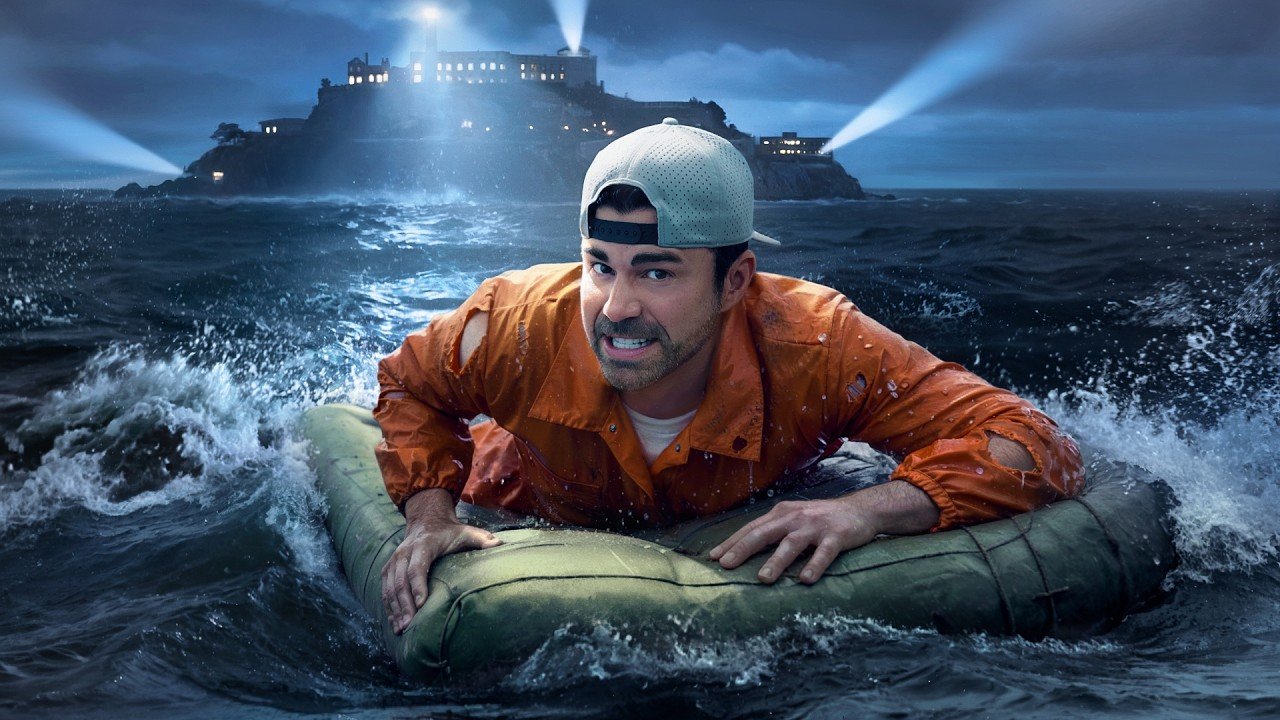
Three men dug through a reinforced concrete prison wall using spoons – and in 1962, Frank Morris and brothers John and Clarence Anglin walked out of Alcatraz Federal Penitentiary and were never seen again. Mark Rober, the former NASA engineer turned science communicator, set out to reverse-engineer that escape using the same primitive tools and the same fundamental physics the inmates relied on, proving that basic engineering principles – not sophisticated equipment – were the real key to the most famous prison break in American history.
Spoons, Saltwater, and Structural Weakness
The cell walls at Alcatraz were not solid reinforced concrete. Decades of saltwater air from San Francisco Bay had corroded the rebar inside the walls, weakening the structural integrity of the concrete surrounding the ventilation ducts in each cell. Morris and the Anglins exploited this specific vulnerability, using sharpened spoon handles to chip away at the deteriorated concrete over months of patient, methodical work. Rober replicated this process, demonstrating that the corrosion reduced the concrete’s effective resistance to the point where a determined person with a hand tool could realistically excavate a passage large enough to crawl through given sufficient time.
The inmates concealed their excavation progress each night by fashioning dummy vent grilles from cardboard painted to match the original. Their decoy heads – constructed from soap, toilet paper, and real human hair collected from the prison barbershop – bought critical hours on the night of the escape by fooling the guard’s bed checks. Rober reconstructed the dummy head methodology to demonstrate how convincing the illusion was under low-light cell conditions, the exact circumstances guards encountered during their rounds.
The Raft, the Accordion, and a Race Against the Tide
Once above the cell block and onto the roof, the three men descended to the water’s edge and deployed a makeshift raft constructed from more than 50 stolen raincoats, stitched together using thread and a steam-heated improvised heat-seal. To inflate the raft, Morris used a concertina – a small squeeze-box instrument similar to an accordion – as a manual air pump. Rober built and tested a replica raft using period-accurate materials to evaluate its seaworthiness, examining whether the craft could realistically survive the currents of San Francisco Bay.
The tidal window on the night of June 11, 1962 was narrow. Currents running through the bay routinely exceed five knots at peak flow, and the distance from Alcatraz Island to the Marin Headlands shoreline is approximately 1.25 miles. Rober’s engineering analysis assessed flotation load, paddle mechanics, and drift trajectory – the same variables that have kept the fate of Morris and the Anglins officially listed as ‘unknown’ by the FBI, whose case remains formally open to this day.
The 1962 Alcatraz escape remains the only known unresolved escape attempt in the island prison’s 29-year federal operational history, which ran from 1934 to 1963. The U.S. Marshals Service, which separately maintains its own active investigation, stated as recently as 2018 that the men could still be alive. Rober’s hands-on reconstruction illustrates a broader engineering truth: material degradation in aging infrastructure creates exploitable failure points that are invisible to routine inspection – a lesson with direct implications for modern facility security and structural maintenance programs worldwide.
By physically stress-testing each component of the escape – the wall excavation, the decoy heads, and the raincoat raft – Rober’s documentation closes the loop on the question Morris himself never answered. The spoon was never just a spoon; in the hands of someone who understood material science, it was a precision instrument aimed at a specific structural flaw. The fact that federal investigators have never officially closed the case suggests that, on the engineering merits alone, the plan worked exactly as designed.
 Wake up to Only Happy News!