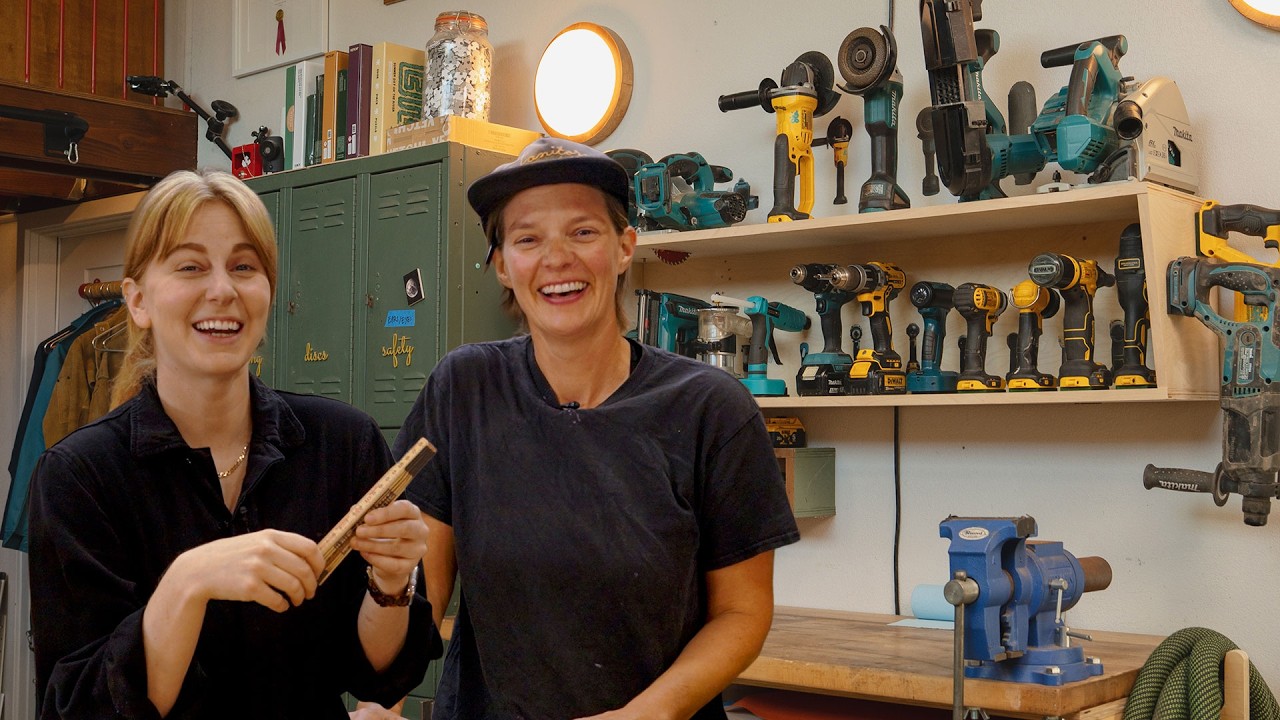
Simone Giertz stood in her workshop staring at a tool cart she described simply as ‘hell,’ surrounded by power tools with nowhere logical to live. For anyone who has ever lost twenty minutes hunting for a drill in a pile of other drills, the frustration is instantly recognizable. The fix she landed on was equal parts practical and quietly brilliant: photo printouts of every tool, positioned behind each one on the wall, so there is zero ambiguity about where anything goes or how it faces.
Bringing in the right person for the job
Giertz did not attempt this alone. She called in her friend Laura, a woodworker with enough hands-on confidence to talk Giertz out of overcomplicating things at every turn. The two had built a tool wall together once before, and Giertz was happy to, as she put it, ‘weaponize my incompetence’ against Laura a second time. Laura arrived with what Giertz called ‘German gusto,’ assessed the available wall space (six feet wide by three feet three inches deep, a measurement that briefly defeated both of them in imperial units), and immediately started simplifying the plan. Where Giertz had imagined a complex wall-mounted arrangement for most of the tools, Laura suggested two shelves instead. Then she drove back to her own shop to cut the veneer pieces on her own equipment, leaving Giertz alone to wrestle a heavy section into position by herself. ‘I am capable even without Laura,’ Giertz announced to no one, before getting it done.
The photo system that makes the whole thing work
The part that makes this more than just another workshop tidy-up is the labeling approach. Giertz set up a small photo studio in the workshop and shot ‘beauty shots’ of every power tool, noting their exact orientation. She printed those photos and placed each one behind its corresponding tool on the shelf. The result means anyone, including a future sleep-deprived Giertz, can return a tool to exactly the right spot without guessing. She had a firm opinion about the alternative: tracing tool outlines directly onto a wall is, in her words, ‘so stupid,’ and she is ‘not allowed’ to do it because of how ugly it looks. A printed photo of the actual tool, though, she called ‘kind of charming.’
When Laura returned with the finished shelves, the two discovered that nearly every power tool fit on the two surfaces without needing wall mounts at all. They arranged the tools, made what Laura described as a ‘forbidden plunge cut’ to create extra clearance for one blade, and mounted everything to studs. The finished layout prompted a brief comparison to a Formula One podium.
A Makita angle grinder, front and center
One of the first tools to get the photo treatment was a Makita angle grinder, visibly banged up from years of use. Giertz photographed it, printed it, and positioned it on the shelf. It sits there now with its portrait behind it, scuffs and all.
Giertz has said before that working on the workshop itself rather than on a project always makes her feel a little guilty. But the finished wall changed her thinking: ‘Sometimes you got to play the sport, but sometimes you got to work on the court.’