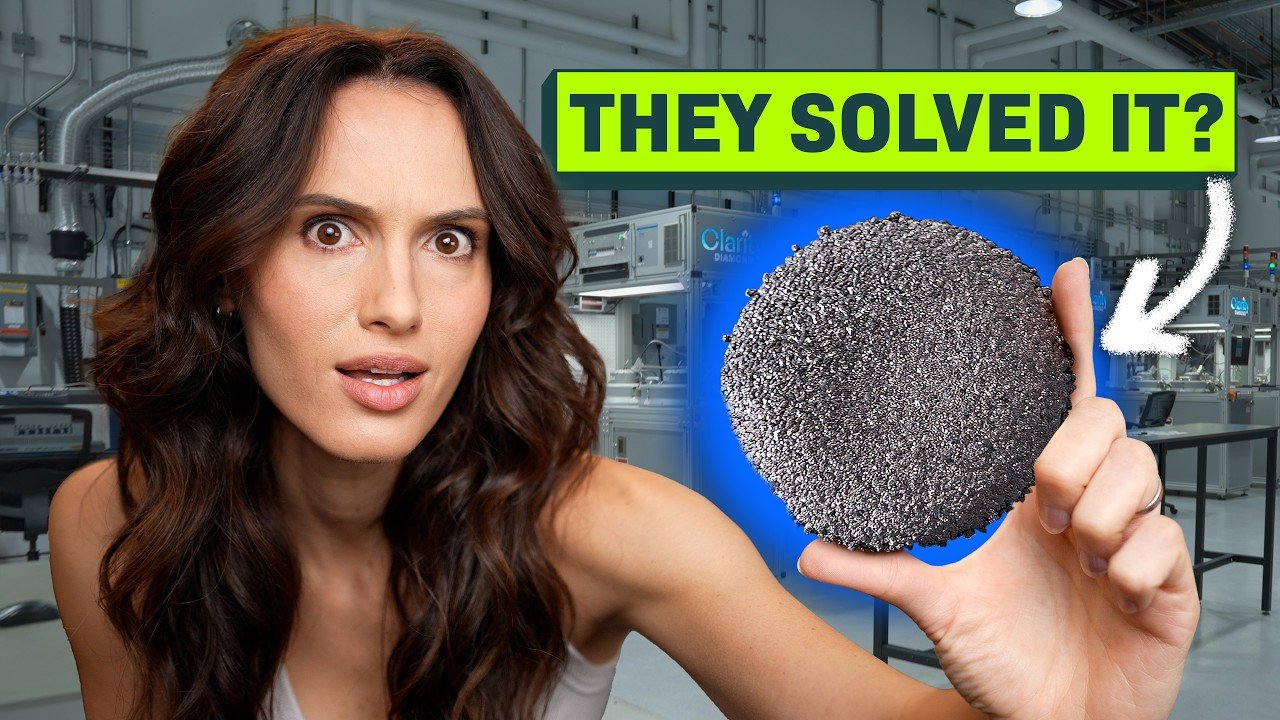
Cleo Abram stood inside a lab filled wall to wall with humming machines, a fistful of razor-sharp diamond fragments balanced on her palm, and a warning still ringing in her ears: ‘Be very careful, see these little crystals? They’re sharp.’ What she was holding was not destined for anyone’s engagement ring. It was the leading edge of a material science experiment that researchers believe could reshape how every computer on Earth handles heat, and by extension, how much computing power humanity can actually build. The problem is urgent, the material is ancient, and the solution is being grown inside microwave chambers from nothing but methane and hydrogen.
Why silicon is running out of room
For decades, the story of computing has been one of relentless miniaturization. The transistors inside today’s chips are smaller than a flu virus, and engineers have roughly doubled the number that fit onto a chip every two years, a pattern known as Moore’s Law. That shrinkage is why a pocket-sized phone now runs more than 100 million times faster than the computer that landed humans on the moon. But physics is starting to push back. Transistors are approaching a size where they simply cannot be controlled reliably anymore, so chip designers have begun stacking them vertically rather than spreading them flat, like switching from single-family homes to multi-story apartment buildings. The catch is that stacking generates enormous heat with nowhere to escape. One of the world’s leading researchers working on diamond cooling put it directly: ‘We are packing things down into smaller and smaller and the more you compel them to run faster and harder, the more heat you are generating and that is making things less efficient until it all falls apart.’
The heat problem is not just an inconvenience inside a laptop. It sits at the center of data centers, electric vehicles, and satellites, and it puts a ceiling on nearly every ambitious future technology, from cleaner energy grids to better medicines to crewed spaceflight.
Growing a diamond from microwaved methane
The key to diamond’s usefulness here is thermal conductivity. On any chart of materials prized for moving heat, copper and aluminum sit near the top and feel impressive. Diamond is not near the top. Diamond is off the chart entirely, moving heat better than almost any other material on Earth. That is why, in one of Abram‘s demonstrations, a diamond slice cut through an ice block like it was not there, stealing the cold so fast the steel razor never had a chance.
Natural diamonds cannot fill this role at scale. Mining is expensive, and many natural stones trap foreign elements during formation that cripple their thermal performance. The only path forward runs through labs, specifically through a process called Chemical Vapor Deposition. A tiny diamond seed is placed on a heat-resistant metal puck, loaded into a chamber, and all air is evacuated. Hydrogen gas enters, a microwave generator ten times as powerful as a home unit fires up, and a glowing plasma cloud forms. Then methane arrives, the plasma tears it apart into carbon and hydrogen, and over weeks, carbon atoms deposit layer by layer onto the seed. Abram watched the chamber shift color as the methane hit: ‘Oh, it’s starting to happen. You can already see it turning green.’ What eventually emerges is purer than anything pulled from the Earth, and it can be grown into any shape a chip designer needs.
The first diamond-cooled server was an Nvidia H200. There are already diamond-equipped satellites in orbit, where the material’s radiation resistance makes it especially valuable. And in a recent test at a data center in San Francisco, a diamond cooling layer doubled the compute output of a GPU. The researcher delivering that number flagged its own novelty: ‘This is hot off the press by the way. We just got this data last week.’ Other lab results have shown temperature reductions of 70 degrees Celsius, against an industry threshold where today’s applications are typically satisfied by just 2 degrees. If those numbers hold, the implication is stark: instead of building two conventional data centers, you might only need one.
The 580-carat diamond in the room
Sitting at the center of the lab Abram toured was a 580-carat diamond grown entirely inside one of those machines, a rough, industrial-looking object with no intention of ever becoming jewelry.
That diamond, and the hundreds like it being produced in chambers across the same facility, represents a bet that the material which formed deep inside the Earth under pressure equivalent to balancing a commercial airplane on a single fingertip can now be replicated reliably enough to wrap around the chips powering artificial intelligence, satellites, and electric cars. The researchers are careful about certainty. Diamond transistors, diamond drug delivery, diamond radiation shields for deep-space electronics: all of it remains, as Abram put it, ‘HUGE* If True.’ But the world’s first diamond-cooled server already exists, the data centers are already running tests, and the machines are already humming.
 Wake up to Only Happy News!