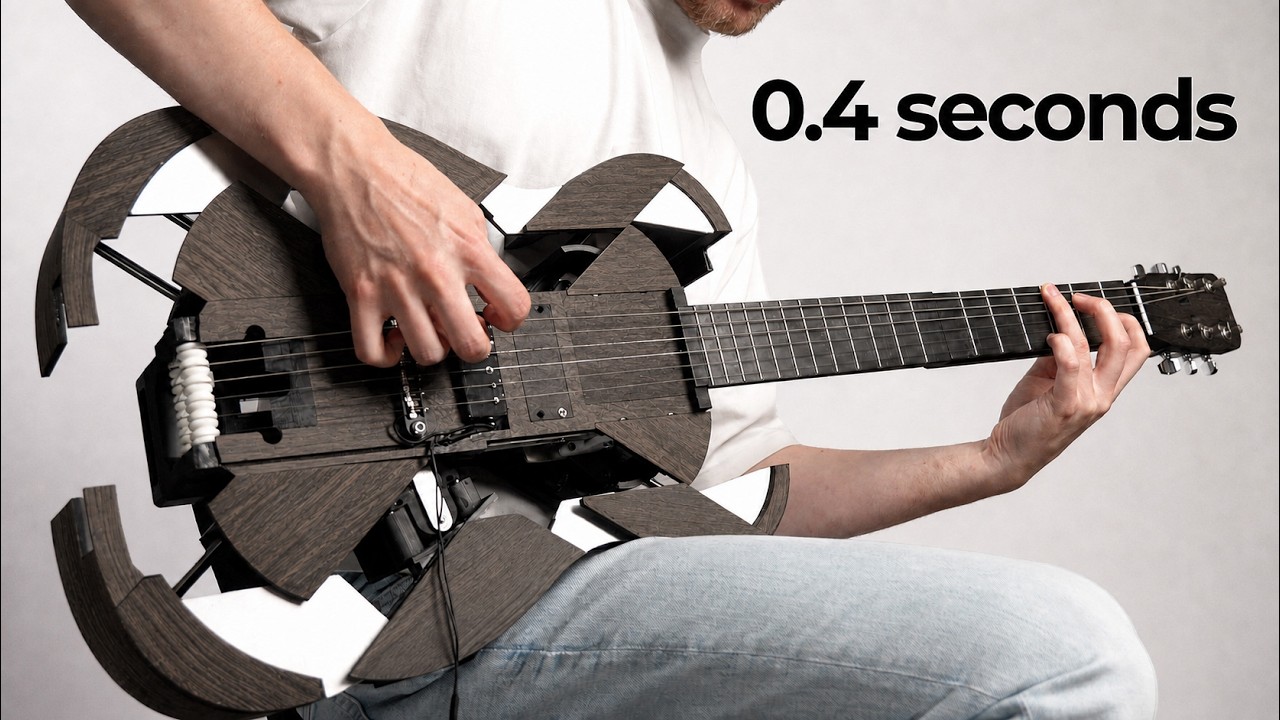
Mattias Krantz was standing on a street corner playing a ukulele, and nobody was impressed. That is exactly the point. The ukulele is inexpensive, portable, and easy to learn, but as Krantz put it plainly, ‘it’s the only instrument where getting good at it actually makes people respect you less.’ So he spent months engineering a solution: a ukulele that physically transforms into a full-size guitar mid-performance, on stage, in front of a live audience.
The neck that had to disappear completely
The first engineering wall was obvious. A ukulele neck is short. A guitar neck is long, roughly 10 inches longer. Krantz initially found inspiration in a historical instrument called the Cithara orbo, which solved a similar problem by folding its neck outward. He tried it. In guitar form it was passable, but as a ukulele it left half a guitar neck jutting into the player’s fretting hand. Completely unplayable.
What he needed instead was a neck that vanished entirely until pulled out, each section sliding into the next like a telescoping antenna. The concept was clean. The execution was not. Once extended, the fretboard had to rise to an exact level flush with the fixed section, and the whole assembly had to withstand 80 pounds of string tension without bending. After one sleepless night of prototyping, the sliding mechanism worked beautifully. Then he put strings on it. It bent like crazy.
That is when he called material scientist Adam Damato. Damato added a steel core, then redesigned the moving parts so that when the neck reached full extension, every component snapped together and mutually reinforced the structure. The result was a neck that did not bend at all under full string tension. ‘I love Adam,’ Krantz said afterward, and it is hard to argue with him.
Custom strings twice the normal length and a fishing-reel moment
The string problem turned out to be its own multi-month rabbit hole. Strings cannot stretch even a millimeter, so attaching them in ukulele form locked the instrument there permanently, and attaching them in guitar form left them hanging loose when retracted. Krantz tried rubber bands. He tried a rope-driven fishing-reel mechanism that fed string out as the neck extended and wound it back as it retracted. The rope stretched, wrecked the tuning every single time, then eventually snapped and ‘the entire guitar just exploded.’
The real solution came from a geometric loophole: if the strings were simply long enough, strategically placed rollers inside the body could let the strings wind around themselves automatically during transformation. The catch was that he needed strings roughly twice the length of any commercially available guitar string. He had them custom-made. They arrived 20 days later. They worked.
The body transformation required six separate sections, each moving a different distance at a different angle. After three attempts on the first section alone, and after the combined mechanism seized up completely once too many plastic parts were added, he brought in a collaborator to redesign the moving parts in metal. ‘It works so well suddenly,’ was the verdict the moment the metal version was assembled.
Designer Shervin then handled the visual plates that cover the mechanical skeleton, turning the raw engineering into something that actually looked like a guitar when extended.
The street corner where everything changed
Krantz took the finished instrument out in public. People walked past a man playing a ukulele without a second glance. Then the neck slid out, the body expanded, the guitar emerged, and the reaction flipped instantly. For a stretch of time, he was pulling the transformation out everywhere, and as he described it, gaining genuine respect from playing a ukulele for the first time in history.
The final test came on a live stage. A band’s guitarist agreed to bring the instrument up during an actual performance. When the moment came to transform, it got briefly stuck. Then it happened. The audience erupted.
The guitarist who almost did not get his moment
When the transformation hesitated on stage, the guitarist held his position, waiting. The instrument had survived rubber bands, exploding ropes, a sleepless night, 20 days of waiting for custom strings, and two full mechanical overhauls.
The cheering that followed was the first time in recorded history that a ukulele performance closed with a standing ovation, and that detail is genuinely not something Krantz could have planned for, because the stuck moment made it real.
Back on the street corner where it all started, a man playing a short-necked instrument nobody took seriously is now the same man who turned that punchline into a full-size guitar in front of a crowd that had no idea it was coming.