Dexter the capuchin monkey had a decision to make. Perched at a picnic table that Mark Rober had dubbed the ‘biological engineering station,’ the small primate surveyed two grown men competing loudly for his attention, and then made his choice with the casual authority of someone who has never once second-guessed himself. Crunch Labs, the summer science camp that brings kids and special guests together for hands-on experiments, had just gotten its strangest and most charming lesson yet. And neither Rober nor his guest, digital illusionist Zach King, was prepared for what the afternoon had in store.
Three animals, one picnic table, zero prior warning
The session was billed as a Camp Crunch Labs first: live animals, presented by Science Bob, the official animal handler on site. The premise was simple. Bob would demonstrate a piece of human engineering, Rober and King would guess which animal had been using the same principle for millions of years, and the animal would be revealed. Nobody told Zach there would be live animals beforehand, which he corrected immediately by vanishing and reappearing in a full camouflage suit.
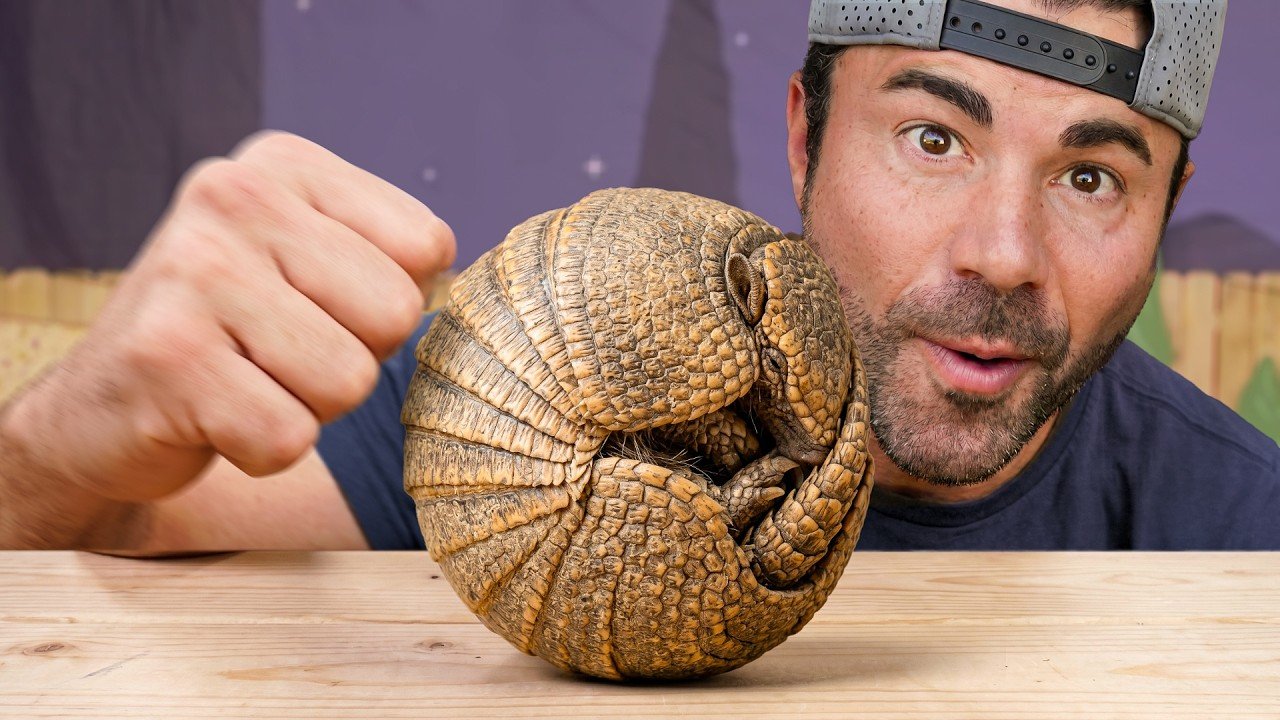
The first reveal was a three-banded armadillo. Rober had guessed armadillo, King had gone with pill bug, and a camper named Naveen had confidently said rhino. The animal arrived curled into what Rober immediately compared to a cantaloupe, its overlapping scutes forming tight natural armor. Bob explained that three-banded armadillos can jump three feet straight up, a jump no other armadillo species can match, and that they are insectivores. A small pile of mealworms was placed on the grass nearby, and by the time the group had moved on, the worms had completely vanished. Rober noticed this, picked one up that had been missed, and ate it. ‘That is like 2 grams of protein,’ he said, apparently counting macros.
The second animal was an eagle owl named Phyllis. Bob had set up a parabolic microphone and a pair of vise grips to represent the owl’s two signature tools: a dish-shaped face that funnels sound to the ears, and talons that Bob had calibrated to approximately 300 pounds of pressure, enough to split a walnut clean through. Phyllis tilted her head repeatedly during the demonstration, which Bob explained was motion parallax, the owl triangulating sound and depth simultaneously. Her feathers were so densely fringed, Bob noted, that she could fly directly over a person’s head without being heard or felt, and her actual body beneath all those feathers is no larger than a pigeon.
The moment Dexter picked a side
The final clue was a human brain model, and the animal was Dexter, a capuchin monkey who arrived carrying the full confidence of someone who has done this before. Capuchins, Bob explained, live in groups of 10 to 30 and are highly social, which is part of why they appear in films so often. Dexter had been given banana gummies and seemed pleased about this arrangement.
What Dexter had not been briefed on was that two adults would spend the next several minutes trying to out-charm him. King, dressed in his camouflage suit, extended his arms and called out ‘come to papi’ in a tone that suggested he considered this a genuine competition. Rober countered. Dexter moved between them several times before settling into a clear preference, prompting King to announce, with real satisfaction, ‘who is the king now?’ Rober put it plainly when it was all over: ‘That was the coolest thing that has ever happened to me.’
Kids watching from camp had been submitting early entries for the summer’s three at-home super challenges, a Rube Goldberg machine that must include water, a slow-motion video that must feature googly eyes, and a reverse video that must include food, all due to campcrunchlabs.com by August 8th.
Rick, still searching
After Dexter left with Bob, the three-banded armadillo, now named Rick by Rober, had uncurled fully on the table and was working his long tongue methodically across every surface in range, still looking for mealworms.
Rick found no more worms, but he kept looking anyway.
 Wake up to Only Happy News!