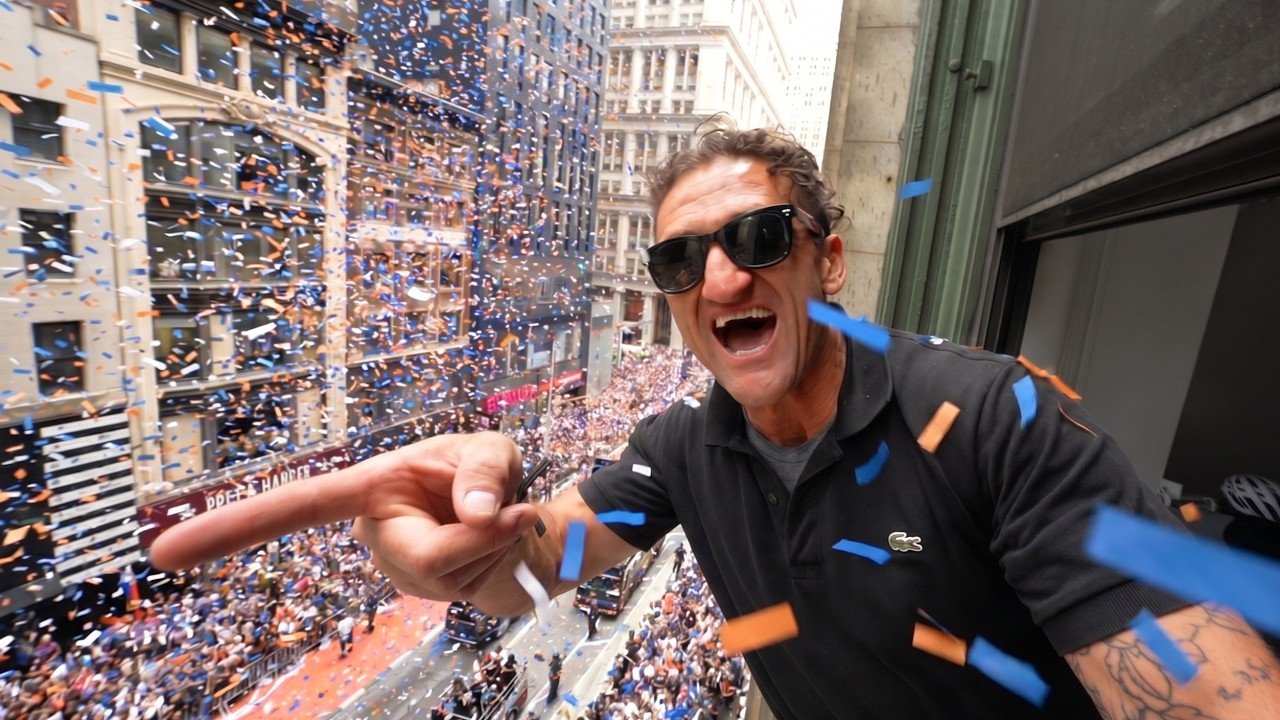
At 10 a.m. on June 18th, 2026, Broadway turned gold. The New York Knicks came rolling down the Canyon of Heroes for the first time in 56 years, and the city that had been quietly losing its mind since the night before finally let everything out at once. For anyone who has ever loved a team through decades of near-misses and heartbreak, this was not just a parade. It was a reckoning.
The city started lining up before the sun did
Casey Neistat was on Broadway the afternoon before, 19 hours ahead of the start, and the bleacher seats were already filling. One man had claimed his spot at noon the day prior. ‘Die hard, bro,’ he said, without a trace of irony. ‘Been a long time, bro.’ By 4 a.m. the line stretched back far enough that getting through security meant running a gauntlet of nine separate checkpoints, each one manned by officers who were skeptical about a boosted board and a backpack. At one point Neistat navigated what he described as ‘a bizarro alternative universe where the entire city of New York is only populated by police officers.’
Workers at a building at 55 Broadway were boarding up windows the afternoon before. The city had towed every parked car south of Canal Street between the East River and the Hudson. Trees along the route had been trimmed back so spectators could see over them. The preparations were not subtle.
By 6 a.m., four hours before the parade began, Neistat was on the Brooklyn Bridge in light rain. The clouds that had rolled in the evening before, prompting genuine anxiety among the crowds gathering near city hall, had softened but not fully cleared. One woman summed up the city’s attitude toward the weather question with the directness New York reserves for obvious answers: ‘It’s still happening. New York, baby.’
The ticker tape came down anyway
The route ran north from the Battery up Broadway to city hall, the same corridor that has swallowed confetti for astronauts and war heroes and championship teams going back to 1886, when stockbrokers first started throwing paper out of windows during the dedication of the Statue of Liberty. The Knicks had not been on this street as champions since 1970.
By the time the floats reached the city hall end of the route, the paper falling from the windows looked less like confetti and more like weather. The crowds outside, packed so densely that Neistat described being ‘fully stuck,’ had apparently been asking for one thing while they waited: toilet paper thrown from above. They got it. They got most things they wanted that morning.
A sign taped to a building the night before
Somewhere on Broadway the afternoon before the parade, workers were taping hand-lettered signs to a building facade in preparation for the route. The signs were still going up when Neistat stopped to watch.
The parade came down that same stretch of street less than 24 hours later, and whatever was written on those signs disappeared into the noise.