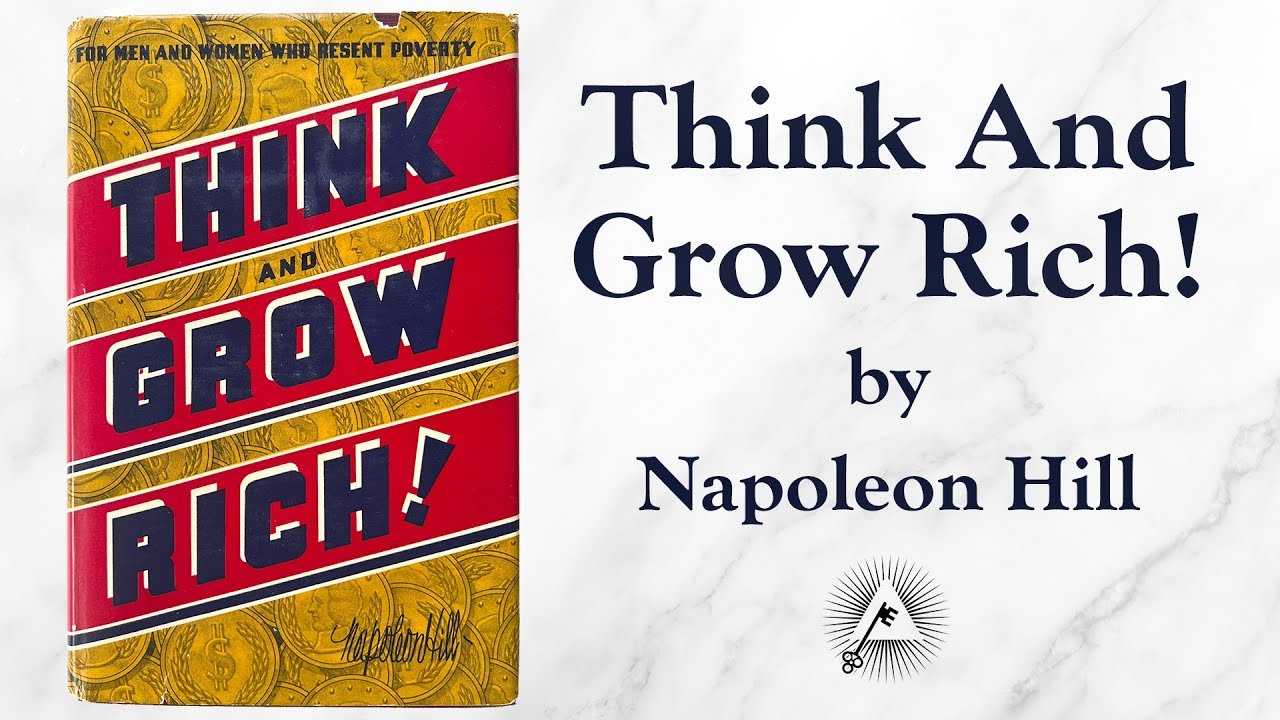
Edwin C. Barnes arrived at Thomas Edison’s laboratory in Orange, New Jersey looking, by Edison’s own account, ‘like an ordinary tramp.’ He had ridden there on a freight train because he lacked the railroad fare, and he walked through the door to announce he had come to go into business with the world’s most famous inventor. What made that audacious arrival matter to anyone beyond Barnes and Edison is the same thing that made Napoleon Hill spend twenty-five years researching it: the gap between a wish and a burning desire is the entire distance between an ordinary life and an extraordinary one, and Hill believed he had found a map across it. That map, first published in 1937 by The Ralston Society and now read aloud in full by Dan John Miller for Master Key Society, is ‘Think and Grow Rich,’ a book Hill describes not as entertainment but as a textbook assembled from the experiences of more than five hundred men who built their wealth from nothing but organized thought.
The story behind the secret that never gets named
Hill opens by refusing to name the secret directly, insisting it works more powerfully when the reader discovers it themselves. He traces it to a meeting with Andrew Carnegie, who, in Hill’s telling, ‘carelessly tossed it into my mind when I was but a boy,’ then watched quietly to see whether the young man had understood. When Carnegie saw that he had, he asked whether Hill would be willing to spend twenty years preparing to carry the idea to the world. Hill agreed, and the book is the result of that agreement.
The stories Hill uses to demonstrate the principle are specific and grounded. R. U. Darby’s uncle struck gold ore in Colorado, brought in machinery, and then quit drilling when the vein vanished, selling the equipment to a junk dealer for a few hundred dollars. A mining engineer called in by the junk dealer calculated that the vein would be found just three feet from where the Darbys had stopped. The junk dealer extracted millions. Darby carried the lesson into a career selling life insurance and eventually became one of fewer than fifty people in the country who sold more than a million dollars of coverage annually. He later told Hill plainly: ‘The better portion of all sales I have made were made after people had said no.’
Hill’s most personal illustration involves his son Blair, born without normal hearing capacity. Rather than accept the doctor’s prognosis of permanent deaf-mutism, Hill spent years transmitting to the child a burning desire to hear. Blair discovered that pressing his teeth against the edge of their victrola cabinet while it played allowed him to perceive music through bone conduction, a principle the family had never heard of at the time. During his final week of college, Blair tried a new electrical hearing device and, Hill writes, ‘as if by a stroke of magic, his lifelong desire for normal hearing became a reality.’ Blair went on to spend his career helping other hard-of-hearing people access the same changed world. A noted specialist who examined Blair later told Hill that ‘theoretically, the boy should not be able to hear at all,’ given that X-rays showed no opening in the skull from where his ears should have been to the brain.
What the thirteen principles actually ask of the reader
The book’s structure builds from Desire through Faith, Auto-suggestion, Specialized Knowledge, Imagination, Organized Planning, Decision, and Persistence, among others. Hill is careful to distinguish between wishing and deciding. His chapter on Decision notes that analysis of more than 25,000 people who had experienced failure showed that lack of decision ranked near the top of thirty major causes of failure. People who accumulated fortunes, Hill found, reached decisions promptly and changed them slowly; people who failed reached decisions slowly and changed them quickly and often.
The Persistence chapter uses Fannie Hurst’s four years of pavement-pounding in New York, collecting thirty-six rejection slips from one publication before breaking through, as a case study in the difference between quitting and continuing. Hill frames persistence not as brute stubbornness but as a cultivatable state of mind, built on definiteness of purpose, burning desire, self-reliance, and a circle of harmonious allies he calls a Master Mind group.
Dr. Miller Reese Hutchison, a consulting engineer and associate of Thomas Edison who reviewed the manuscript, put the reading prescription plainly: ‘No more than one chapter should be read in a single night. The reader should underline the sentences which impress him most.’
The six cents Barnes never had
Blair Hill, the son at the center of the book’s most personal chapter, sat in bed asleep on the evening of his first solo business venture, his net profit of forty-two cents clenched tightly in his hand.
Edwin Barnes walked off a freight train with no money and no connection to Edison, and walked out years later with a national distribution contract and a slogan printed on Edison products across the country. The same laboratory door. A different quality of desire.
Source: Watch original
This article was reported in June 2026.
OHN Editorial Note: This article is based on publicly available sources. If you spot an error or have updated information, contact us at editorial@onlyhappynews.com. We correct mistakes promptly.