Ben Felix, chief investment officer at PWL Capital, opens with a confession that reframes everything he has built his career around: he used to believe that working, saving, and investing were about accumulating as much money as possible. That assumption, he now argues, is exactly what keeps people from living well. The research he assembled for this project changed how he thinks about every financial decision he makes, and the implications stretch far beyond spreadsheets.
Why the income-happiness link is weaker than almost anyone thinks
A 2010 study on a US sample found that life satisfaction rises steadily with income, but experienced, day-to-day happiness plateaus at around $75,000, which translates to roughly $112,000 today. A 2018 study went further, identifying what the researchers called points of income satiation: for North America, life evaluation stopped increasing at around $105,000 (about $137,000 today), while experienced happiness leveled off at around $65,000 (about $85,000 today). A 2021 study using a smartphone app that asked participants ‘how do you feel right now?’ multiple times daily found no such plateau, prompting the authors of the 2010 and 2021 studies to team up in what they called an adversarial collaboration published in 2023. Their reconciliation: happier people do keep seeing well-being gains at higher incomes, while less happy people hit the plateau the original study described.
The numbers themselves, though, are worth sitting with. The correlation between average happiness and log income in the experience-sampling data is 0.09. The difference in happiness scores between a household earning $15,000 and one earning $250,000 is about five points on a 100-point scale. Felix puts it plainly: ‘an approximately four-fold difference in income is about equal to the effect of being a caregiver for a disabled or elderly family member, about twice as large as the effect of being married, and less than a third as large as the effect of a headache.’
The pursuit of money for its own sake carries an additional cost. People focused on extrinsic objectives like money, fame, and image tend to be less happy than those oriented toward intrinsic objectives like growth, intimacy, and community, and they consistently overestimate the emotional benefits of hitting their financial targets.
The decisions that actually shape how life feels day to day
Felix organizes the evidence around a framework from positive psychology called the PERMA-V model: positive emotion, engagement, relationships, meaning, accomplishment, and vitality. None of the factors have a fixed optimal allocation, but together they describe what research finds tends to make people evaluate their lives as good.
Two practical areas receive close attention. First, the time-money trade-off. People who prioritize time over money, choosing fewer hours and less income rather than more of both, report greater happiness, stronger social connection, and a better relationship with their partner. Second, homeownership. Citing studies from Canada, Switzerland, the United States, and Germany, Felix finds that owning a home does not make people happier than renting once other variables are controlled for. In one American sample of 600 women, homeowners were no happier than renters and spent less time on enjoyable activities. In the German sample, ownership did raise life satisfaction, but far less than buyers had expected when they made the decision.
Felix also flags noise as one of the few stressors people genuinely do not adapt to: variable or intermittent noise continues to raise stress hormones even after years of a long commute, while the larger house that justified moving further away tends to fade into the background quickly.
Spending on experiences outperforms spending on things for the same reason the PERMA-V model predicts: experiences generate engagement, they are more likely to be shared with others, and they are harder to adapt to because each one is unique. A simple test Felix proposes for any purchase is to ask how it will change how you spend your time, since time use is more predictive of happiness than stable financial circumstances.
A goal on a whiteboard that does not match who you will be
In 2022, Felix ran a study of 310 participants, largely listeners of his podcast, asking them to write down their goals, then double the list, then consider the PERMA-V categories as prompts. Morningstar’s behavioral research team analyzed the results using natural language processing and found that after being introduced to the model, people listed deeper goals reflecting their values rather than surface-level targets like retirement. The master list generated by the study is available on the PWL Capital website.
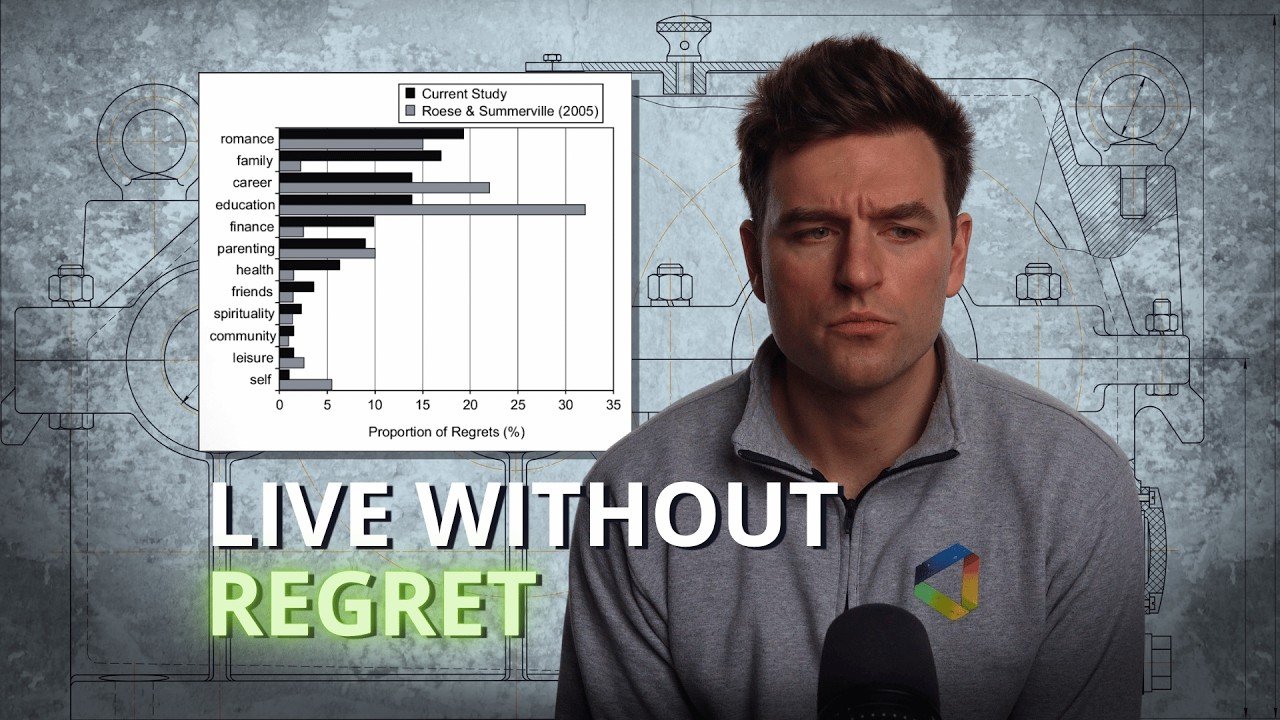
Regret research adds a longer lens. In work for his book on regret, Dan Pink found in a large US sample that people most commonly regret inactions rather than actions. Regrets about things done tend to dissipate; regrets about roads not taken linger. Felix frames this as relevant to financial decisions where playing it safe, declining a job, not starting a business, feels painless in the moment but compounds into something harder to reverse.
The master list, still open on the screen
The PWL Capital goal master list sits on a website, populated by 310 people who pushed past their first answer and found something closer to what they actually wanted.
The first step in finding a good life, Felix concludes, is finding a good life. Not the retirement number. Not the target income. The actual one.