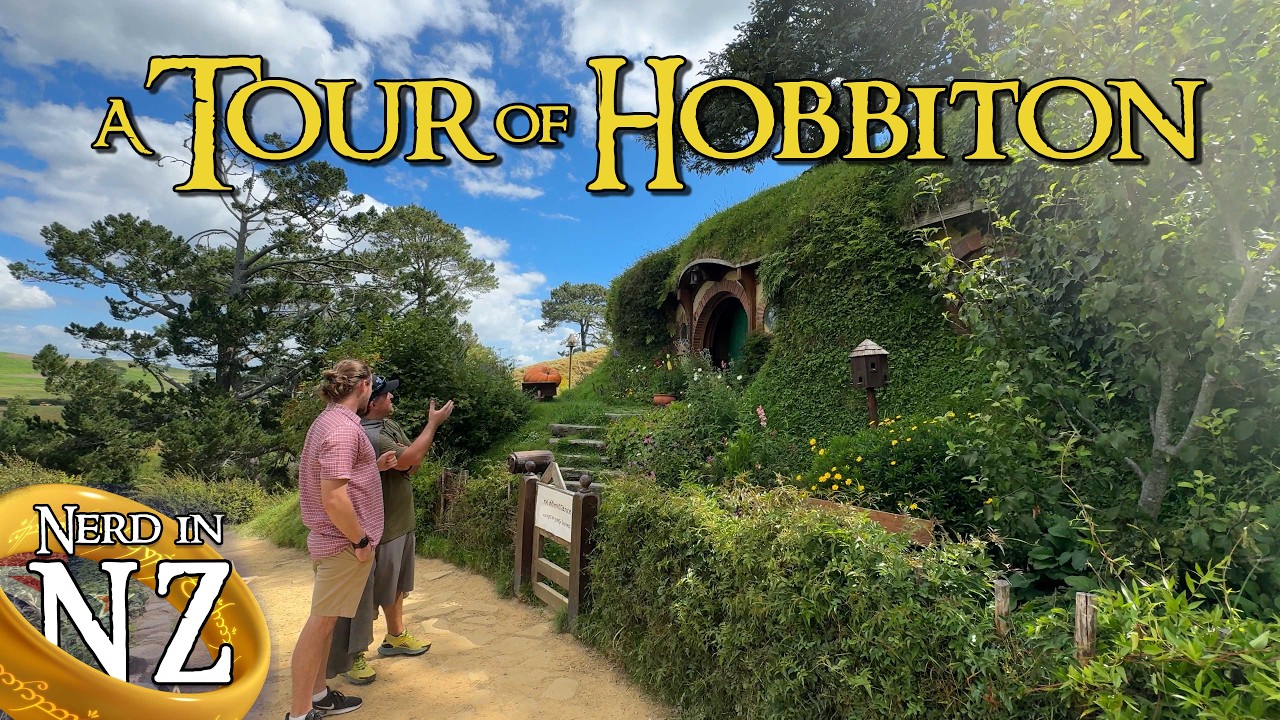
Luke stopped walking just long enough to point out the smoke. Real wood chips were burning inside the chimneys of the Hobbit holes on the hill above, and the smell drifted down the lane in a thin haze that no camera had ever needed to capture. This is Hobbiton Movie Set in New Zealand, the only surviving permanent film set of its kind in the world, and for anyone who grew up reading Tolkien or watching the films, standing here feels less like a tourist attraction and more like a mild hallucination. Luke, a Hobbiton guide and self-described film-set extraordinaire, walked the full 12 acres of it, and almost nothing turned out to be what a first-time visitor would expect.
Forty-four doors and the hierarchy of the hill
The set currently holds 44 Hobbit holes, no two of which share a design. The mailboxes do most of the storytelling work before you even reach a door: a carved fish signals an angler Hobbit, spare rods hang above the lintel, and smoked eel is strung up nearby as though market day is tomorrow. The art department, Luke explained, invented complete backstories and daily routines for every imagined resident, always anchoring their work in the books first. ‘If Tolkien gave you a reference or a character, that was their jumping-off point,’ he said, ‘and if he didn’t tell us something, the art department used that as an open brief to fill in the blanks.’
The position of each house on the hill was not accidental. Wealthier Hobbits live higher up, a rule followed from early concept work all the way through to the finished set. Bag End sits at the very top. The oak tree shading it for The Lord of the Rings was a 26-ton specimen cut from a nearby property, transported in pieces, bolted back together, and dressed with hundreds of thousands of artificial leaves and acorns held in place by high-tensile cables. For The Hobbit, set 60 years earlier in the story’s timeline, a new tree was required: smaller, younger in appearance, built in Wellington from steel, expanding foam, fibreglass, and silicon, with roughly a quarter of a million synthetic leaves. Birds nest in it year-round without complaint.
Inside Bag Shot Row, where the real Hobbits live
For years the most common piece of visitor feedback was a single request: let us go inside. The interior Hobbit holes at Bag Shot Row had only been open for four weeks at the time of the visit, and the response had already been overwhelming. The Proudfoot family home at number one Bag Shot Row is the anchor of the experience. The pantry is fully stocked with real jars of jam and honey, real mushrooms, a fish-shaped loaf set aside for feast day, and a bottle of the Golden Perch stout. A Shire newspaper called the Shire Reckoning covers a mayoral election. A child’s drawer holds a map of the Far Downs and an unwrapped present that has not yet been given. The long drop out back invites visitors to work out the purpose of the accompanying spoon for themselves.
The tree roots that break through the interior walls were never cut back or boxed in. The house was simply built around them. Luke called it the most Hobbit thing he could imagine: ‘they didn’t change it, the hobbits just lived with it and continued building around it.’
One jar that tied the whole village together
Earlier on the tour, a jar of Proudfoot’s Bellbird Honey appeared on a table outside a different Hobbit hole entirely. The label surfaced again inside the Proudfoot home, where a fill-your-own-jar station and a full honey and mead operation explained the connection. The same art department that invented the fishing rod, the fish trophy shelf, and the third-place ribbon for ‘Prettiest Piglet in the Shire’ had quietly constructed an entire domestic economy and scattered it across the set for anyone paying attention.
The guide who will not be remembered by name
Luke paused near the Green Dragon before the tour ended, holding a dark stout the pub had been pouring since Sir Peter Jackson opened its doors in 2012 alongside cast members and Roy Tolkien.
The Green Dragon is where every tour of Hobbiton finishes, a pint of apple cider, amber ale, ginger beer, or dark stout in hand, sitting in front of a fire that is genuinely too warm on a hot day and somehow still exactly right. The original Green Dragon set was burnt to the ground during production for a four-second practical shot depicting the Scouring of the Shire. This one is meant to last.