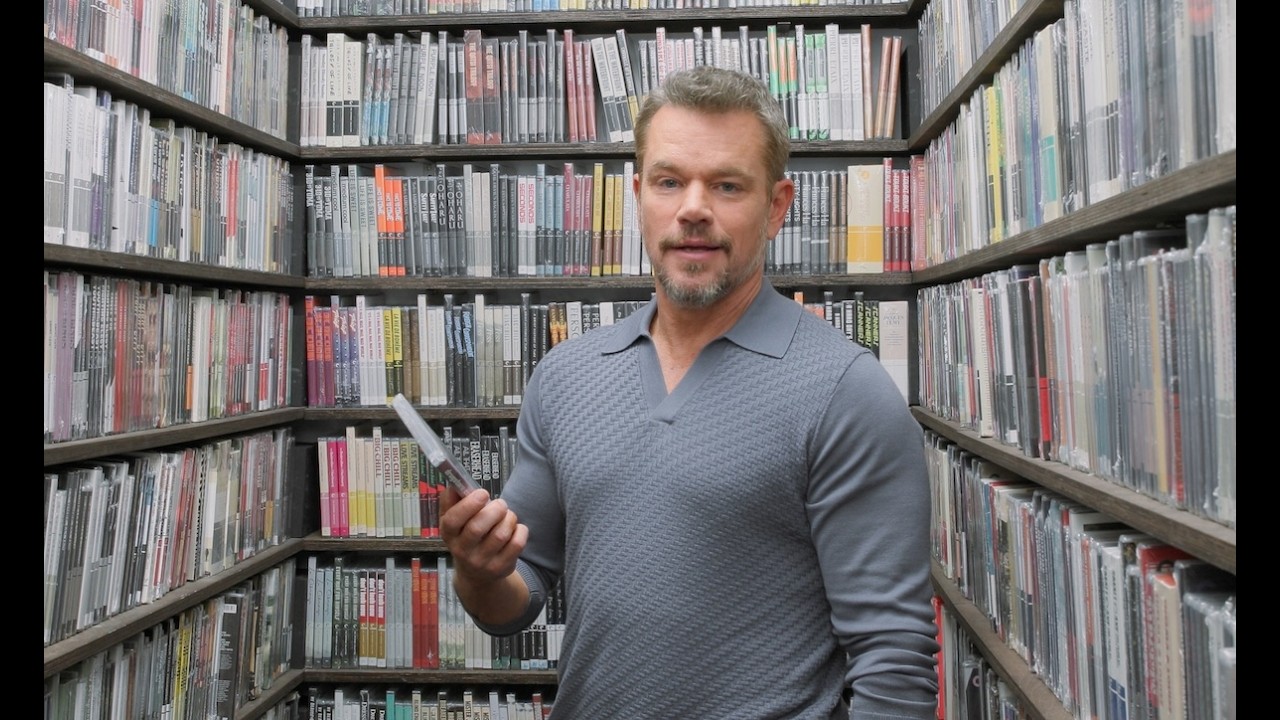
Matt Damon walked into the Criterion Closet the way most people walk into a bookshop they already love: reaching for things before he had finished deciding, holding them up, and suddenly telling stories he had not planned to tell. The Criterion Collection keeps thousands of titles on those shelves, and Damon moved through them not like a curator but like a man pulling at loose threads from his own career, finding that each one was attached to something bigger.
The movies that made Good Will Hunting possible
Damon picked up Steven Soderbergh’s Traffic and immediately framed it as a cautionary lesson rather than a trophy. He described working with Soderbergh on roughly ten films and used Traffic as the centerpiece of a philosophy the two have returned to repeatedly. ‘When things go really well in your life creatively, never protect your beachhead,’ Damon said, naming it as something he and Soderbergh have discussed many, many times. The point, he made clear, is to keep pushing rather than repeat what worked.
He lingered over You Can Count on Me, the Kenneth Lonergan film he called impossible to find even by calling Lonergan himself directly. Lonergan reportedly told him he could not locate a copy either. That film, seen roughly 27 years earlier, was his introduction to Lonergan’s writing and eventually led him to produce Manchester by the Sea with Casey Affleck. A single hard-to-find movie, in other words, generated a chain of work that spanned decades.
One False Move carried a similar kind of origin-story weight. He and Ben Affleck loved it when it came out, it was their introduction to director Carl Franklin, and it gave them their first look at Billy Bob Thornton, who wrote the film and acted in it. Damon noted that watching Thornton pull off both jobs, while he and Ben were in the middle of trying to do the same thing on Good Will Hunting, felt like a signal they might be on the right track.
River Phoenix, Tommy Lee Jones, and a campfire monologue
The title Damon searched the shelves for most deliberately was Gus Van Sant’s My Own Private Idaho. He had first seen Van Sant’s work at the Harvard Square Theatre, where Drugstore Cowboy was playing, a cinema he noted no longer exists. When he later got to know Van Sant personally, the first thing he asked about was River Phoenix’s campfire monologue. Van Sant told him Phoenix had arrived on set, set aside the scripted scene, said he had an idea, and Van Sant simply let him go. Damon took the story as a lesson about collaboration: trust your actors, and trust what they can do.
For No Country for Old Men, he was specific about his reason for returning to it obsessively. While preparing his accent for True Grit, he studied Tommy Lee Jones’s final monologue in that film repeatedly, working on it for the role. He called the monologue devastating and Jones one of the greatest actors who has ever lived.
The one he had never heard of
With his eyes closed, Damon reached blind into the shelves and came out with Barbet Schroeder’s 1976 film Maîtresse. He read the back-cover description aloud, a Paris apartment burglary, sadomasochism, the line between fantasy and reality, then paused. ‘I guess I was five when this came out,’ he said, ‘and it’s about S&M, so it’s not a mystery why I didn’t know about it. But I’ll check it out.’
He also grabbed Purple Noon, the Alain Delon adaptation of the same Patricia Highsmith novel he made as The Talented Mr. Ripley. He had deliberately avoided it before filming, on director Anthony Minghella’s instruction, and had never gone back to watch it after. He was finally ready.
The Lonergan film nobody can find
A Criterion spine of You Can Count on Me sat in his hand for a moment longer than the others. He said he had been trying to track it down to show to his kids for years.
He left the Closet carrying Traffic, You Can Count on Me, Drugstore Cowboy, My Own Private Idaho, One False Move, No Country for Old Men, Double Indemnity, Knife in the Water, Purple Noon, Maîtresse, and 12 Angry Men under his arm, a stack assembled not by theme but by the specific, unplanned way a life in film actually accumulates.