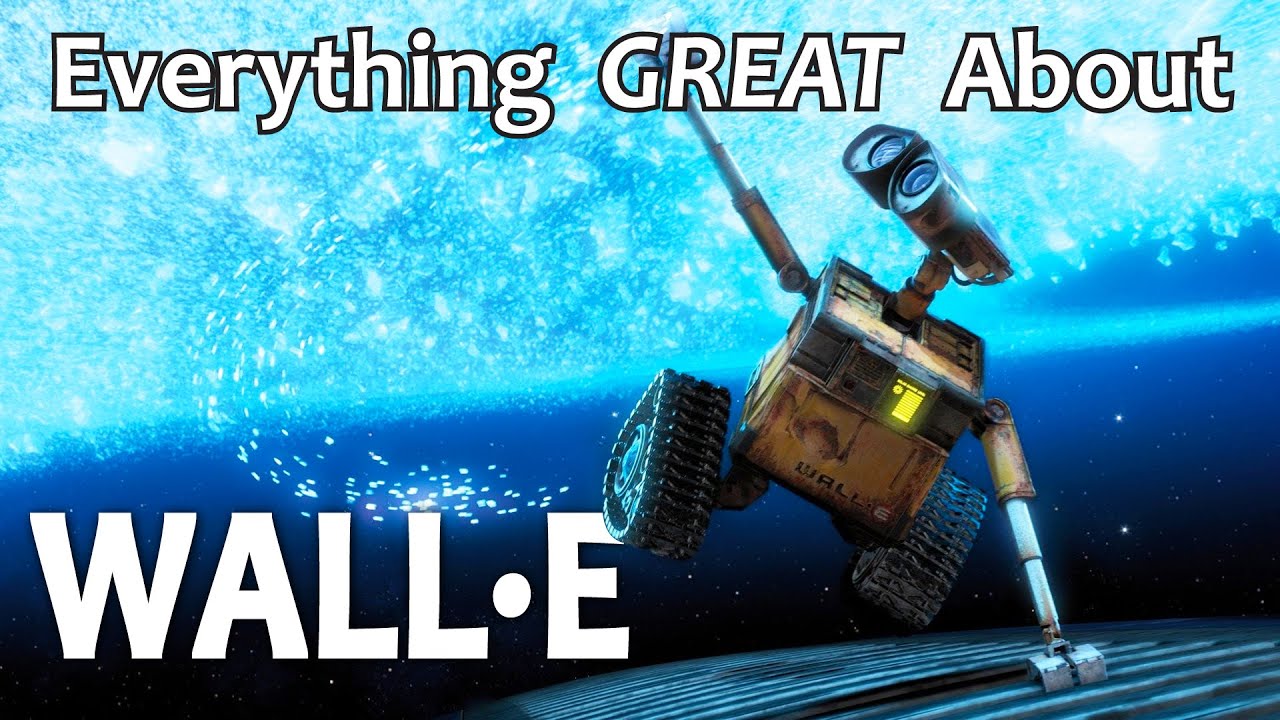
Before a single word of dialogue lands, WALL-E opens in space with a show tune so cheerful it feels almost cruel against what follows. The camera drifts toward a recognizable but ruined Earth, satellites choked in debris, and the dissonance between the song and the view does something few animated films ever manage: it builds dread without announcing it. That gap between a character’s joy and the audience’s dawning horror is what makes WALL-E one of the most precisely engineered emotional experiences Pixar has ever produced, and a close reading of every detail the film buries in plain sight only deepens that case.
CinemaWins host and creator of the ‘Everything GREAT About’ series walks through the film with the kind of attention that rewards repeat viewers, and the sheer density of intentional craft on display is genuinely staggering.
The robot who built a personality out of spare parts
WALL-E survives centuries of solitude by cannibalizing other units for replacement components, which is the mechanical explanation. The emotional one is stranger and more interesting: some glitch, possibly a lightning strike, possibly just the accumulated friction of endless error-correction, appears to have produced genuine sentience. CinemaWins frames it precisely, noting that ‘a malfunctioning robot asking questions and feeling emotions is not so different from imperfect humans whose emotions are never neat and tidy either.’
That framing reshapes the whole film. WALL-E’s curiosity, his nightly ritual of playing music to set the mood before rocking himself to sleep, his careful removal of his tracks before entering his home to keep the dirt out: none of this is accidental production design. It is a portrait of a mind assembling itself from available materials, which is also, the film quietly implies, what every person does.
The subtitles note is worth taking seriously. The sounds WALL-E and EVE make are written out, and what reads as a grunt of acknowledgment turns out to be a fully articulated response. Ben Burtt, the sound designer behind R2-D2, built thousands of individual sounds for this film, and the contrast between the two robots is embedded in the audio design itself: EVE’s effects are smooth and rounded, WALL-E’s are retro and mechanical, a smartphone beside a rotary phone.
A love story that never announces itself as one
WALL-E enters space for one reason only: EVE’s ship has come to collect her, and he will not let her leave without him. Everything that follows, the chaos aboard the Axiom, the captain’s slow awakening, the revolt of the malfunctioning robots, all of it originates in one small robot’s refusal to let the only thing he has ever cared about disappear.
The film earns that without a single speech about it. The motif that first plays when WALL-E watches EVE fly returns at the moment he finally reaches what he has been chasing, and the callback lands because the film trusts the audience to carry it. The misfit robots who cannot complete their primary functions turn out to be exactly the ones needed at the end, which is the kind of structural payoff that only works when a story has been built carefully from the first frame.
The humans, by contrast, have no such animating force. Multiple generations have accepted the Axiom’s blue lines and never questioned them. When WALL-E is rebooted with all memory wiped, his blank eyes and mechanical compliance mirror exactly what the humans around him have always looked like. The film does not underline this. It simply places it in frame and moves on.
A discarded Dinoco lighter that refused to go out
Among all the artifacts WALL-E has collected across what may be centuries, a small lighter catches EVE’s attention early. He carries it with him for the rest of the film, not because it is useful, but because she was briefly enchanted by it. A lighter that should have run dry decades ago, still producing a flame in the low gravity of the Axiom’s corridors.
The Axiom itself is a vessel of managed forgetting, every surface selling something, every passenger on a predetermined route. WALL-E’s presence there is a disruption that the ship was never designed to absorb. By the time the closing credits roll through cave drawings, technical sketches, and paintings that trace humanity reclaiming its own history, the film has argued, without ever quite stating it, that inconvenience and imperfection are not problems to be optimized away. They are the whole point.
Back on Earth, in the salvaged home where a very old battery went from three bars to zero after a night of music left playing, the story started with one small robot who noticed the stars above his trash heap and turned on a song to set the mood for himself. That detail, which the film drops in the first ten minutes and never explains, is probably the most quietly radical thing in it.