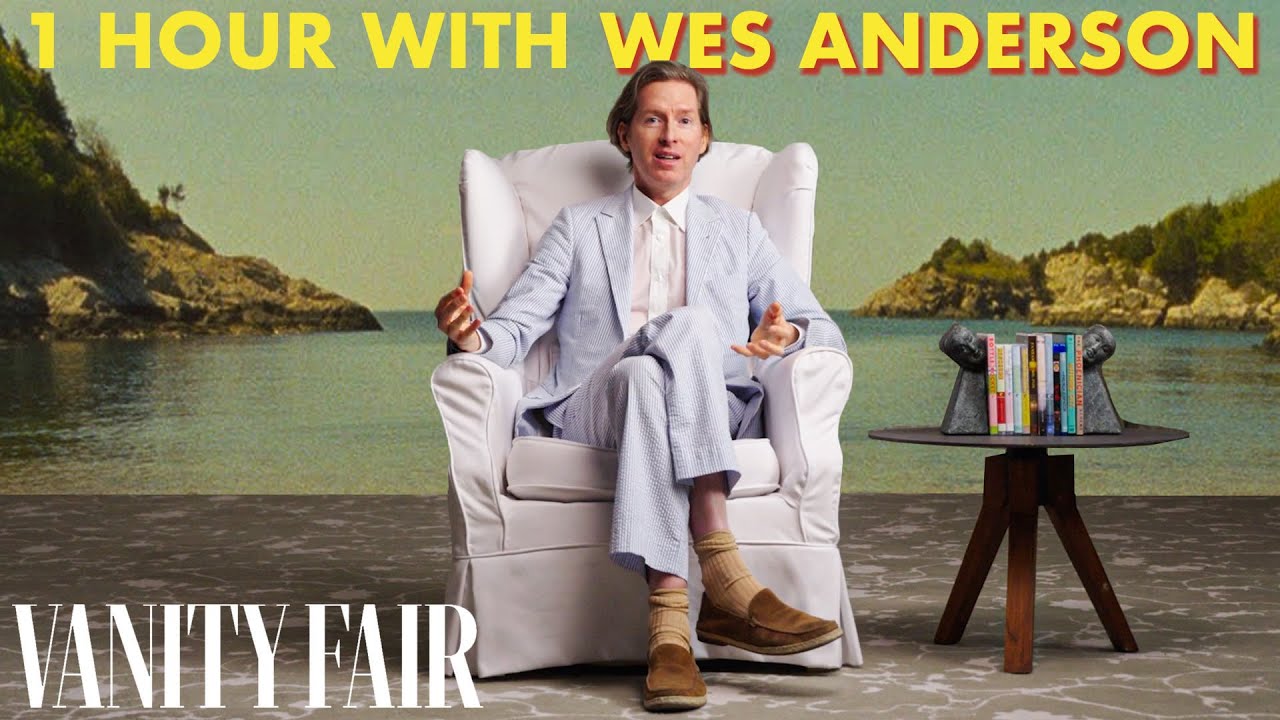
Wes Anderson settled in to describe twelve films and immediately undercut any expectation of a tidy tour: ‘When you’re writing a story it often feels less like you’re doing architecture and more like you’re doing excavation,’ he said, ‘like it’s something that already exists and we’re just unearthing it.’ That instinct, trusting the buried thing over the blueprint, turns out to explain a lot about how every film he has made actually came to be. For anyone who has ever loved a frame of his work and wondered where it came from, his own account is stranger, messier, and more interesting than any retrospective analysis could manage.
From a bad first take in Texas to Bill Murray on a golf deadline
It started at the University of Texas, where Anderson and Owen Wilson wrote the script for Bottle Rocket while they were students. They made a short film first, with Owen and his brother Luke in it, and the first take they shot was, by Anderson’s own assessment, very bad. They ran out of money before they could finish and eventually found their way to producer Polly Platt and James L. Brooks, who gave them the chance to make a feature. Anderson describes the process of working with Brooks on the script as essentially taking a private screenwriting class, cutting a very long comedy down to something manageable. His director of photography on that film was Robert Yeoman, who went on to shoot more than ten films with him.
For Rushmore, he and Wilson had already been developing what they called their ‘school movie’ before Bottle Rocket was even finished. Jason Schwartzman auditioned in a rented house after his cousin mentioned to a casting director that the character sounded like him. Bill Murray came aboard with one condition: he needed to be able to leave for Pebble Beach at a certain point during filming. They made it work, and Murray’s approach to being on set quietly established a template for how Anderson would bring actors into productions for years afterward, building schedules around people he could not otherwise afford.
A garbage island in Japan, a train designed to face both directions, and a nun
The Darjeeling Limited grew from Anderson falling in love with Jean Renoir’s film The River and revisiting Satyajit Ray’s work, then going to India. The production acquired train cars from across the country and built a single train they could use for filming, with the same compartment duplicated to face opposite directions so they could adapt to the sun or a change in the train’s route. He notes that once everyone was on board, there was nowhere else to go, which made it unexpectedly efficient.
For Isle of Dogs, what started as a short story intended for The French Dispatch grew too large and too expensive to contain, so it became its own stop-motion feature. He had been sitting on the image of a garbage dump as an animated setting since before Fantastic Mr. Fox and finally used it here. Greta Gerwig, Brian Cranston, Scarlett Johansson, and Yoko Ono all joined the cast.
The Phoenician Scheme, his newest film, was written specifically for Benicio Del Toro, who he first worked with on The French Dispatch. Anderson describes it as a story about a tycoon who confronts his own death at regular intervals throughout, with visions he connects loosely to a biblical thread. The character’s daughter is a nun. He mentions Luis Bunuel as a loose presence in the thinking, though he is not certain how directly it translates.
The collaborators still traveling with him
Randall Poster, his music supervisor, appeared at a farmers market during Bottle Rocket and wanted to release the soundtrack when the studio had no interest. He has handled the music on every film since. For Rushmore, Anderson had already planned certain shots to specific British Invasion songs, using a stopwatch during filming to hit the choreography.
A line about a cafe that only gets one line
In The French Dispatch, one small cafe receives a single line of dialogue in the final cut. Anderson mentioned that he had cut something else the cafe’s owner told him. ‘He told me it made me too sad,’ Anderson said. ‘I can stick it back in if you like.’
Looking back across twelve films and forward into whatever gets unearthed next, Anderson offered the thing that has kept him moving: ‘I’ve always had something else that sort of has presented itself to me from somewhere in my unconscious.’ A mission, he said, is a great thing when what you’re doing is a bit challenging. Making a film qualifies.