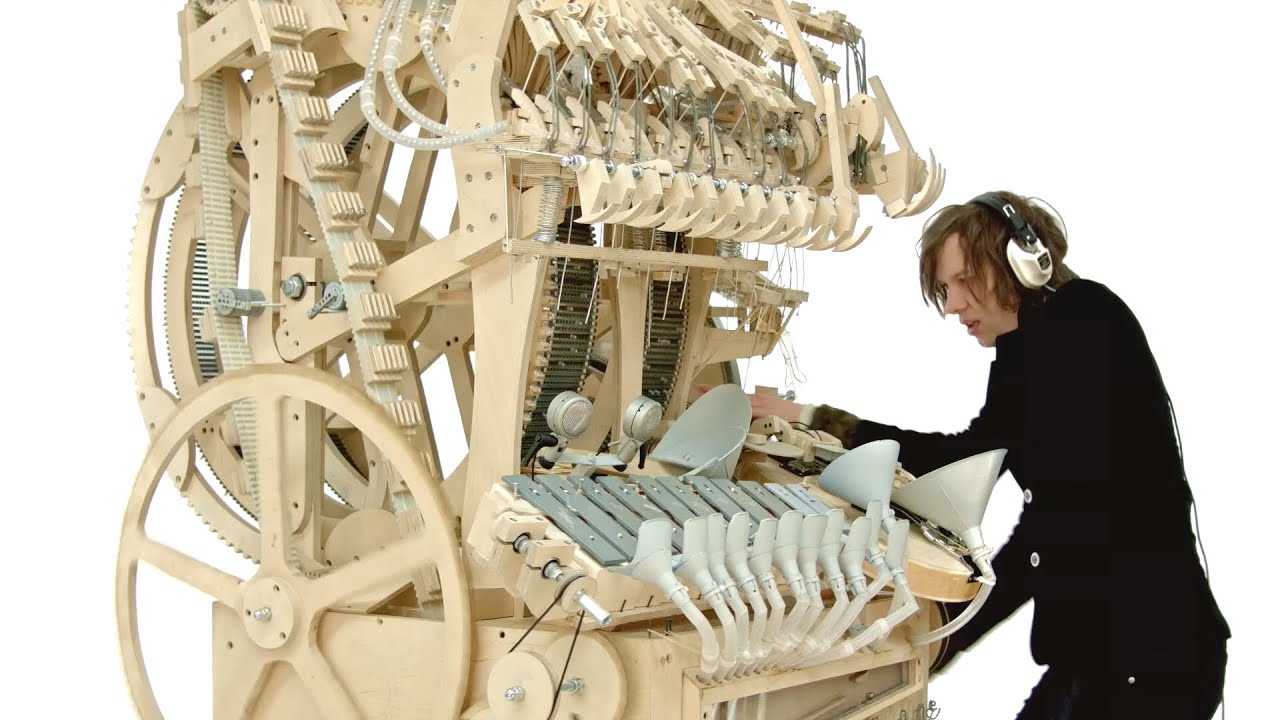
A light switch clicks. Shutters open. Footsteps cross the floor. Then 2,000 marbles begin to roll, and a vibraphone starts to sing. The Marble Machine, built by Swedish musician and inventor Martin Molin of Wintergatan, is a hand-cranked wooden instrument that uses gravity-fed marbles as its percussion and melody engine, and the moment it winds up to full speed is one of the most quietly astonishing things a listener can experience without any explanation at all.
How a wooden box full of marbles became a full band
The machine opens alone, vibraphone notes arriving one at a time as the mechanism finds its rhythm. Then the snare enters. Then a cymbal crash. Then the bass guitar, the kick drum, and the hi-hat layer in together until the machine is running at something close to a small ensemble. The marbles do not merely trigger sounds as a novelty: they are the percussive mechanism itself, routed through channels and released in timed sequences so that the rolls, clacks, and bounces between notes are part of the composition rather than noise around it.
Mid-performance, the machine brakes. Single vibraphone notes hang in the air while the mechanism is steadied by hand, a moment of manual vibrato control that makes the instrument feel alive in a way that purely electronic systems rarely do. Then it restarts. The bass note sounds. The melody rebuilds slowly, hi-hat first, then snare, then kick drum, until every voice is back and the full piece resumes as though the pause was always part of the arrangement.
The sounds the machine makes between the music
The Marble Machine performs as Wintergatan, and the track it plays is simply titled ‘Marble Machine.’ What distinguishes it from a studio recording is the physical evidence layered underneath the melody: the clack of marble release gates, the soft rolling sound of steel balls finding their path, the wood creaking as the frame absorbs the motion. At the close, the music slows, the last notes thin out, a final marble comes to a stop, and the light switch clicks off. Silence.
Molin himself has described the machine’s relationship with its own mechanics as inseparable from the music. The clacks and rolls are not cleaned out in production because they are not errors. They are the instrument declaring what it is.
A marble that briefly stopped rolling
At one point mid-performance, a soft double clack lands in the silence just before the full ensemble resumes, two small sounds from a marble finding its rest somewhere inside the mechanism, unscheduled and unrepeatable.
The shutters opened, the marbles rolled, and by the time the last one came to a stop, a wooden machine had made a complete piece of music from the inside out.