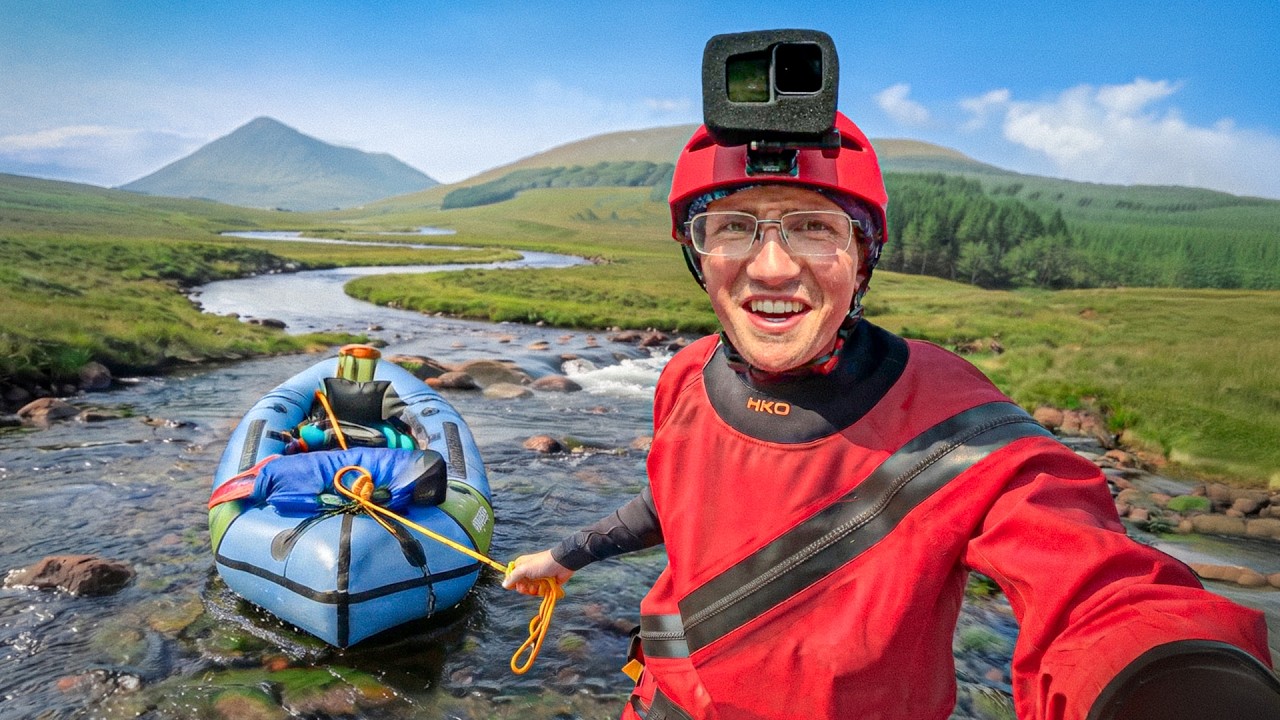
Ed Pratt stood at the edge of a rock-choked drop somewhere in the upper River Tay, staring at a hole in the riverbed where the water recirculated in a slow, grinding loop. Nobody else was out there. No rescue line, no phone signal, no one who knew exactly where he was. The challenge he had set himself, following Scotland’s longest river continuously from source to sea without leaving it, had just produced its clearest summary yet: gorgeous, unrelenting, and quietly trying to kill him.
The River Tay runs roughly 120 miles from its high moorland source to the sea, and Pratt had committed to staying inside the river’s course the entire way. Part one had already claimed two days and produced sinking bogs, a treacherous mountain scramble, and a clutch of waterfalls. Part two was shaping up to be considerably more instructive.
When the packraft becomes a liability
The plan for day three had seemed reasonable enough. After camping on a small riverside mound, free of midges for once thanks to a stiff breeze, Pratt reconfigured his kit to ride inside his inflatable packraft rather than on his back. The raft, a whitewater-rated Amphibio Revo CL weighing around three kilos, was pumped using a lightweight bag system rather than a pump. Gear was packed into the buoyant side chambers before inflation, because once the zips were pressurised, nothing was getting back out until camp.
The first kilometres were promising in a punishing sort of way. Where the water was too shallow to paddle, Pratt walked and towed the raft on a lead line like a dog, as he put it. Where the river deepened briefly, he lowered himself in and covered a few metres by hand before hitting gravel again. After two and a half days of this, his GPS tracker showed he had covered four miles from the source. He called it ‘silly, to be honest, but that’s part of what these expeditions are about.’
By mid-morning of day four the calculus had shifted. A drone survey of the river ahead revealed continuous rapids, rock gardens, and no meaningful stretches of open water for as far as the signal reached. One attempt to lower the raft down a drop on a rope ended with Pratt declaring the whole manoeuvre ‘kind of dumb’ out loud to no one in particular. He had covered 700 feet in an hour and a half, with another 21 miles still to go before Loch Tay.
The solo calculus
Pratt hiked out of the valley, stashed the raft a couple of miles downstream near a railway bridge, then hiked back up and traversed the technical section on foot and by scrambling across the rocks themselves, staying within the river’s course but off the water flows. He swam one calmer pool before discovering, for the second time on the trip, that he had left his drysuit zip undone. ‘What an absolute fool,’ he said, wringing himself out on a boulder.
The solo nature of the challenge sat close to every decision. At one particularly violent set of recirculating holes, he stopped and explained exactly why he would not go through: water trapping under rocks, nobody within earshot, no one who would notice for two or three days if things went wrong. The hole in the wall waterfall from day two had already turned him back. These rocks had the same logic.
Food was becoming its own quiet concern. He had been rationing four cold-soaked chili stew packets, cooked without a stove because he carried no stove, and the distance covered against the supplies remaining was not adding up the way he had planned.
The thing in the water
Something was floating in the river ahead. Pratt spotted it from a distance and could not identify it. He described it as freaking him out a little. Getting closer was the only way to find out what it was.
Back at the riverbank where he had decided to camp on day three, the packraft sat beached on a small gravel shore, its blue waterproof bag still lashed to the bow, the rope he used to lead it coiled across the tubes. It had carried his kit, taken the drops, and not once punctured on the slippery rock. That much, at least, had gone to plan.
 Wake up to Only Happy News!