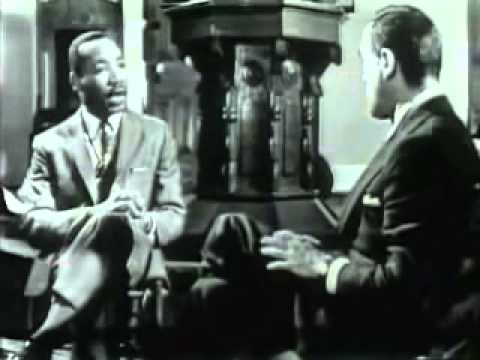
The question arrived like a legal trap. Seated across from an interviewer pressing him on Gandhi, contradictions, Hungary, and Little Rock all at once, Dr. Martin Luther King Jr. did not flinch or deflect. The stakes of the conversation were not abstract: they were about whether oppressed people, anywhere on earth, had a fighting chance without picking up a weapon. The answer he gave that day remains one of the sharpest philosophical arguments for organized nonviolent resistance ever put on record.
Three roads out of oppression
Dr. King laid out the framework plainly. Oppressed people, he said, have essentially three options. The first is open physical violence. He did not dismiss those who had chosen it. He acknowledged fighters in places like Hungary, who rose against a totalitarian regime the year before this conversation, saying clearly that he admired freedom fighters wherever they are. But his conviction held: ‘I still believe that nonviolence is the strongest approach.’ Violence, in his view, creates more social problems than it solves. Its danger is its futility.
The second option is resignation, what he called acquiescence. He rejected that path just as firmly. Non-cooperation with evil, he argued, is as much a moral obligation as cooperation with good. Accepting injustice quietly is not neutrality; it is a different kind of defeat.
The third road is organized nonviolent resistance, and that is where Dr. King planted his flag without qualification. He called it ‘the most powerful weapon that oppressed people can use in breaking loose from the bondage of oppression.’ The word organized carried real weight in his framing: this was not passivity dressed up in principle. It was, he insisted, dynamically active. Physically passive, yes, but strongly active spiritually.
Where police force and nonviolence meet
The interviewer pushed on what looked like a contradiction. Dr. King had publicly backed President Eisenhower’s decision to send federal troops to Little Rock, Arkansas, to protect Black high school students attempting to attend a desegregated school. How, the local newspaper editor wanted to know, did that square with a philosophy of nonviolence?
Dr. King’s answer was careful. He called the situation regrettable but placed responsibility squarely on the public official whose ‘irresponsible actions’ left the president with no other alternative. He was not an anarchist, he explained, and he believed in the intelligent use of police force. What was happening in Little Rock was not an army fighting a race of people. It was law enforcement upholding the law of the land.
He extended the same scrutiny to both political parties. Neither Democrats nor Republicans, he said, had clean hands on civil rights. Both had failed to take the strong moral stand they were capable of taking, treating the issue as a political football rather than the moral emergency it was.
The man who first asked the question
The Gandhi framing that opened the exchange is worth pausing on. The interviewer cited Gandhi’s suggestion that if the only alternative to fear is violence, then fight. Dr. King did not accept that framing as Gandhi’s final word. He read it as a refutation of a fallacy: the assumption that people who practice nonviolence are simply the weak ones, the ones without weapons, the ones who are afraid. That, Dr. King said, is precisely what Gandhi was pushing back against. Nonviolence, properly understood and properly practiced, is a method of the strong, not the weak.
The question the interviewer set as a trap became the clearest possible entry point into what Dr. King actually believed: that the strength to resist without destroying is harder to build, and harder to sustain, than the strength to simply fight back.