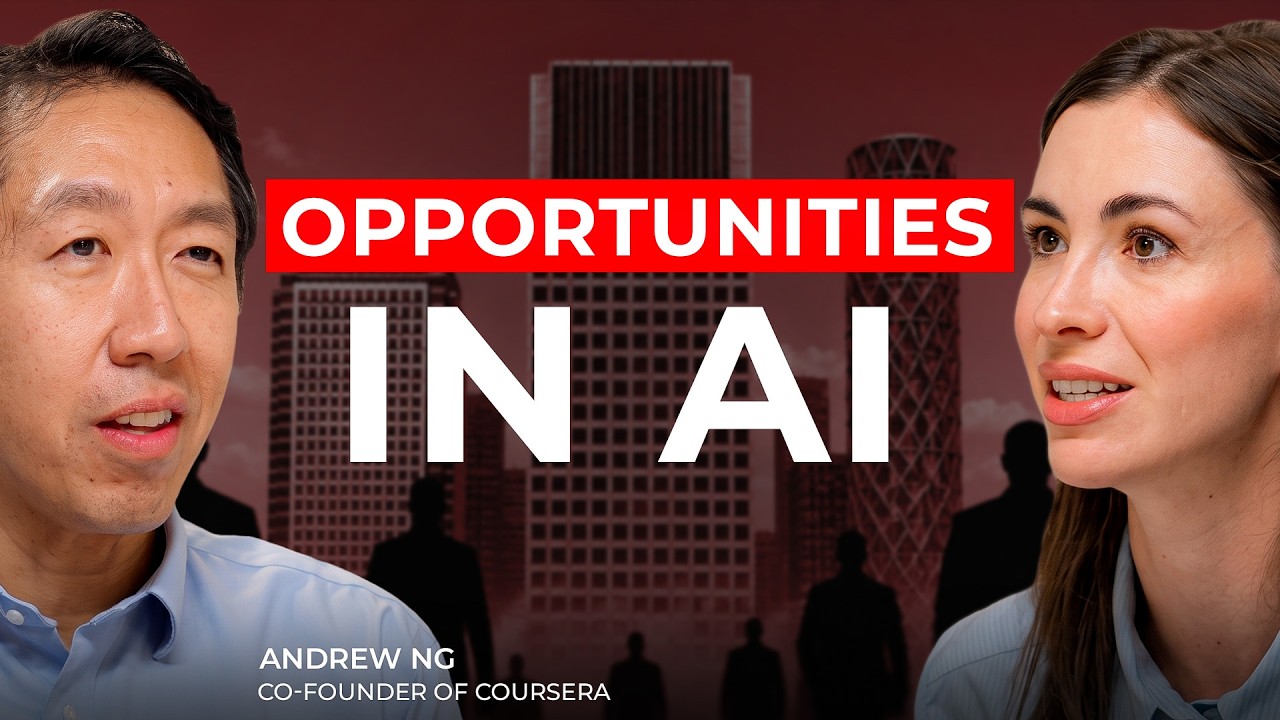
Andrew Ng, the co-founder of Google Brain and Coursera whose machine learning courses have reached millions of learners, did not open with a statistic or a warning. He opened with a diagnosis: a deliberate, years-long campaign of fear-based messaging about artificial intelligence, driven not by genuine safety concerns but by business strategy, has warped how ordinary people think about their own futures. And he is worried the damage is real.
Where the fear actually came from
Ng’s argument is specific and pointed. A handful of leading AI companies, he explained, spent billions of dollars training large language models. When other teams, including open-source researchers, began offering comparable models for free, those same companies had a financial motive to push for regulation that would lock in their advantage. The mechanism was fear. Analogies comparing AI to nuclear weapons, cherry-picked stories of AI failures, and inflated claims about data center water usage all fed a drumbeat that, as Ng put it, ‘has skewed societal perception to be really negative on AI.’ The result, he argued, is a slower American adoption rate and a genuine competitive cost.
On job loss, the most common anxiety, he drew on the work of economists he named directly: Erik Brynjolfsson at Stanford and Andrew McAfee at MIT, both of whom have broken down job descriptions into individual tasks. Their analysis, he said, suggests AI can handle roughly 30 to 40 percent of most jobs. The implication runs opposite to the headlines: that remaining 60 to 70 percent, the part requiring human judgment, contextual knowledge, and real-world relationships, becomes more economically valuable, not less. Software engineering is the field most visibly transformed right now, and yet job openings in that sector are up. The engineers who are struggling, he said plainly, are the ones still writing code as if it were 2022.
The context advantage no model can close
Ng’s sharpest observation was about why AI will not replace human judgment anytime soon, and it was not about regulation or ethics. It was about information architecture. Humans carry what he called a ‘massive context advantage’: the offhand remark a manager made, the facial expression a customer flashed, the institutional knowledge accumulated over years that no data pipeline currently exists to transfer to a model. When an AI brainstorming partner produces one good idea, two mediocre ones, and several genuinely baffling suggestions, the human instantly knows which is which. The AI does not know what it does not know.
He applied that logic to education with equal directness. Students who use AI tools score higher on homework assignments. Their long-term retention, however, is significantly worse, a finding now supported by multiple studies, because the cognitive work that builds durable knowledge is being offloaded to the model instead of done by the learner. ‘LLMs as they are most commonly used are terrible for learning,’ he said, adding that even he regularly re-asks AI the same technical questions he asked six months earlier because the answer never stuck.
His response to that problem is a new organization called Learn Vector, backed by a 100 million dollar investment, focused on building one-to-one personalized learning experiences that go well beyond the one-to-many format that online courses, including his own early work, have always relied on.
For new graduates navigating a curriculum that is still teaching skills suited to 2022, his advice was direct: keep attending class, but supplement aggressively through platforms that update faster than faculty senate approval cycles allow.
A question Andrew Ng keeps coming back to
An email from a prospective college student has stayed with him. The student asked whether any major was worth pursuing if AI would render it obsolete in four years. Ng’s answer was no, nothing will be entirely obsolete, but he acknowledged that the fear-mongering itself is the danger: it makes people hesitate to acquire skills that would put them in a much stronger position, at exactly the moment when leaning in would matter most. His daughter, who is seven, has been learning to type on a custom app he built himself because he did not like any of the free options available.
She can now type all lowercase letters reliably. The uppercase shift key is still a work in progress.