
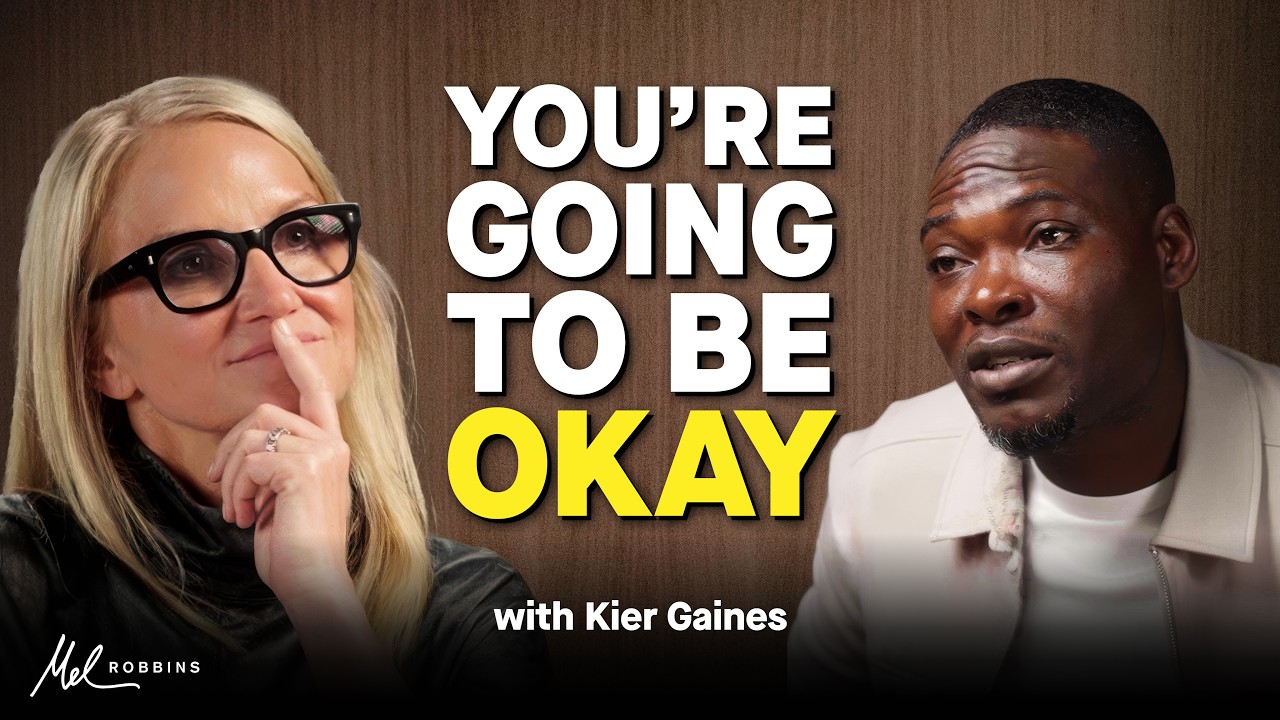
Kier Gaines has sat across from enough people in crisis to know that the fire hose is the problem. Not the person drinking from it. The therapist and author walked into the Mel Robbins studio carrying a single conviction: the world was not designed for your peace. It was designed to absorb your attention and churn productivity out of you. And most people have nothing to fight back with. That gap, between the billions of dollars engineered against individual wellness and the near-total absence of any counter strategy, is where Gaines has built his life’s work.
His framework starts with a reframe. He doesn’t talk about mental health. ‘I don’t like it because it feels like there’s something wrong with you,’ he told Robbins. What he talks about instead is emotional fitness: how prepared you are to handle the slings and arrows of daily life, how well you can navigate what keeps hitting you. The language matters. Fitness implies strength. It implies something you build deliberately, not a diagnosis you manage.
Why you’re still angry when the problem is actually hopelessness
One of the sharpest tools Gaines unpacks is what happens underneath anger. Most therapeutic frameworks treat anger as a secondary emotion, meaning something else caused it. Gaines argues it comes first. Anger arrives, and if you sit with it long enough to ask what else is attached, you find disappointment. Sit with the disappointment and you find hopelessness. ‘You’re trying to solve for anger,’ he said, ‘but what you really feel is also hopelessness. If you have a migraine, I don’t think allergy medicine is going to fix that.’ The prescription has to match the wound.
For men specifically, Gaines laid out a developmental timeline that explains why so many arrive at adulthood with no emotional vocabulary at all. From the moment a boy cries and someone tells him to toughen up, through the teenager whose heartbreak is dismissed with ‘there are other fish in the sea,’ straight through to the adult partner who gets labeled ‘sassy’ for expressing displeasure, every stage of development is engineered to separate him from his feelings. The result is a man who can only access anger because everything else has been trained out of him. Underneath that anger, Gaines says, is almost always fear. And then there are two types of men: those who are afraid and those who are terrified of being afraid. The terrified ones perform masculinity. The brave ones try to actually be it.
The three-step move for when overwhelm has already arrived
For anyone already inside the flood, Gaines offers a sequence that runs counter to every instinct overwhelm produces. First, pause. ‘When everything is urgent, nothing is urgent.’ Second, name it out loud. ‘I’m overwhelmed right now.’ Calling it by name pulls it out of the internal noise and lets it exist somewhere you can actually look at it. Third, release the pressure to fix it immediately. Overwhelm is rarely the result of a single misstep. It is usually a failure of systems, and systems cannot be redesigned in a moment. He reached for a football reference to land the point: a coach was once asked how you stop 264-pound New York Giants running back Brandon Jacobs. The coach laughed. ‘You don’t stop Brandon Jacobs. You slow him down enough for the defense to catch their breath.’ That is the entire strategy for overwhelm. Slow it. Breathe. Then figure out which specific part of the pile is actually the problem, because it is almost never all of it at once.
For depression and anxiety, the target shrinks further. Gaines, who has spoken openly about his own diagnosis, described the scale differently than most. On a standard wellness scale, ten is thriving and zero is baseline. With a mood disorder, the real work is getting from negative five to negative four. ‘A win is being able to not slide down to eight.’ He names the depression directly when it arrives. ‘Depression, you can’t hide from me, bro. I know it’s you. I know you won’t always be here. So I’m going to do what I need to do to survive the moment.’ He ties it off at the elbow, in his words, so the venom does not spread.
For the men in people’s lives who need a practical on-ramp, Gaines offered two options. The light lift: call someone you haven’t spoken to in more than two weeks. Not a text. A call. No agenda required. If they hit you with ‘I can’t complain,’ push gently: ‘What’s been good? What are you excited about?’ The heavier lift: go to breakfast together. Men talk better shoulder-to-shoulder, doing something easy, than face-to-face in a chair. Stuffing your face with cheese fries, as Gaines put it, removes the awkwardness of silence and lowers the barrier to everything that actually needs to be said.
The 1992 Buick Roadmaster that broke down every other week
Gaines bought his first car, a 1992 Buick Roadmaster, for $1,400 from an auto auction. It broke down constantly. Steam popping from the hood, engine refusing to turn over, and his immediate instinct every time was catastrophic: the engine is dead, that’s a $2,500 fix. But the actual discipline he learned was to start with the cheapest, easiest possibility first. Is a tube leaking? That’s a ten-dollar fix. Is the seal leaking? Check the water pump. Walk backward through the simple options before jumping to the worst case. He uses the same logic on blame. Blame grabs all your awareness and accomplishes nothing. Accountability says these things are my responsibility and I am empowered to do something about them.
The last thing Robbins asked was what a person should do the moment the conversation ended. Gaines answered without hesitation: ask yourself the uncomfortable question. Not the soft-lob version where you already know you can hit it out of the park. The real one. ‘Are you willing to pay the price that comes with the comfort of not asking yourself the hard question? Not just today, but for the rest of your life?’ His book, ‘It All Starts When You Do,’ ends up being the title and the answer at once. The journey, he said, doesn’t start when it’s convenient. It doesn’t even start when you’re ready. It starts when you do.