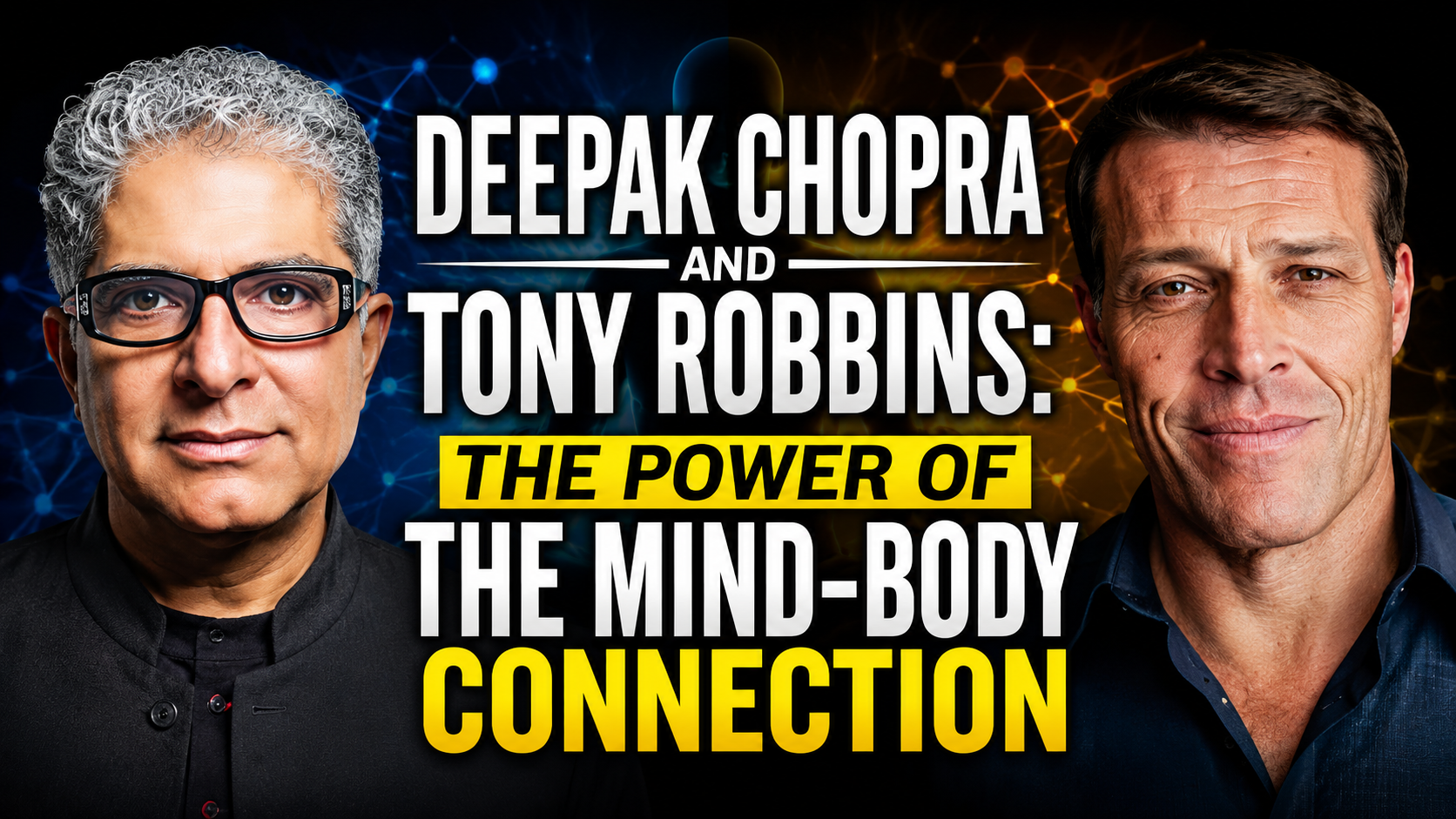
Deepak Chopra was sitting across a desk from Tony Robbins at an Ayurvedic health center in Lancaster, Massachusetts, describing the human body as the most sophisticated pharmacy on earth, one that manufactures every compound Hoffman-La Roche makes, at the right dose, aimed at the right organ, with zero side effects, and at no cost. For anyone who has ever swallowed a pill and wondered whether the belief in it mattered as much as the chemistry, this conversation offers a quietly unsettling answer. It began, as most good things do, with a man who was deeply unhappy with his own work.
Read and Listen to the original Tony Robbins Podcast here – The mind-body connection
The legal drug pusher who quit
Chopra trained in internal medicine and endocrinology and spent years teaching at Boston University School of Medicine, Tufts, and Harvard before moving into private practice. He was intellectually stimulated and clinically miserable. Each day ended the same way: a stack of prescriptions for tranquilizers, sleeping pills, and antibiotics, and patients who had no interest in changing the habits driving their conditions. When he suggested someone cut back on alcohol or lose weight, the reply was often some version of: ‘My mother-in-law tells me the same thing and she doesn’t charge fifty bucks.’ He put it plainly: ‘I would feel that I had been a legal drug pusher.’
The turn came in 1985 at a medical conference in Washington. He met Maharishi Mahesh Yogi, skeptically, out of politeness, with no intention of following through on anything. Walking through the airport afterward, he ran into an old friend from medical school who handed him a book on Ayurveda. He took it as a signal, read it, and flew to India to meet the practitioners. His partners at the time were embarrassed. He no longer cared.
The molecule is the meaning
What Chopra brought back from that investigation became the axis of his conversation with Robbins. The central claim is not mystical but biochemical: the interpretation the mind assigns to an experience determines which molecules the body manufactures in response to it. Take a joy ride at an amusement park and genuinely feel it as fun, and the body produces interleukins and interferons, molecules classified as powerful anti-cancer agents. A full clinical course of interleukin treatment for melanoma or kidney cancer, he noted, costs roughly $40,000 and carries significant side effects. Interpret the same ride as terror, and the body floods itself with cortisol and adrenaline, which suppress immune function. The difference between immune stimulation and immune destruction, Chopra said, is an interpretation.
The placebo evidence makes this concrete. In pain studies, participants who believed an inert substance was a painkiller produced endogenous opioids, compounds Chopra described as 40,000 times more powerful than street heroin, blocked by naloxone, meaning the body had genuinely synthesized a narcotic. A different participant given the same inert substance but told it would heal an ulcer produced an H2 receptor blocker, a chemically unrelated compound that interferes with hydrochloric acid. A third, told it would lower blood pressure, produced a beta blocker. Same sugar pill, three entirely distinct pharmacological outcomes, each matching the specific belief held.
The reverse, which Chopra called the ‘nocebo,’ is equally precise. He described a pattern in Aboriginal Australian communities where a person who believed a curse had been placed on them developed vomiting, rapid weight loss, and in some documented cases died within a week. The diagnostic statistics a physician recites in a clinical setting, he argued, function the same way: a doctor who tells a patient they have a 90 percent chance of dying in six months may be delivering a collective nocebo to someone who, without that information, might have been in the surviving ten percent.
Rats, camper oil, and the cellular memory underneath
Robbins and Chopra both pointed to a rat study that illustrated how deep this conditioning reaches. One group of rats received injections of an immune-stimulating chemical while simultaneously being exposed to the smell of camphor. After repeated pairings, camphor alone triggered immune stimulation. A second group received an immune-suppressing compound paired with the same smell. Camphor alone then suppressed their immune systems. When both groups were later exposed to carcinogens and infectious agents, survival tracked entirely with the camphor association, not with any current external condition. Chopra’s framing: ‘The crucial difference between survival and death in these mice is the interpretation of a memory that they have linked to a stimulus.’
The body, he said, is not a physical machine that produces thought as a byproduct. It is closer to the opposite: impulses of intelligence that have learned to construct physical matter. He described the human skeleton replacing itself every three months, the stomach lining every five days, the DNA’s raw carbon and hydrogen atoms cycling through like migratory birds every six weeks. The tumor visible on an X-ray contains not one atom that was there six months ago. What keeps it returning in the same form is not matter but memory, the underlying ‘recipe,’ as he put it, of belief, expectation, and conditioned response that keeps translating fresh material into the same physical output.
One question still open in Lancaster
Chopra described the gap between one thought and the next as a ‘little transformational vortex’ where the individual mind touches a larger field of possibility and genuine choice becomes available.
The Ayurvedic center in Lancaster, Massachusetts, where all of this was said out loud between two people who had each arrived at the same conclusion from opposite directions, sat at the point where a Harvard-trained endocrinologist and a man who had spent decades watching bodies change in real time found they were describing the same mechanism in different languages.
Read and Listen to the original Tony Robbins Podcast here – The mind-body connection